Every single time I followed all the steps in my book, and got no results, I knew my book was missing pages. This is the framework I use to solve that.
Every single time my SEO methodology met a case outside the narrow conditions where I'd built it — a different platform, a different industry, a site ten times larger and more complex than anything I'd touched up to that point — it broke. My book didn't cover that, but of course. That page wasn't written yet for me.
I spent a decade in search, discoverability, and agency operations. I've read close to 150 Google patents. I've ranked projects across virtually every industry. And the single most important thing I've learned is this:
You can move fast on search by moving slow.
Not a million steps at a million miles an hour. Five steps. Taken slowly. Taken deliberately. And once you do, the progress is fast.
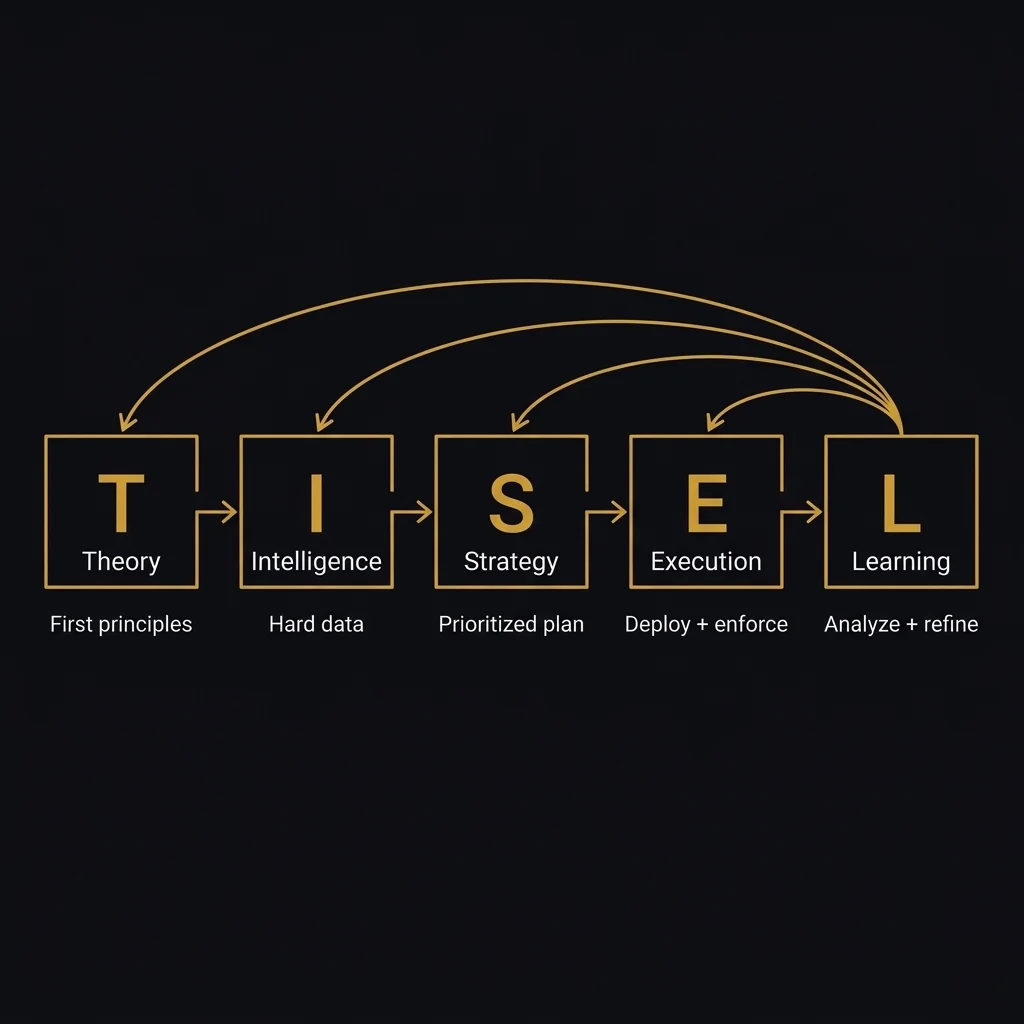
Those five steps are Theory, Intelligence, Strategy, Execution, and Learning — TISEL.
Nothing New Under the Sun
I want to say this upfront, for the observant reader: I am saying absolutely nothing new.
There is nothing new under the sun.
— Ecclesiastes 1:9
Every serious discipline has its own version of this model. Clausewitz described war using three layers: theory and understanding, strategy, and tactics — with a fourth piece he kept coming back to, feedback, because reality contradicts your plans and you must adapt. Not that I am a fan of war — quite the opposite — but we humans sure have gotten crafty at it and even from the mud does the lotus flower grow.
The scientific method runs the same way: theory about how the world works, observation and data, hypothesis, experiment, analysis.
Aristotle divided human action into episteme (knowledge of principles), phronesis (practical reasoning), prohaeresis (deliberate choice), praxis (action), and poiesis (outcomes and validation). His entire logic of mastery is fundamentally this.
| Discipline | Their Version |
|---|---|
| Clausewitz (Military) | Theory / Understanding → Strategy → Tactics + Feedback |
| Boyd (Fighter Pilots) | Observe → Orient → Decide → Act |
| Scientific Method | Theory → Data → Hypothesis → Experiment → Analysis |
| McChrystal (Team of Teams) | Shared Understanding → Real-time Intel → Decentralized Decisions → Tactics → Feedback |
| McKinsey (Consulting) | Diagnosis → Guiding Policy → Coherent Actions → Measurement → Principles |
| Engineering | Conceptual Model → Requirements → Architecture → Implementation → Testing |
| Machine Learning | Theory → Data Gathering → Training Architecture → Fine-tuning → Benchmarking |
| Aristotle (Praxis) | Episteme → Phronesis → Prohaeresis → Praxis → Poiesis |
Scientists have their own version. Aristotle had it for the greater philosophy of life. Military theory has its own. High-level consulting has its own. But the SEO industry doesn't have a clearly formalized version that follows the precise order in which things actually happen. And I believe it's important to solve that as more and more people are now equipped to do SEO completely on their own thanks to AI tools. AI is fast. As in, a little too fast. Too confident. It needs the slow behind it to ground it.
It needs a framework that works both for traditional search and for AI and LLMs. And after my ten years of experience in this field, this is precisely what I've learned.
OODA vs. TISEL — Same Family, Different Tempo
While there are clear parallels between TISEL and John Boyd's OODA loop — observe, orient, decide, act — there is a fundamental difference. OODA crunches theory and intelligence into one step because observation is primarily driven by sheer training, where you are capable of extremely quickly identifying inputs and reacting. The OODA loop is extremely tight because it's used by fighter pilots who must make decisions in split seconds, not quarterly plans or bi-weekly sprints.
TISEL is something different. To put it in military context: the war general who's been tracking a particular enemy for 30 years, the one who's the absolute foremost expert on the subject — that person operates in TISEL. The fighter pilot operates in OODA. Both are valid. They're for different types of disciplines.
TISEL is for disciplines that reward depth over speed. Where moving slowly through each stage produces compounding returns that outperform any amount of fast-twitch reaction.
Stage One
T — Theory
Every SEO worth their salt knows that one of the single best places to learn SEO is the Google Patents. However for the everyday person that isn't a lawyer nor an engineer, when attempting to open, read and digest any of the Google Patents that describe how one tiny micro-system of the search environment works, the natural reaction is near to vomiting. They're ugly documents, written in both engineering and legal language that for a lot of people — including myself — is more cognitively taxing than the reward out of understanding it promises to be.
This makes the default of the vast majority of SEOs to be: Let me read other SEOs.
Heck, I'll tell you this much, that's where I started. Not patents. Blogs, case studies, forums. Language I could understand with promises of outcomes that got me excited about the prospect of not being a waiter anymore.
But why though, after a certain point into the field, would an SEO stay at that level only? My understanding is that since a lot of SEOs evolve into broader marketers, and marketers have an inexplicable affinity for marketing speak, the cookie crumbles into the echo chamber. Interestingly marketing speak is one of the single reasons why SEO has been so polluted as an industry.
And now, as we enter into the era of AI SEO/GEO, we're seeing a whole new level of it.
The Recipe Trap
How does a young, hungry and excited new practitioner end up becoming another voice swimming against the science and the principles of search and towards their own benefit only?
Well, most people — myself included — start doing SEO purely from an experimental standpoint. They watched a guy on YouTube. Maybe they took that guy's course. They built a website targeting something very specific that looks low competition because that's where you start, of course.
And then, lo and behold, the site ranks. Truth is for the vast majority of niches and cases, SEO is not that difficult. The long tail greatly outdoes the head — this is true both in search volume but also in the strength of competitors — and you're primarily going head to head against other people who aren't SEOs. So yes, it's relatively easy to win.
Once that person creates one project, maybe two, maybe ten, maybe twenty — maybe they get really good at one particular type of site they can rank — they make money.
If you build a website and do A, B, C, and D, and the site ranks, you will believe that all four things rank. What can perfectly well happen is that A and B are things that help you rank massively, and C and D are mildly negative — but the site survives because you got A and B super right. You start teaching people that you must do A, B, C, and D, because every single time you do it in your own hyper-narrow verticals, it works.
But if the same principles that rank a plumber in a small city in Florida can't rank a money lender in Canada and can't rank an educational platform in Malaysia, it means those principles are not principles. They're a recipe of executional steps that work to rank plumbers in Florida.
This is where things can get a little messy. Put that person within the context of a lot of other marketers with big egos, and what can unfortunately happen — which did happen to me too, I'm not impervious to the temptations of sin — is that this person now develops an unhealthy amount of ego. They believe their method is the method. Their knowledge is superior. The LinkedIn posts get louder, personal beefs appear, and it just gets sad and divisive from there.
For the record, if all you do is rank plumbers in Florida, and they rank, and they're happy, and you run an agency that makes money, that's glorious and I'm real happy for you — it shall not be me who hates small, niched agencies. I did that for three years of my life, and it changed my life. My disagreement is with the imperative that everything has to be packaged into a marketable asset you can monetize aggressively. Not everything, and not first. First, you get the principles right.
Where Real Theory Lives
So how do you get your principles right? A few sources.
The Content Quality Rater Guidelines. Extremely important, easy to understand (it's real thorough) and a fantastic starting point. This document is a lot more revealing of the mentality of the search engine Google has been aiming to build — and the mathematical principles behind it — than it is about what the quality raters are instructed to deem good or bad (which is also super helpful). If you go deeper into what they've been told to rate, and you look past the SOP to the reasoning behind it, and then you read the single best source...
The Google Patents. This is the single best source of SEO theory. They're not a fun document to set as your weekend reading. There are definitely better things, more edifying things to be reading on a Sunday. But if you're an SEO practitioner, on a Tuesday afternoon, you should be reading about Google patents related to search. The late Bill Slawski was one of the few who really dug into this, and I happen to publish a little bit on the subject as well.
Google Search Central. Yes, I know. A little pinch of salt. SEOs love hating on Google because Google has, for a long time, said things that were right in the general idea but executionally wouldn't always deliver results. Certain things that did deliver results — things that were antithetical to the direction Google wanted to take search — were exploited by very smart SEOs who figured out the math so Google spent a lot of effort telling people not to do those, which made things fuzzy. But that doesn't mean you can completely discard what Google says. On Search Central, the vast majority of general directives are there for a reason.
You must also understand that just because a system is described in a patent doesn't mean it's running. And it doesn't mean that it runs precisely the way the patent says it does. But it does mean something we cannot dismiss too quickly: that extremely handsomely paid engineers, in groups of many, sat down for innumerable hours to develop these systems. And very expensive legal teams filed the patents. That in some cases, a whole 21 years later, when you look into the Google API data leak, you find attributes that map directly to mechanisms described in those patents, for which renewal fees are still being paid today. Why would that be the case unless those attributes were still in use in some form?
This is the part where theory requires intelligent interpretation. Not blind faith in the patent text — but an understanding of systems theory:
All complex systems that work evolved from simpler systems that worked.
— Gall's Law
The search ranking algorithm is extremely complex, although it started very simple. The origin is the document that gave birth to PageRank. That's where it all starts. And guess what? That hasn't changed so much. They've developed multiple versions of PageRank for different things of different nature. NavBoost appears to function as a type of PageRank. Loads of weighted models that aggregate different data signals, give a cohesive score, and then that score meets another score — and then you have rankings.
The hierarchy of theory: Google Patents → API Leak → Quality Rater Guidelines → Systems Theory → Google Search Central. In order of closeness to truth, and inverted order of usefulness.
Stage Two
I — Intelligence
Provided that you know what you're looking for — that you've been oriented properly by the client or the case or the company in terms of vision, mission, and goals — then it's your time to get your hands on actual, real, hard data.
Who is already ranking for what you want to rank for? How strong are they? How much content do they have? How many links, and how good? How well-built is the website? What user experience are they offering? How strong is the brand? There are only five layers. Thankfully
— Technical, Content, Links, UX, Brand —
You don't have to gather intelligence on that many things.
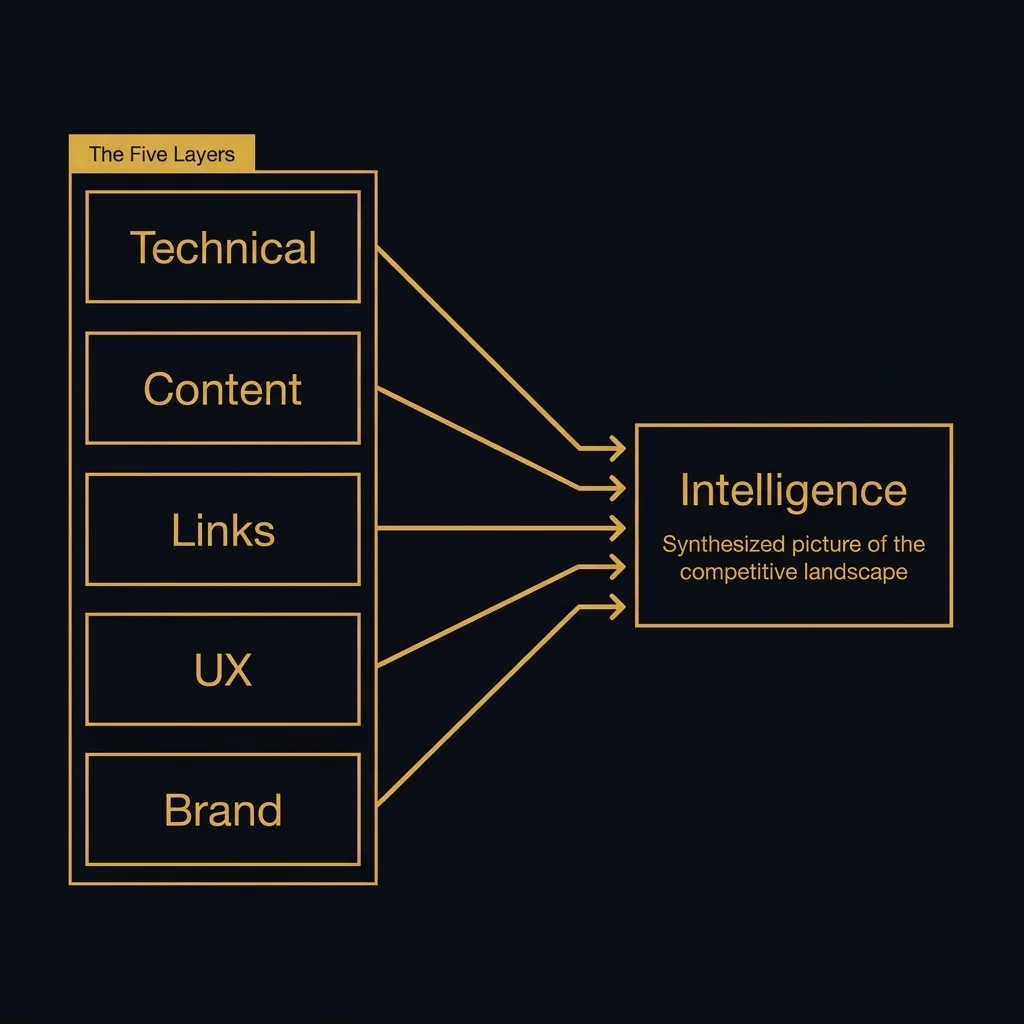
The question is: how do you accurately gather the right intelligence across all five dimensions?
The Compartmentalization Problem
This is where niche specialization happens in SEO, and it's fine to a point. There are technical SEOs who can navigate a money lender in Canada with a thousand pages, an e-commerce store built on Ruby on Rails serving India with four million pages, a small dropshipping store with ten pages, and a custom platform with 50 million monthly users — as well as a small WordPress site for a plumber in Florida. Their capacity for understanding both the theory and the intelligence-gathering process of their discipline is unparalleled. That's a very valid specialization, and the better you get at it, the more handsomely you get paid per project.
But what happens when that technical SEO has to work in a team with content people, link acquisition, UX designers, and advertising teams, all under the Brand Guidelines given by corporate? Unless they orient themselves to at least a level of general proficiency in the other dimensions and integrate their thinking vertically, two things normally happen. They can't collaborate, and they're most likely doing their own part incompletely.
There's a concept Naval Ravikant discussed on his podcast episode "A Motorcycle for the Mind": the advantage of knowing the step before and after yours. Understanding hardware makes you a better software developer. Understanding user experience makes you a better engineer, because you write software that flows and expresses itself in a way that's friendliest for users. You become a more cohesive thinker.
In SEO, hyper-compartmentalization in intelligence gathering is dangerous because it makes you ignore entire layers. Take a technical SEO whose client/employer gets hit by an update. Their biases immediately render them less effective than they could be. They gather intelligence in their comfort zone — Screaming Frog, Search Console, server logs, sitemaps — crunch it all, find some small improvements, deploy them. The site doesn't recover. Because the real problem was that the three competitors at the top have 50 times the amount of contextually relevant backlinks. But because this person isn't proficient in analyzing the complexity of a backlink profile — which you can slice in at least 12 different ways — they don't see it. They think all they need to do is fix a schema tag. Or worse: they fire the link building agency because they saw a link they didn't understand and assumed it was bad and the source of all their ailments.
Vice versa — the link builder who blames technical SEO or Content for something that's actually a links problem, or a UX–NavBoost issue, or a massive Brand gap. Both miss the actual issue because neither has sufficient cross-dimensional literacy.
How Theory Downstreams Into Intelligence
SEOs' favorite unfavorite issue of drowning in spreadsheets also comes from theory. When your theory is incomplete or incoherent, you feel compelled to gather as much data as possible from all sources. But when it comes to prioritizing that data — knowing which three signals validate each other, which two are exclusive, which one negates everything else — that's where the money is. What do you do then if your theory isn't very good? And if you haven't executed enough times to have the reps?
Well, I'm afraid there's no way to circumvent the work that I know of — nor that I'm interested in. Get your theory right. Then execute. That's what gets you the learning through doing more reps.
For the matured, experienced practitioner, when something changes and you have to diagnose a problem, you don't download a quadrillion reports. You know the one or two reports to check. Then you use a waterfall — the same way a doctor would. When a patient presents an ailment, the doctor doesn't put them immediately into an MRI. Maybe a simpler observation first. Maybe a blood test. Start with the tests that have a much higher degree of confidence for yielding results you can use to orient you further — rather than downloading everything, shoving it into Claude Code and expecting it to tell you precisely what your problem is — it won't. And if you trust it blindly, you may end up worse than you were before. If you insist on having AI do the analysis for you, let me at least give you a grounding system you can use so it doesn't rely too hard on vibes.
The Triage Sequence
When something breaks, here's the blood test — in order:
- Google Search Console — Crawl Stats. Time to first byte and number of requests. If TTFB has gone through the roof, you have a server issue. If crawl budget has decreased significantly, go deeper into indexation. If neither yields anything, your technical SEO is most likely fine — or at least as fine as it was before, which could mean it was garbage before, and the algorithm is just punishing that deficiency harder.
- Content assessment. Run the pages that dropped the most through a content quality assessment. I have a three-dimensional content quality assessment system you can use for that at The Atelier.
- Microsoft Clarity + Analytics. What is the user experience? If the stats aren't good and Clarity confirms engagement is poor, you have a content and presentation problem. The content assessment tells you what kind.
- Ahrefs — backlinks. Look at incoming links over the last few months. See if anchor ratios have fallen into SpamLand (not an actual term). Most importantly, look at your lost backlinks. Go back in time, link echo is a thing. If you lose your top ten backlinks, you will inevitably drop. Most people don't look because they think backlinks come and go.
- Brand sentiment. How has it changed? Any major changes in review scores across platforms, chatter on Reddit, loss in branded searches...? This is harder to measure holistically — it lives outside the subject. It's a manifestation of the subject, not a data point you pull from a single tool, but those checks above are a good starting point.
Having the theory right tells you not only what to triage, but how those signals converge. Having a full understanding of the holisticness of SEO — Technical, Content, Links, UX, Brand — tells you what complementary intelligence you should be gathering outside the one discipline you work closest with.
A note on finite caps. Technical and Content have finite caps — there's a ceiling to how much they can move the needle. Links and Brand don't. UX has a bit of a cap. This changes how you prioritize intelligence and how you allocate effort.
Stage Three
S — Strategy
Strategy is the hardest to nail down. You have to account for as many variables as possible, but weight them by their impact. And this is when you need the other side of intelligence — the constraints. What kind of budget do we have? How much manpower? What will corporate never let us do? (e.g. changing the H1 in the homepage) Sometimes you won't be able to define a perfect strategy because it's unexecutable.
The premise of a strategy is to prioritize the things that are lowest effort and highest impact and that won't make the next things harder.
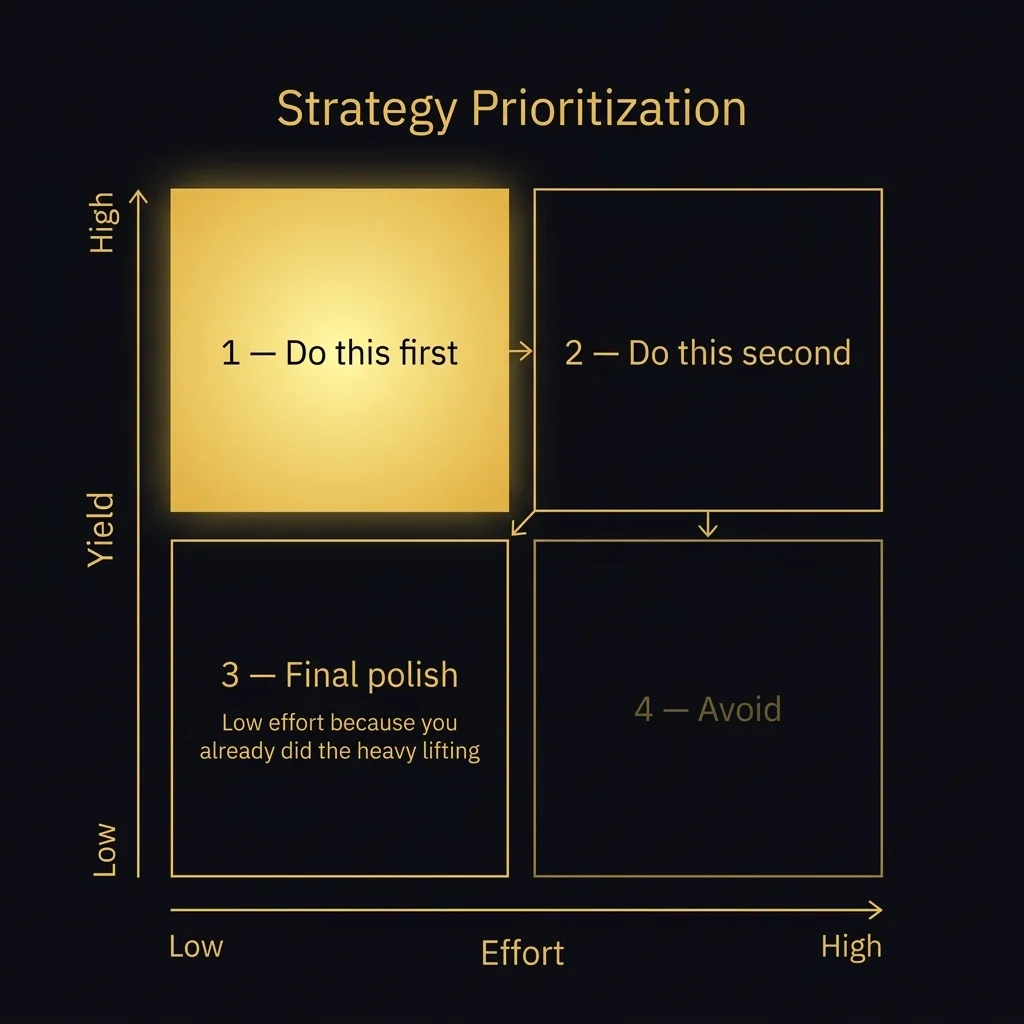
An example of a sequence of questions you should be equipped to answer from the link building dimension, at the intelligence step: to what pages should you be building links? When and how? How many, with what anchor text, from what sources, at what cost? Does this fit the budget and timeline?
Links, and every other item from the intelligence phase must pass through a series of gates:
- Should they be deployed concurrently or sequentially?
- Can they be grouped into a single action, or do they require multiple?
- Do they require a single contributor or multiple?
- Low budget or high budget?
- And most importantly: what is the allowed order of events?
The Allowed Order
In chess, you can't castle if your knight and bishop aren't out of the way first. You also can't castle if either king or rook have already moved.
Similarly with SEO, there are rules to the order of factors if you want things to work out.
You're not allowed to build backlinks to a page that doesn't exist. You're not allowed to build a lot of backlinks to a page that's brand new with no traffic. You're not allowed to publish 200,000 pages of AI programmatic content with no effort on a site of any authority — because it won't index. Even if the domain rating is high, it won't index.
If you want to publish content at scale, you need to know how to make it good enough. Not only what keywords to target, but what that content has to say. You have to go deeper into the intelligence and figure out not just what pieces of content to create, in what order, in what silo structure — but how to make those pieces good enough to rank.
The Question That Supersedes Everything
When will we get an ROI?
If the answer is "we don't know, maybe never" — don't do it. Don't do SEO. Do something else. This is not exclusive to this framework. The same logic applies to everything. You're going to run an ad that costs a million dollars? What's the total addressable market? 50,000 people? How much will each spend at 100% conversion? $50? Okay, let's not spend $2 million on the single best ad to launch the narrowest product in the world then. Let's start with some UGC creators, some Meta ads, and $10K first.
The Strategist as Micro-Visionary That Acts as Bridge
Strategic thinking is sometimes incompatible with the modes of thinking required for intelligence gathering. The deep-dive mindset of a good theorist or field agent is not the same as the mindset of a strategist. In order to strategize, you have to stay slightly above. You go deep enough to have a thorough understanding of what each layer is reporting, but you don't drown in it. You contextualize it into the macro — the business, the economic market, the competitive landscape.
A good SEO strategist is also a people strategist. If the execution involves other humans, they need to rally developers and media buyers and link builders for coordinated campaigns. They need to sync with the UX/UI people. Align with what the CMO is told can and cannot be said from Leadership & Legal.
They have to think many chess moves ahead. This is why chess is a wonderful teacher for anyone who wants to learn strategy, even if you're not good at it like myself. My ELO is trash — though that doesn't prevent me from thoroughly enjoying it because it has taught me so much.
When we enter people problems, the strategist has to address things like the five dysfunctions of a team and deploy a kind of tribal leadership — so that the content writers aren't fighting with the technical SEO, who isn't fighting with the link building provider. And by fighting, I don't mean arguing verbally. I mean working in a disintegrated manner. That is a fight. That makes you actually slow.
What does the output of strategy look like? It depends on the ambitiousness of the plan. Every organization has its own culture for how they organize work. But in the macro, what you get is an action plan.
We're going to do this first, then this, then that. This person does this thing. That person does that thing. And it has to be articulated in a way where they all understand the role they play, how, and when.
This is a fractal of what happens in an organization that uses something like EOS — a visionary and an integrator, departments that collaborate while going in the same direction.
With SEO, you have five "departments" (the TCLUB layers) that can all be operated by the same person, a team of two, or a mix of internal staff and external providers, just to name some combinations. The strategist is the micro-visionary within the department — someone who can both lead and be led — a bridge. That's a difficult role. A really good SEO strategist who can deliver results by gathering and aligning people and orchestrating execution flawlessly is rare. And worth good money.
Stage Four
E — Execution
Execution is when you meet reality face-first. And it typically punches you in the mouth, as Tyson said.
Execution is driven by three forces — three E's:
- Experience. You can only get experience by executing. That is simply the way it works.
- Everything else preceding this step. Execution quality is a direct function of everything upstream — the quality of your theory, the depth of your intelligence, the coherence of your strategy.
- Enforcement. The specs designed in the strategy phase must be enforced. Things happen when they have to happen. They get executed the way they were designed. Because a lot of times, you'll deal with frictions and narratives that have nothing to do with the strategy but with individual contributors' own inadequacies masquerading as reasons not to perform.
Here's what's beautiful about execution: you're going to learn not only a posteriori based on the results you get, but while you do it, based on the challenges you have to solve. And here's the other thing — every previous stage already included execution. Reading theory requires execution. Downloading and parsing data requires execution. Putting an action plan together requires execution.
Crawl, Walk, Run
The gap between strategy and execution is smaller than you think. The moment you bring your strategy to the first stakeholder, you're already executing. That CMO call where you present the plan and they say "we can't do this because leadership said that other thing" — that's execution. You're setting the strategy by deploying it into reality, and reality is already pushing back.
The first real deliverable of execution is the system itself. How are we going to keep track of everything? Who's assigned to what? What are the communication channels? When are the daily huddles? What tools are we using, and for what? If you don't already have these in place, building them is the first piece of execution. The Strategist owns the systems.
And then, crucially: crawl, walk, run. You don't deploy a massive, complex campaign on day one. You build a simple system that works — because systems, as we said, start from something simple that works, and then they grow. Crawl first. Get the operating rhythm going. Make sure every single person knows what they're working on this quarter, this month, this week. Then walk. Then run.
Every stage has its own micro-TISEL loop. There's a theory about theory. There's an intelligence-gathering process about theory. There's a strategic process about how you consume and formalize theory. There's an execution about how you bring that theory into practice, and then you learn about the theory itself. This happens at every level. When you start moving the macro strategy into the macro execution, it's not a jump — you start walking.
The Commitment Problem
This is one of the things that will derail a project faster than anything else: reactive, fear-based decisions.
Let's say the algorithm changes. YouTube now produces more citations in AI responses than Reddit. And let's say Reddit was a core piece of your strategy. Do you stop doing Reddit and move resources into YouTube? Now you have to redraft and replan. Maybe you have someone who's really good at Reddit, but you don't have somebody who's good at YouTube. What do you do? Every one of those changes subtracts from the cumulative force that can actually get work done.
These disruptions typically happen midway. You're building a massive campaign to aggregate reviews and distribute them across platforms to build EEAT — because say, you've identified that trustworthiness is the biggest gap for the brand. You've committed resources, you've started moving. And then something changes. A shiny object appears, or a competitor does something that makes the team nervous, or an industry influencer on LinkedIn says the thing you're doing is dead.
Your confidence on stages T-I-S determines how undeterred your E will be in light of these "changes". Just because things around you changed it doesn't mean you have, in the same way that just because nothing changes around you doesn't mean you can't change either.
When you get overly distracted by the environment and its fickle moods, and you lose momentum. You never finish anything. You will never have SEO results.
The same thing happens when you lose a team member mid-campaign — maternity leave, illness, they quit, they get fired, choose your reason. Things that will always happen, eventually. You have to adjust. And adjusting typically means doing fewer things, not more things. Don't put the fewer people you are left with to do more things. Keep the existing people doing what they're doing if it's critical. And if the gap comes in the single most critical piece of the entire plan, don't assign someone who isn't qualified to pick it up. That person doing the critical thing poorly while also diluting their attention across more responsibilities — that's worse than slowing down. Fast and scattered is always slow.
You have to commit. That's the core of enforcement. Finish what you started. If your theory was solid, you should never have to make massive alterations to your strategy because of an algorithm update. If you do, your strategy was weak — because you didn't account for algorithm flavor changes or you were solving for tomorrow's win at the expense of next year's.
Quality Enforcement
Somebody has to be the person who — without being abrasive about it, with kindness but unwavering commitment to quality — tells people: this is not good enough. Let's write this page again. Let's choose better websites for our links. Let's write a better story for our digital PR campaign.
Here's the thing about quality in SEO: for some things, you can get away with surprisingly low quality. It just works. But for other things, the difference between doing something at a six out of ten or a nine out of ten is the difference between 10% of the possible yield and 90% of the possible yield. It's not linear — it's exponential. That's why quality enforcement matters so much.
What does "good enough" look like? Whatever the competitors have, and then double. Not necessarily double the backlinks or double the content — double in essence. If the competitors have 10 backlinks that are a 4 out of 10 in quality, you can build 4 links and make each one a 10. That's effectively a lot more. It's the compound win across multiple dimensions. If the competitor's homepage has 5 gaps you've identified and yours has 2, hit all 7 — don't just fix your 2 and match them.
Put a lot of pride in the work that you do, but be extremely humble about it. Pride as in: do your actual best work. Humble as in: hear from the next person in line, or your boss, or the market, that you fell short — and say "OK, fantastic. How? How do I make this better?"
"This can be better" is always good news for you. That's how you grow. It's just real hard for egos to handle.
Operating Rhythm
The enforcer role isn't about a specific day of the week. It's whatever natural cycle works — a seven-day sprint, a monthly rock, a quarterly plan. If you say this month we're building this many pieces of content, fixing these particular pages, deleting these from the index, deploying these technical changes, and building 10 links — fine. That's the scope.
Number one: is everybody correctly assigned? Are the right people on the right channels, the right processes? Do things have due dates and tracking? Yes? Great.
Number two: do you have the enforcer in place? Someone who, every single day, checks every single thing being done or not done — and if something isn't done, will immediately ask: where are you at with this? This was due yesterday. It is now today. Where is it?
Whether that's a Monday ritual or an everyday thing doesn't matter. What matters is that the accountability is consistent. Not aggressive — consistent.
Stage Five
L — Learning
This is where you get the real gold. And this is the only way to get good.
You read your patents. You put your theory into action by gathering the right intelligence from the right sources so you can validate what those patents and API leaks were telling you. You build a dossier that tells you where you are, where you stand, and what you can do. You prioritize and deploy. Rankings go places, traffic follows. Amazing. And then — what happens?
The Feedback Loop Problem
Extracting clean learnings in SEO is extremely difficult because the feedback loop could be literally any period of time — from hours, to weeks, to the next two core updates. It's not the same in all languages. Doing SEO in English and doing SEO in non-English is simply not the same. It's quite hard to pinpoint with precision what worked and what didn't.
Google's own systems put a number on part of that delay. Under sworn DOJ testimony, RankBrain — one of Google's core machine-learning ranking systems — has to be retrained every two to three months, or it goes "blind" to new patterns. So a change you ship today may not fully register in that system until its next cycle — though other systems respond far faster (some off roughly the prior 24 hours). It's one measurable lag inside a feedback loop stacked with them, operating on different clocks. (I mapped the full picture in What Google Said Under Oath.)
Eventually, all SEOs end up doing some sort of single-variable testing, typically done a posteriori of the big execution. What happens if the only thing we did was remove the first published date from the post meta and only show the last updated? You remove that little piece from 1,000 pages, and your traffic literally doubles in a week. If that's the only thing you did, you can pretty much say: yes, this was problematic, and now we've learned. Fantastic. Heck, go publish on LinkedIn about it, you'll help someone else.
But what happens if, at the same time, you have a Google core update, your developer pushes three other major changes to production, and you had a viral post that earned 700 digital PR links? Was it the date change, or was it everything else? Very hard to know.
The learnings phase in SEO requires absolute skepticism and a deep reticence toward forming any opinions at all.
Not "this worked." Instead: "It looks like these variables were auspicious." Then you test further.
Multi-Variable First, Isolate Later
If you're starting from good theory, good intelligence, and a good strategy, you can deploy large-scale, multi-variable changes on a site. You don't have to start isolating one thing at a time. Once you've deployed a comprehensive packet of things you believe are right for the brand, and things do move in the direction you want — then you start slicing. Deploy individual variables into smaller segments of the site, or into other projects, so you can get further validation.
The Strategist Owns the Learnings
This is where compartmentalization is extremely dangerous. The post-hoc learnings should primarily be done by the strategist, because they have a stake in the holistic performance of the brand as a whole and the highest level of visibility. They should be aware of all channels being run. And they should be very slow to ascribe wins to a particular step, method, or action.
This is very hard when you have compartmentalized contributors who are hyper-specialized in their own domain. The link builders want to attribute wins to the links. Technical SEO wants to attribute wins to the crawl improvements. The content people want to attribute wins to the content they've published. A good CMO will reward all of them. That's something worth remembering.
Micro-OODA Loops
Here's where TISEL and OODA converge. Within every single iteration of following the process — every stage — there are small, tight learning loops.
The first patent I read, I just read it. I kind of got what it was about. The second patent I read, I took notes and did some voice memos. The third patent I read, I threw up. I said: I need a better process. I built it, and it's how I do my research pieces now.
That's execution and learning in action. I was learning that the process was too painful, that I couldn't condense the knowledge effectively. From there, every time I approached a task — whether reading a patent, analyzing anchor text, or producing a report — I asked: how can I do this in half the time? With a better visual representation? With deeper contextual analysis? In every single iteration, you try to improve the process. You try to incorporate what you learned just last time.
That micro-retro often happens unconsciously — a quick review of what you just did, what worked, what didn't, and the one thing you're going to change next time. This is something the world's best salespeople do. The world's best leaders do it. Athletes do it. Elite performers across every discipline do this:
After every engagement, they review themselves relentlessly.
An hour reviewing a ten-minute engagement. Take notes. List do's and don'ts for the next session. Repeat. That's how you get amazing at virtually anything.
Run, Stabilize, Then Revolutionize
To bring output to a high level that is consistent — which is extremely important for commercial applications, especially for agencies — every now and then you must ask yourself: if I had to build this entire process from scratch and make it 50 times better, how would I do it?
For me, the opportunity to 100x my SEO came a few months ago when AI coding tools crossed the Rubicon of ease of application. I went back to my library of 150 Google patents — collected since 2019, read at very different degrees of depth and care — and I built a process where I could read them, digest them, have the AI explain things in a way I understand, cross-reference with my own practitioner experience, go back and forth until, about an hour into it, I arrive at the place where I know Kung Fu.

Not only that — because of that interactive process, I have the AI interviewing me on my experiences relative to the subject and my own understanding of the document, generating readable diagrams from ugly patent figures, we could document everything and create a piece of content I can share with the world. Now you can read an article in 20 to 25 minutes and know exactly what a patent does and why it matters for SEO. At least, that's my aim. Feedback welcome always, for I am an audience of only one.
That's one example of applied learnings, with TISEL and OODA loops converging at the same time, aligned with my belief that giving is what we're here to do.
The Honest Limitation
When Is TISEL Too Much?
In SEO? You can't avoid it. Because the sequence is always there. When is sunrise too much? It happens every day. If you're doing SEO — as backwards as you might want to do it, as simply as you can, one-page micro-websites for the narrowest thing in the world — you're still operating within TISEL whether you know it or not.
The real question isn't whether TISEL is too much. It's whether the depth in any given stage is too much. Too much theory that impedes you from gathering intelligence. Too much intelligence that delays your strategy. Too much strategy that keeps you from executing. And that's constrained by resources — money, time, people, software. How deep can you go into each stage so that your execution is stronger?
Naturally, the deeper you go and the harder you work across all five layers — Technical, Content, Links, UX, Brand — the better results you're going to get.
The Bridge
In the world of physics, if you're building a bridge, you are constrained by the laws of the physical world. How deep do you go in the theory? Deep enough that the bridge stays in place for the next 100 years, ideally 2000 if you're an architect from the Roman Empire. You cannot make a bridge that collapses in two summers. That's a disgrace. Engineering has a pass-or-no-pass gate — will this bridge collapse? That's why engineers study Theory for four or five years. Let's not even enter into a field like medicine.
In SEO, the pass-or-no-pass gate is: however strong the bridge of the person in the number one position is. That's your bridge. Your bridge could be made of sticks and glue, for as long as it's a better bridge than theirs. If the previous position holder made a makeshift bridge out of toothpicks, your sticks and glue will eat that cake. This is commonly known as a "low competition niche".
But if someone comes and builds the Golden Gate, you're out. Because you don't have the skills to build a better bridge between Google and your website.
There are rules of visibility — the laws of physics of Search, so to speak. But you don't have to get them perfect. You have to get them better than. And to very accurately get them better than, you need to know what you're looking at. The biggest problem most people make in their strategy is they make a lot of assumptions because they're uninformed. They look at a website, say "this is trash, I can make a better one," pull a few keywords in Ahrefs, see the keyword difficulty is low, run some content through AI, and build a website. Sometimes it ranks, sometimes it doesn't. Is that a better bridge? You don't know. You don't know your own gaps in your own knowledge. So you have to continue going deeper.
The People Who Prove It
There are too many living examples in the industry that have done this.
Take Koray Tuğberk GÜBÜR from Holistic SEO. His story: he built a bunch of websites. Panda wiped them out. Back to square zero. He didn't want to stay in square zero nor get hit by Panda again, so he read all the theory of SEO from the ground up — every single patent available at the time. He remodeled his entire way of doing SEO. Then he coined Topical Authority and became a superstar. That was slow. It took years until that podcast with Matt Diggity where he talked about ranking a site to 200,000 visitors a month with zero backlinks. Then it skyrocketed — conferences, courses, millions in revenue. He went slow and then went really fast because he had enough foundation.
Kyle Roof did something similar but different. He applied TISEL to apply maximum pressure on the Learnings side. He did over 400 single-variable isolation tests — same kind of tests as Ted Kubaitis from Cora. Does having the keyword at the beginning of the title or at the end influence rankings? Launch 10 pages, all the same type of content on the same type of website. The only variable changing is where the keyword sits in the title. Rank for a made-up term, isolate the signal. That's as slow as it gets. One doesn't need to read a single Google patent for that. Establish a hypothesis and go test. But it's still TISEL. Then he identified patterns, talked about it, and built an agency, software, courses, conferences.
Both went slow. Both then went fast. Neither could have shortcut the foundation.
Where People Stall
The real limitation of TISEL isn't the framework — it's human nature.
People get stuck. Not because they derive some fetishistic intellectual pleasure in reading patents or combing through Screaming Frog reports — there is nothing pleasing about reading patents, I'll tell you that much. It's a self-protection mechanism. They retreat to the stages they're already comfortable with because they've already gone through that learning curve. Moving to the next stage means going back to being a student who knows nothing, which requires genuine humility — something that's very difficult in SEO because this industry develops, in many cases, a bit of an attitude. Ultimately you can make it rain if you're good, so there's that.
Take the technical SEO who's fantastic at intelligence gathering and diagnosis. Can they actually go into the website and deploy changes? Can they work on content while being cognizant of what good content looks like for user experience and conversions — without messing with the CRO by fixing some technical issue on the menu that now breaks conversion flow?
The same is true at every TISEL stage. Someone might perpetually gather intelligence because analysis is safe — nobody criticizes data collection. Someone else might endlessly strategize because the plan never has to face reality if you never deploy it.
Some people don't want to take the risk of breaking something, having to take accountability, and get their egos challenged, so they stall, delay, and don't get the job done. Which interestingly produces what they were avoiding: pain.
The antidote is what I'd call aggressive humility. You have to approach the work with sufficient urgency and sufficient reverence for the craft. You don't casually read through patents over years and only fire up Ahrefs once you feel ready. No. You do both on the same day. Every single day you have to be hitting each one of these five stages if you're dedicated to working on SEO. It's just for different parts of the big project at different points in time.
Moving slow can cost you — not because of the nature of TISEL, but because of how you approach work. Insufficient urgency. Insufficient reverence. There are two failure modes: people whose "enough" threshold is way lower than what enough actually is, and people whose "enough" threshold is way higher than it needs to be. How do you know where it actually is? Only by doing.
And for the solo practitioner: understand the full picture first, then specialize. Don't pick link building because you like it and then be completely unable to look at Search Console and do anything meaningful with its data. That makes you a worse link builder. If you're going to specialize in writing the single best semantically rich, entity-focused, topically perfect content on the planet — amazing. Don't do that at the expense of knowing that the Knowledge Panel is a thing. Because if you compete toe-to-toe with someone just as good as you in content, you have no advantage. And SEO is purely a competition.
The Bigger Game
So, is that it? Is competition all this reduces itself to? How to win over others?
Not really.
Zero-sum games can be won by TISEL proficiency. But one can also win at non-zero-sum games through it.
And that's where something like SEO — filling the pages of one's own incomplete manual on "how to win at search" — serves as a vehicle to equip us to pursue things that are a little more meaningful than ranking websites and making money (which, fool ourselves we shan't — is great if we intend to live in this world).
How do we stay healthy long enough to do all the things we aspire to in this life? We ought to know what health is made of (theory), where ours is at (intelligence), how we can improve it (strategy), then do the thing (diet, sleep, exercise execution), and refine the process through learning. Health sciences have some of the thicker books written, and new pages get added every day while others get completely struck through.
But even in disciplines one would call living traditions — those where you could say there was no need to add any more pages, because everything there was to learn was given by the same source that provided the theory, the intelligence, the strategy, the execution, and its rewards — one can use TISEL to approach them and get closer to those rewards.
And that's something a lot better than competition.