For the first time at this scale, Google's own people were compelled to describe under oath how large parts of search actually work — with penalties for lying.
So they did.
Beginning in September 2023, the United States Department of Justice tried Google for unlawfully maintaining monopolies in general search services and search text advertising — a case that would run through closing arguments in May 2024, a monopolist ruling that August, a second trial on remedies in 2025, and a Final Judgment in December 2025. Across the filings I processed, 95 witnesses are cited and 842 exhibits referenced — over a thousand pages documenting the internal mechanics of the world's dominant search engine, not through Search Central or hired spokespersons, but through sworn federal testimony. The full case documentation — hundreds of filings, thousands of pages — is publicly available.
I've spent the last few months building an extraction pipeline to systematically process the eight highest-priority documents from this case — 1,004 pages of primary source material. What follows is the practitioner's map of what the trial revealed: the systems, the data, the admissions, and the implications for anyone whose work depends on understanding how Google Search actually operates — and for anyone whose business has a dependency on search.
This is not commentary on the legal outcome. This is an intelligence extraction — a systematic mapping of 37 internal search systems, models, and metrics, cross-referenced against the 2024 API leak, a NavBoost patent chain spanning 17 years of continuations, and the practical reality of running hundreds of SEO campaigns with verified Search Console data.
Sober Summary
Every analysis has a threshold where certainty ends and inference begins. This investigation draws from three evidence tiers:
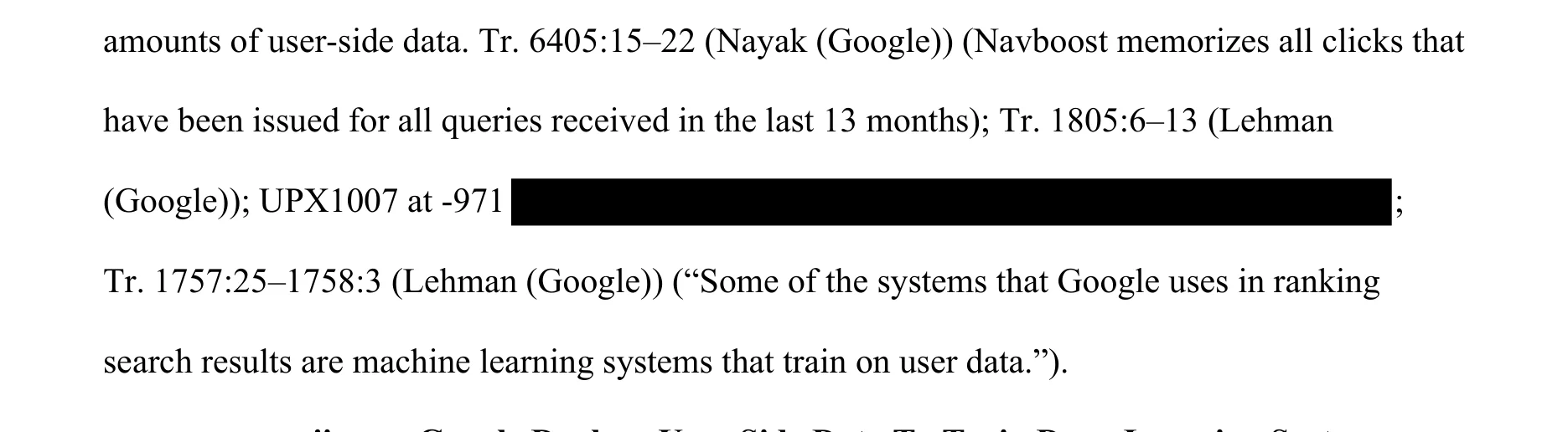
NavBoost stores 13 months of click data and is "one of the most, if not the most, impactful systems on Google's search quality." Glue records clicks, attention, hovers, and scrolls over the same 13-month window. BERT does not replace traditional memorization systems like NavBoost and QBST (Query-Based Salient Terms) — they are complementary. All major machine learning ranking systems (RankBrain, RankEmbed, DeepRank) train on user interaction logs. Google pays over $20 billion annually to be the default search engine on browsers, phones, and operating systems. Google adopted systematic policies to destroy business communications during active litigation.
The 13-month retention window is designed to eliminate seasonal bias. The ordered data sharing with "Qualified Competitors" (GLUE and RankEmbed model data) confirms these systems' centrality to ranking quality. Scale advantages compound non-linearly — Microsoft's $100 billion investment in Bing over 20 years has not closed the quality gap. The remedies' inclusion of generative AI products signals the court views AI search as an extension of the existing monopoly.
Exact production weights for any system. How the 37 identified systems interact in the current ranking pipeline (the trial evidence reflects 2020–2023 configurations). What was in the redacted sections of multiple filings. What was in the destroyed chat messages. Whether the ordered remedies will meaningfully change the competitive landscape or become another consent decree that expires without impact.
The U.S. v. Google antitrust trial produced more actionable intelligence about how Google Search works than every official Google blog post, developer conference, and public statement combined. Not because Google volunteered it — because a federal court compelled it. Under oath, with cross-examination, with exhibit numbers, with penalties for perjury. This is the difference between marketing and testimony.
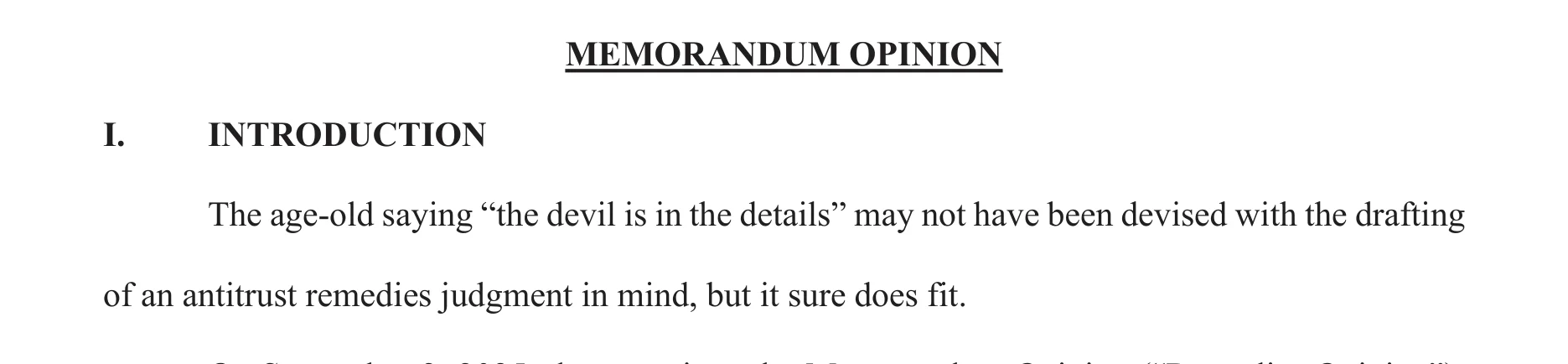
The Evidence Stack
Before we get to what was revealed, two things need framing: when it happened, and what we're working from.
The Case at a Glance: 2020–2026
This was never a single event. It's a six-year arc — and it isn't over. Most of what follows comes from the liability phase of 2023 and 2024. But the case has since moved out of the courtroom and into remedies and active enforcement, and that second half changes what you should be watching for.
| Date | Milestone |
|---|---|
| 20 Oct 2020 | The DOJ and eleven states file suit (the Complaint). An amended complaint follows in January 2021. |
| Sep–Nov 2023 | The liability trial. Roughly ten weeks of testimony before Judge Amit P. Mehta in the District of Columbia. |
| 2–3 May 2024 | Closing arguments. The six closing decks are among the primary documents analysed here. |
| Aug 2024 | Judge Mehta rules Google an unlawful monopolist in general search and search text advertising. |
| Apr–May 2025 | The remedies trial. A separate phase, with its own expert testimony, to decide what Google must do. |
| 5 Dec 2025 | The Final Judgment and Memorandum Opinion. The court orders its structural and behavioural remedies. |
| 3 Feb 2026 | The judgment takes effect. Google's behavioural obligations — the limits on exclusive default deals — begin. |
| Jan–May 2026 | The court-appointed Technical Committee is seated (five members) and begins standing up enforcement. |
| Late 2026 – early 2027 (est.) | Certified competitors are expected to begin receiving Google's shared ranking data. See Where the Case Stands Now. |
Priority 0 — The Core Documents
These four documents contain the highest density of search system intelligence:
| Document | Date | Pages | What It Contains |
|---|---|---|---|
| Plaintiffs' Proposed Findings of Fact | 2024-02-09 | 509 | The motherlode. 89 witnesses cited, 2,368 exhibit references, 33 search systems identified. The plaintiffs' proposed account of what the trial established — every claim they asked the court to find, each tied to testimony and exhibits. |
| Plaintiffs' Post-Trial Brief | 2024-02-09 | 108 | The DOJ's legal argument. Synthesises the trial evidence into the monopoly maintenance theory. Contains the "more than $20 billion annually" default payment figure. |
| Final Judgment | 2025-12-05 | 35 | The court's ordered remedies. Bans exclusive defaults, orders GLUE and RankEmbed data sharing, includes GenAI in scope. |
| Memorandum Opinion | 2025-12-05 | 95 | Judge Mehta's reasoning for the remedies. Explains why each provision was ordered and how the court weighed competing proposals. |
Priority 1 — The Supporting Evidence
| Document | Date | Pages | What It Contains |
|---|---|---|---|
| Closing Deck: Anticompetitive Effects | 2024-05-02 | 134 | The DOJ's closing slides on how Google's monopoly harms competition. Contains the "every ranking system learns from logs" slide. |
| Closing Deck: Market Definition | 2024-05-02 | 66 | Market share data, query volume breakdowns, and the data retention survey showing users wanted Google to store data for 18 months or less. |
| Closing Deck: Summation | 2024-05-03 | 22 | Final summary. Contains the compressed version of the "all ML systems train on logs" evidence. |
| Sanctions Motion | 2023-02-23 | 35 | Google's systematic evidence destruction. "Off the Record" defaults, "Communicate with Care" training, legal hold failures. |
Everything in this guide traces back to these eight documents. Where I cite testimony, I include the witness name and transcript line. Where I reference exhibits, I include the exhibit number. Where I infer beyond what was stated, I mark it clearly.
The Systems Inventory
Thirty-seven internal systems were described in sufficient detail across the trial documents to catalogue. They're organised below by function, with their evidence sources.
Ranking Systems — The Core Pipeline
These systems directly determine which results appear and in what order.
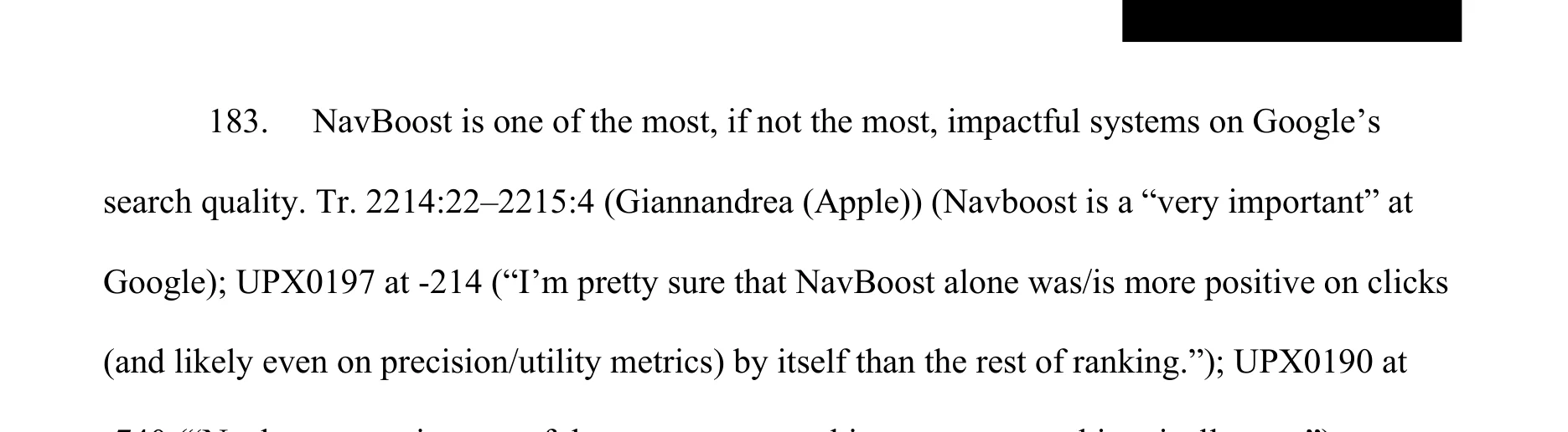
16 mentions across 4 documents. "One of the most, if not the most, impactful systems on Google's search quality" — Tr. 2214:22–2215:4 (Giannandrea, Apple/former Google Head of Search).
NavBoost memorises all clicks for all queries over the prior 13 months (Tr. testimony, PFOF ¶¶ 183–184). It is a "traditional" system that counts and tabulates results — not a neural network. BERT "does not subsume big memorization systems, navboost, QBST, etc." — Tr. 6440:13–18 (Nayak, Google VP of Search).
Cross-reference: Full NavBoost practitioner guide | NavBoost patent analysis

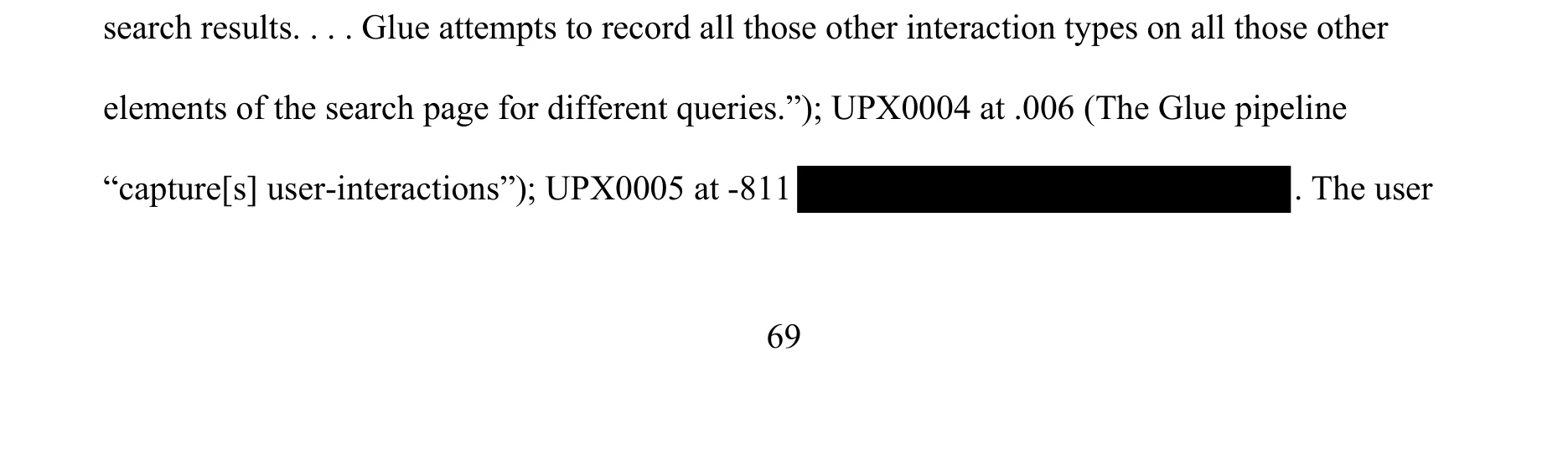
14 mentions across 4 documents. A critical input to Tetris/Tangram that triggers search features. Glue "capture[s] user-interactions" including "clicks, attention, hovers, scrolls etc." over 13 months — PFOF ¶¶ 194–195, UPX0262.
The Final Judgment specifically orders Google to share "User-side Data used to build, create, or operate the GLUE statistical model(s)" with Qualified Competitors — confirming its centrality to ranking quality.
7 mentions, Proposed Findings of Fact. QBST (Query-Based Salient Terms) is a memorization system paired with NavBoost. "Navboost and QBST are memorization systems that have [significant impact on ranking]" — Tr. 1837:22–1839:4 (Lehman, Google). QBST has "a substantial effect on Google's search quality" — UPX0887.

10 mentions across 3 documents. One of two primary deep-learning ranking systems (alongside DeepRank) — Tr. 6399:23–25 (Nayak). Trained on user-side data — Tr. 6433:9–13. Must be retrained with fresh data every 2–3 months "because otherwise it would be blind to new [patterns]" — Tr. 6432:8–25. Computationally expensive — only runs on the final 20–30 candidates, not the full result set. RankBrain is a machine learning system, not a hand-crafted algorithm.
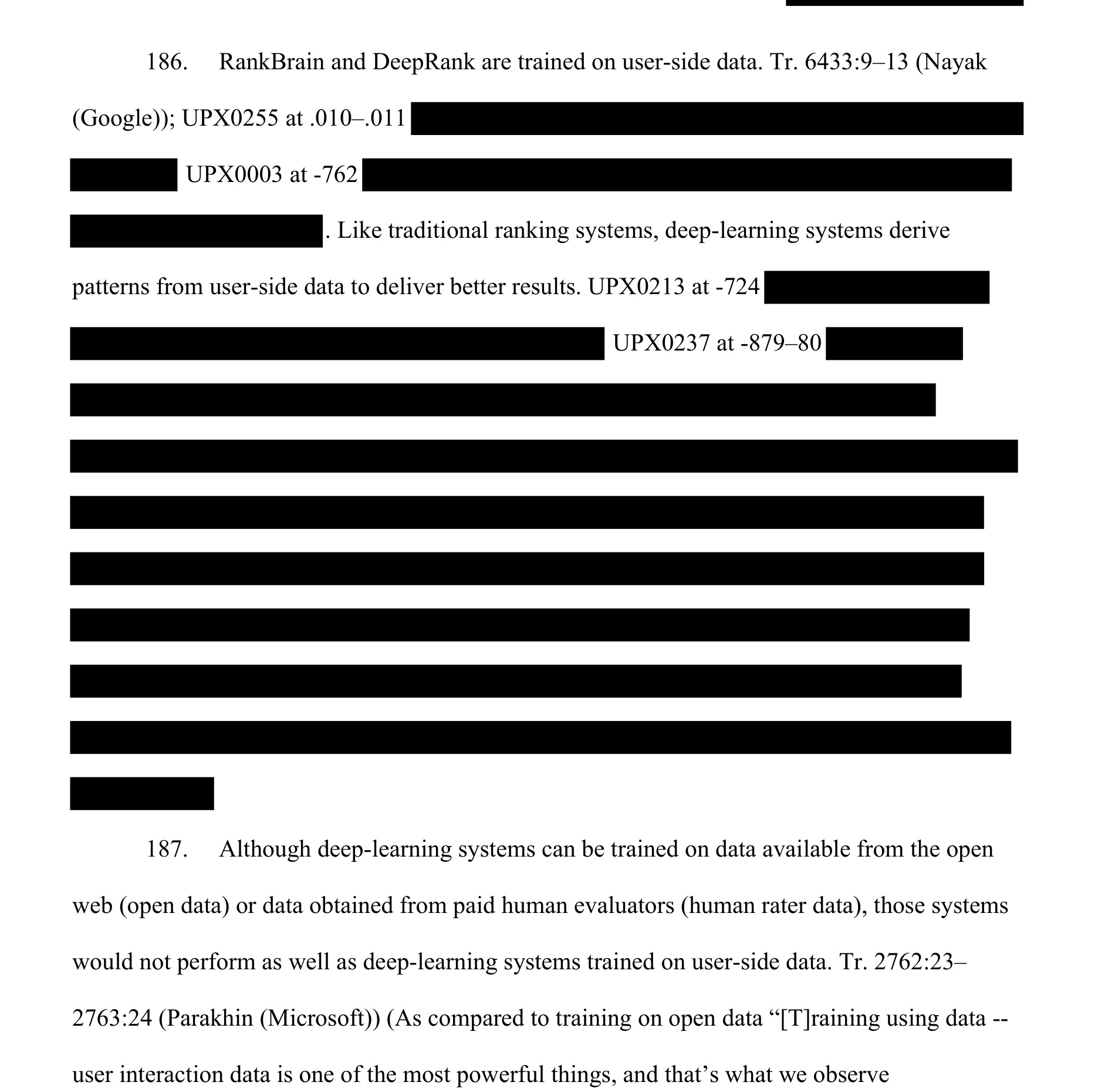

5 mentions across 3 documents. The second primary deep-learning system alongside RankBrain. Also trained on user-side data. Both are complementary to traditional systems, not replacements — Tr. 6430:18–22 (Nayak).
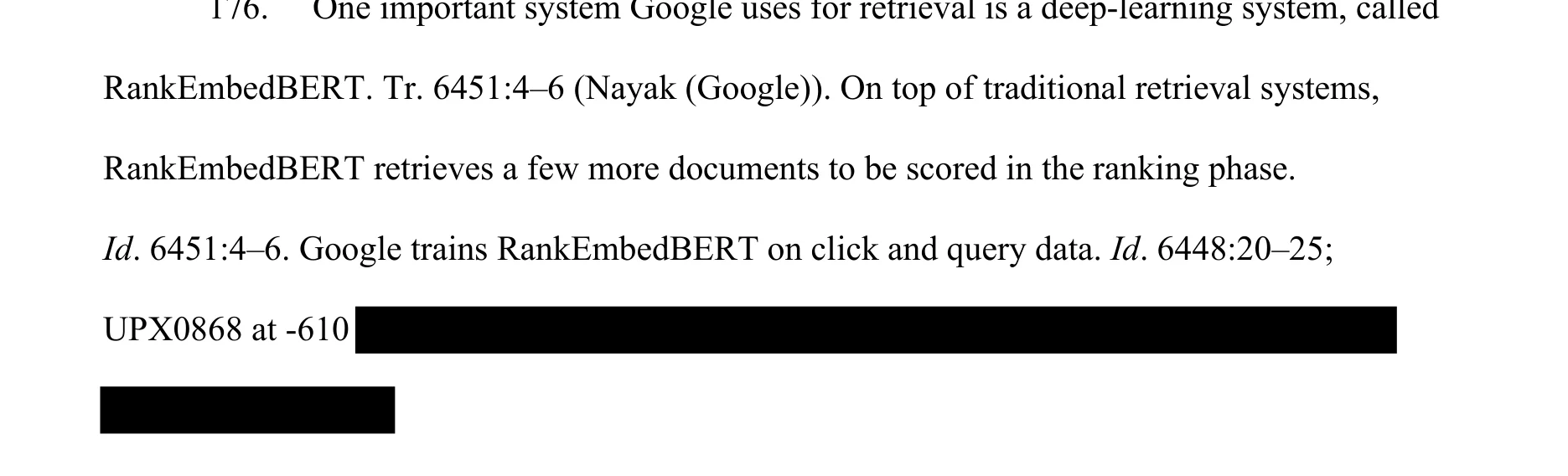
Referenced in Final Judgment and Closing Decks. "RankEmbed BERT is trained on click and query data" — Tr. 2207:7–9 (Giannandrea). The Final Judgment orders sharing of "User-side Data used to train, build, or operate the RankEmbed model(s)" — placing it alongside GLUE as a system central enough to warrant court-ordered data sharing.
Quality and Evaluation Systems
4+ mentions across 2 documents. Each query evaluated by a human rater receives an IS score — Tr. 1779:21–1780:1 (Lehman). "IS4@5" means raters evaluated the top 5 results. The IS score gap between Google and competitors represents "a fairly meaningful difference in quality" — Tr. 6323:6–18 (Nayak). Value in Search is "typically expressed in terms of improvements in well-understood metrics such as rater-based Information Satisfaction, or IS, scores and live experiment metrics" — PFOF.
61 mentions across 4 documents. Not a single system but the organising principle for Google's entire ranking infrastructure. Key finding: defaults were "more important than search quality in protecting market shares" — PFOF ¶ 879. Google's "ordinary-course experiments degrading its search quality for testing purposes showed little user response to quality reductions" — Post-Trial Brief, confirming monopoly insulation from quality pressure.
Whole-Page and Feature Systems
7+ mentions across 2 documents. After web results are ranked individually, Google determines which types of results (web links, images, knowledge panels, local results) to display and how to arrange them — the "whole page ranking" layer. Tetris/Tangram is the system that orchestrates this, with Glue as a critical input signal — Tr. 6408:8–18 (Nayak). This is where search features get triggered or suppressed.
AI and Language Models
BERT (Bidirectional Encoder Representations from Transformers): 2 mentions. Google's language understanding model that processes query intent by reading words in both directions. Trained on click and query data — Tr. testimony. Does not replace NavBoost or QBST — the systems are complementary, not substitutive.
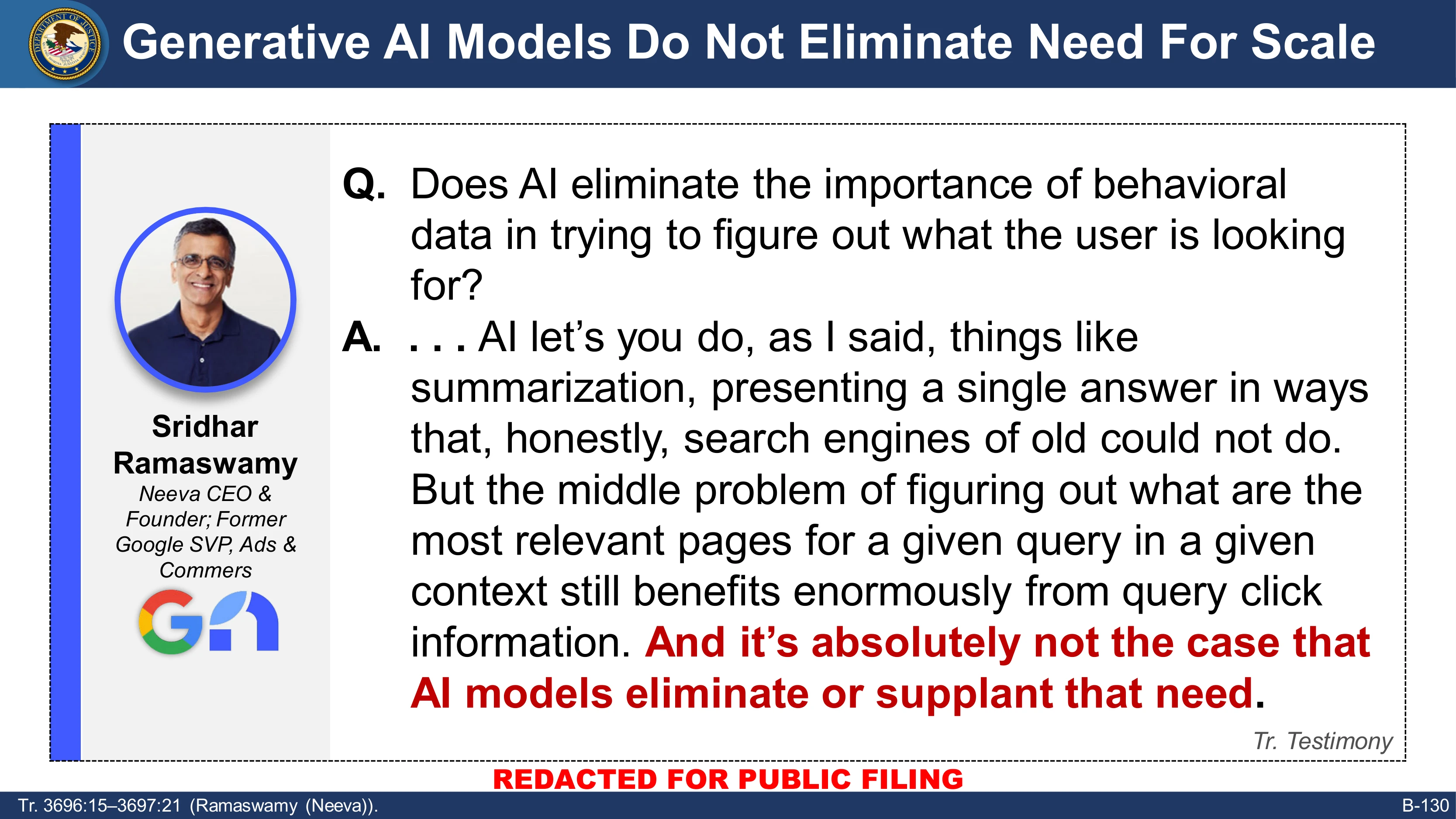
MUM (Multitask Unified Model): 2 mentions. Google's multimodal AI model — 1,000× more powerful than BERT, capable of understanding text, images, and multiple languages simultaneously. "Can be more expensive than core models" — Tr. 6452:9–24 (Nayak). "Generative AI models will not replace traditional search" — PFOF ¶ 1027.
Bard/Gemini: 11 + 10 mentions. Google's conversational AI (Bard was the original name; it was later rebranded to Gemini). Receives "only a small fraction" of the queries that Search handles. At the time of testimony, still "very much in early stage" and "experimental" — Tr. 8333–8334 (Reid, Google).
Advertising Systems
The trial produced extensive testimony on advertising mechanics. While not directly related to organic ranking, these systems reveal how Google's monetisation layer operates alongside search quality.
pCTR (Predicted Click-Through Rate, 21 mentions): Predicts what percentage of viewers will click. Components train on "quantities of data greatly exceeding that possessed by any of Google's rivals" — Tr. 8880:11–8881:9.
pLQ (Predicted Landing Page Quality, 12 mentions): Captures the value of the landing page, including "click cost" — the effect of clicking on the ad on future ad-clicking behaviour.
pCQ (Predicted Creative Quality, 11 mentions): Evaluates the ad creative itself.
Together, these three predictions compose the "quality" components of Google's Long-Term Value (LTV) formula for ad ranking. The LTV formula determines ad placement — not just the bid amount.
25 mentions. The pricing mechanism that replaced format pricing. rGSP "raised CPCs by inflating the runner up's Ad Rank and sometimes randomly replaced the winning ad with lower-ranked ads" — Post-Trial Brief. One of three "pricing knobs" Google used to adjust ad prices (alongside format pricing and squashing) — PFOF ¶ 653.
23 mentions. Google reduced the granularity of Search Query Reports — the keyword performance data available to advertisers. This reduced advertisers' visibility into their own spend. Combined with silent auction adjustments, Google operated its text ad auction as a "black box" — Post-Trial Brief.
The Data Asymmetry
The single most important finding from the entire trial — the one that connects monopoly economics to ranking quality to your daily SEO work — is this: every major ranking system at Google trains on user interaction logs.
Not some of them. All of them.
"RankBrain, DeepRank, and RankEmbed BERT are all trained on user-side data" — Tr. 6433:9–13, Tr. 2207:7–9 (Nayak, Giannandrea). NavBoost and QBST are memorization systems that directly tabulate user click data — Tr. 1837:22–1839:4 (Lehman). Glue captures user interactions including "clicks, attention, hovers, scrolls etc." over 13 months — PFOF ¶ 194. RankBrain must be retrained every 2–3 months with fresh data "because otherwise it would be blind to new [patterns]" — Tr. 6432:8–25.
This creates a structural advantage that money alone cannot buy. Microsoft has invested approximately $100 billion in Bing over two decades — PFOF ¶ 537. Bing's market share remains 5.5%. The gap is not engineering talent or computational resources. The gap is data.

The Scale of the Asymmetry
| Metric | Competitors | Source | |
|---|---|---|---|
| Daily search queries | 3+ billion | ~100 million (DuckDuckGo) | UPX0001, Tr. 1938:11–15 |
| General search market share (US) | 89–95% | 5.5% Bing, 2% DDG, 2% Yahoo | PFOF ¶¶ 521–524 |
| Mobile query share | 98.4% | 1% Bing, 0.7% both | PFOF ¶ 980 |
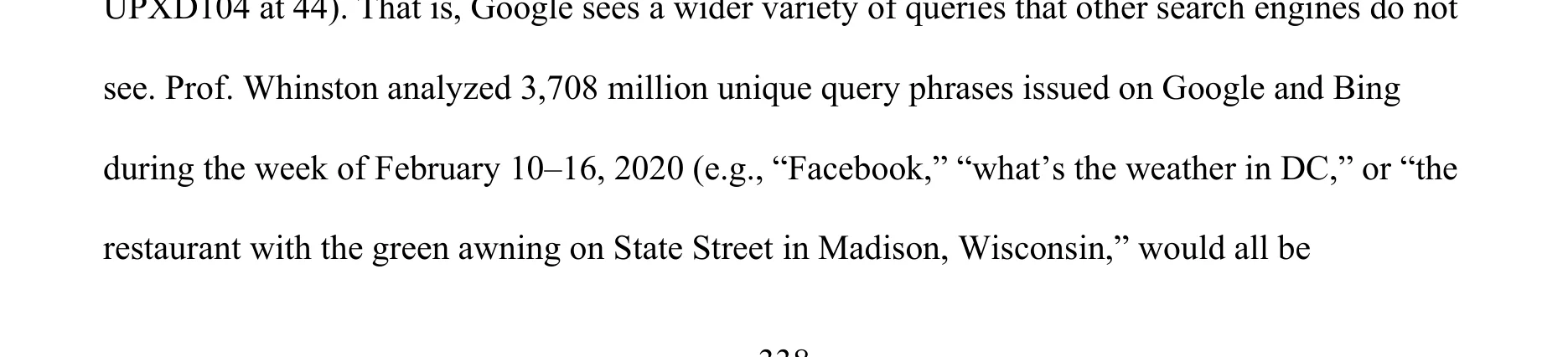
| Unique query phrases seen | 93% exclusive | 4.8% Bing-only, 2.2% shared | PFOF ¶ 980 |
| Annual default payments | $20+ billion | — | Post-Trial Brief p.8 |
| Cumulative Bing investment | — | ~$100 billion over 20 years | PFOF ¶ 537 |
The "unique query phrases" statistic is the one that matters most for SEO practitioners. Google sees 93% of all unique search phrases exclusively — queries that Bing, DuckDuckGo, and Yahoo never see at all. On mobile, that exclusivity rises to 98.4%. This means Google's ranking systems train on a query vocabulary that no competitor can access.
Why This Matters for Ranking Quality
When Pandu Nayak testified that RankBrain needs retraining every 2–3 months with fresh interaction data, he confirmed something practitioners have suspected: ranking quality is not a static engineering achievement. It's a continuously regenerating output of user behaviour data.
There's a practitioner corollary buried in that 2–3 month number. If a primary ML ranking system only refreshes its model of the world every two to three months, a change you ship today may not fully register in that system until its next cycle. That's one plausible contributor to delayed, uneven SEO feedback — not the whole story, since other components respond far faster (Instant Glue works off roughly the prior 24 hours). It's one measurable lag inside a feedback loop stacked with them — which is why the Learning phase of the TISEL method demands you hold your conclusions loosely.
More queries mean more click data. More click data means better NavBoost signals. Better signals mean better training data for RankBrain and DeepRank. Better models mean better results. Better results mean more users. More users mean more queries. This is not a competitive advantage. It's a self-reinforcing loop that compounds with scale.
The API Leak Connection
In May 2024 — the same month the DOJ delivered its closing arguments — Google's internal API documentation leaked. I've cross-referenced every DOJ-confirmed system against the leaked schema. The corroboration is extensive.
Dual-Source Confirmations
| API Attribute | Leak Schema | DOJ Testimony | What It Confirms |
|---|---|---|---|
NavboostQuery |
NavBoost module | NavBoost is "most impactful" — Tr. 2214 | Click-based ranking is production infrastructure |
goodClicks / badClicks |
CrapsData | 13-month click memory — Tr. (Nayak) | Long/short click distinction is production-active |
navDemotion |
CompressedQualitySignals | UX degradation effects — PFOF | Navigational UX penalty is quantified (10-bit) |
pandaDemotion |
CompressedQualitySignals | Site-level quality mechanisms — testimony | Site-wide quality penalty is production-active |
pqData |
PageQualityData | IS scoring framework — Tr. 1779 | Page quality is scored independently from ranking |
siteQuality |
NSR (SiteChunk) | Domain-level quality — PFOF | Host-level quality aggregation is production infra |
chromeInTotal |
CrapsData | Chrome usage data — PFOF | Chrome browsing data feeds ranking signals |
smallPersonalSite |
NSR (SiteChunk) | Market power analysis — PFOF | Google classifies sites by entity size |
For a deeper analysis of these API attributes and their quality scoring context, see the Quality Scoring Ensemble analysis.
Before the trial, we had the API leak — code without context. Before the leak, we had patents — claims without production confirmation. Now we have both. A leaked attribute name (goodClicks) independently confirmed by sworn testimony about how NavBoost processes long clicks creates a dual-source verification chain. Neither source alone is definitive. Together, they approach ground truth.
The Document Destruction
The DOJ filed a standalone sanctions motion documenting what it called systematic evidence destruction. Judge Mehta ultimately declined to impose sanctions — he could decide liability without them — but he was, in his words, "taken aback by the lengths to which Google goes to avoid creating a paper trail," and warned the company "may not be so lucky" next time. The practices themselves are on the record; the interpretation below is mine.
"Off the Record" chat defaults — Google employees' chat sessions defaulted to auto-delete mode. Multiple employees interpreted their legal hold obligations as not covering chat messages.
"Communicate with Care" training — Google trained employees on communication practices that the DOJ characterised as designed to shield discussions from discovery.
Attorney-Client Privilege shields — An in-house attorney was systematically added to competitive strategy discussions, allowing Google to claim privilege and withhold documents from discovery.
What This Tells Practitioners
- Public statements about search are marketing, not engineering documentation. The people who build search systems communicate informally, off the record, with auto-delete enabled. Blog posts and developer conferences are a different function entirely.
- Public statements are not a complete description of the engineering. The sanctions record documents institutional mechanisms to avoid creating records about sensitive topics. Whether Google's "we don't use clicks" messaging was part of a deliberate external strategy is an inference, not an established fact — but the record makes it hard to treat its public statements as the full picture.
- The trial testimony is uniquely valuable because it was compelled. This is the only context where Google employees were legally required to be complete and accurate, rather than strategically selective.
What This Means for Practitioners
The trial evidence doesn't change what works in SEO. It confirms why it works.
1. Clicks Power One of Google's Most Important Re-Ranking Systems
NavBoost is, per the plaintiffs' proposed findings citing sworn testimony, "one of the most, if not the most, impactful systems on Google's search quality." But it's a re-ranking system — you earn initial visibility through other signals first. Once a result is eligible for meaningful exposure, user-interaction data becomes an important input into whether that visibility persists. So title tags, SERP snippets, Core Web Vitals as NavBoost gateway, and information architecture all feed one of the strongest signals Google has — even if its exact weight against the rest of the pipeline stays undisclosed.
2. Site-Level Quality Is Structural
Query-Based Salient Terms (QBST), the quality evaluation framework, and the API leak's pandaDemotion and siteQuality attributes all point to host- and group-level quality evaluation. The Group-Based Quality patent describes a mechanism by which weak pages could drag down stronger ones — which makes content pruning a practitioner hypothesis supported by converging evidence, not a proven law. Pruning is one lever; improvement, consolidation, and de-indexing are others.
3. The Training Data Loop Is Everything
Every ranking system trains on user interaction logs. Fresh data is required every 2–3 months. Sites with thin engagement data are not just poorly ranked — they're poorly understood by the systems that determine ranking.
4. The Default Search Engine Position Is the Moat
Google pays $20+ billion annually to be the pre-installed default search engine on browsers (Chrome, Safari, Firefox), mobile operating systems (iOS, Android), and devices — foreclosing 50% of U.S. general search queries before a user ever makes a choice. Any SEO strategy that depends on Google alternatives taking meaningful market share should account for these structural barriers.


5. The Remedies Signal Future Architecture
The Final Judgment orders GLUE and RankEmbed data sharing with "Qualified Competitors" and includes GenAI products in scope. If the remedies hold, competitors will gain access to ranking model data for the first time. That implementation is now underway — see Where the Case Stands Now.
Where the Case Stands Now (Mid-2026)
Everything above draws on the trial record — the liability and remedies phases that ran from 2023 through 2025. But a verdict isn't the end of an antitrust case. It's the start of the hard part: making a monopolist actually change. That work is underway right now, and as of mid-2026 here is where it stands — because the one remedy that could touch your rankings is finally on a clock.
The Final Judgment took effect on 3 February 2026. Since that date, the behavioural remedies — the limits on the exclusive default-payment deals that foreclosed competition — have been binding law, not argument. Google notified the Department of Justice on 27 February that it believed it had complied.
The Technical Committee Now Polices Google
The judgment created a court-appointed Technical Committee to police execution — fielding third-party complaints, vetting which competitors qualify for data, and helping set the terms of the sharing — though the plaintiffs, not the committee, hold final approval. It's now fully seated: Tammy Savage (Chair), Gerry Campbell, and Prof. John Abowd, appointed on 21 January 2026, joined by Prof. Dirk Bergemann and Cesare John Saretto on 9 May. They're building the thing from scratch — a legal entity, secure infrastructure, staff — and the court itself expects roughly a year before it's fully operational.
The oversight reaches inside Google, too. The company has to keep an internal Compliance Officer, and the plaintiffs get to approve the pick — a detail that turned out to have teeth. The plaintiffs rejected Google's first nominee outright before signing off on the replacement, Terry Morrison-Wells, Alphabet's Head of Enterprise Risk Management, in March 2026.
The Data-Sharing Remedy Has a Date
Of every remedy in the judgment, one touches ranking directly: Google must share its User-side Data — including the GLUE and RankEmbed model data — with certified "Qualified Competitors." The template licence for that data is due by 3 August 2026, and per an April 2026 status hearing, competitors should begin receiving data and syndication access by late fall 2026 or early winter 2027 at the earliest. Some have already come knocking. Read what that means: for the first time, a rival gets to train on the exact interaction signals this entire investigation pins as Google's structural moat. The moat doesn't disappear — but it stops being Google's alone.
The Fights Are Now About Access
With liability decided at the district-court level — though now on appeal (see below) — the day-to-day fights have narrowed to the mechanics of enforcement, most of them playing out under seal:
- Third-party information (resolved 29 May 2026). Judge Mehta limited how much confidential third-party material Google gets to see from the Technical Committee, siding with the plaintiffs to protect competitors' business plans. Mehta was blunt about it: Google does not get "an equal seat at the table" in the oversight of its own conduct.
- Committee staffing (pending, filed 17 June 2026). Google is challenging whether the committee's hiring plan is "reasonably necessary" — pointing out that the technical committee in the 1998 Microsoft case hired just six people in nineteen months — while the plaintiffs' answer is essentially this: you don't get a vote on the staffing of the body that polices you. The court hasn't ruled yet.
None of this is final. Google filed its notice of appeal on 16 January 2026 and a 111-page brief with the D.C. Circuit on 22 May 2026, challenging both the monopoly finding and the ordered remedies. The United States and the plaintiff states have cross-appealed, arguing the remedies didn't go far enough — the court declined to force a Chrome divestiture. The Final Judgment remains the operative district-court order while the appeal proceeds, with arguments expected in late 2026 or early 2027. Liability is decided; it is not yet settled.
The behavioural remedies are already live. The structural one — data sharing — lands late 2026 into 2027. And here's the question nobody can answer yet: does forcing Google to hand a rival its click data actually narrow the asymmetry this entire investigation documents? Or does it become one more consent decree that runs out the clock and changes nothing? That's the next eighteen months. I'll keep this section current as the docket moves — as of mid-2026, the case is very much alive.
The Evidence Checklist
- NavBoost uses clicks to re-rank search results
- Click data is retained for 13 months (NavBoost and Glue)
- BERT does not replace NavBoost or QBST — they are complementary
goodClicks,badClicks,lastLongestClicksare production attributes- All major ML ranking systems train on user interaction logs
- RankBrain requires retraining every 2–3 months with fresh data
- Google pays $20+ billion annually for default positions
- Google holds 89–95% general search market share (US)
- 93% of unique query phrases are seen exclusively by Google
- Glue captures clicks, attention, hovers, and scrolls
- Defaults were "more important than search quality" in maintaining share
- Google systematically destroyed business communications during litigation
- Microsoft invested ~$100B in Bing with minimal market share gain
- Exact IS score gaps between Google and competitors
- GenAI models "will not replace traditional search"
- RankBrain runs only on final 20–30 candidates
- Ad auction "pricing knobs" (rGSP, format pricing, squashing)
FAQ
What did the DOJ antitrust trial reveal about Google's ranking systems?
The trial record — sworn testimony, internal exhibits, and plaintiffs' filings — documents 37 internal search systems, models, and metrics, including NavBoost (click-based ranking), Glue (user interaction aggregation), QBST (query-based salient terms), RankBrain, DeepRank, and the Information Satisfaction scoring framework. Key revelations include NavBoost's 13-month click data retention window, BERT's inability to replace traditional memorization systems, and the fact that all major ML ranking systems train on user interaction logs.
How does the DOJ case connect to the 2024 Google API leak?
At least 8 API attributes discovered in the 2024 leak are independently corroborated by sworn DOJ testimony. NavboostQuery and QualityNavboostCrapsCrapsData map directly to NavBoost testimony. The goodClicks and badClicks attributes align with sworn descriptions of long clicks and short clicks. The compressedQualitySignals container matches quality signal testimony. This creates a dual-source confirmation chain — leaked code plus sworn testimony.
What is the 13-month click data window confirmed in the trial?
Under sworn testimony, Google confirmed that NavBoost memorises all clicks for all queries over the prior 13 months. The Glue system similarly records user interactions — clicks, attention, hovers, and scrolls — over a 13-month window. This retention period likely eliminates seasonal bias while maintaining data freshness for ranking model training.
Did Google destroy evidence during the antitrust trial?
Yes. The DOJ filed a sanctions motion documenting systematic evidence destruction. Google defaulted to 'Off the Record' chat settings, trained employees via 'Communicate with Care' programmes, and used attorney-client privilege shields for competitive discussions. Multiple Google employees interpreted their legal hold obligations as not covering chat messages, resulting in the destruction of potentially relevant business communications. Judge Mehta sharply criticised these practices but declined to impose sanctions, noting he could decide liability without them.
What remedies did the court order against Google?
The December 2025 Final Judgment orders: a ban on exclusive distribution agreements for search defaults, required data sharing with 'Qualified Competitors' (including GLUE and RankEmbed model data), forced search text ad syndication, a Technical Committee for ongoing oversight, and the inclusion of GenAI products in the remedy scope.
How much does Google pay to maintain its search default positions?
More than $20 billion annually, which exceeds the combined R&D budgets of most competitors. Google paid carriers and OEMs more than $1.5 billion for U.S. searches in 2020 alone. The Apple Safari default agreement alone accounts for 28% of U.S. general search queries.
Why should SEO practitioners care about the DOJ case?
The trial produced more actionable intelligence about how Google Search actually works than any official Google publication. Sworn testimony confirmed mechanisms that Google publicly denied for years — including the direct use of clicks in ranking. The systems inventory, data retention policies, and quality scoring frameworks revealed under oath provide practitioners with verified ground truth for SEO strategy.
The U.S. v. Google LLC antitrust trial produced the most comprehensive forced disclosure of Google's search infrastructure in the company's history. Thirty-seven systems and components, ninety-five witnesses, eight hundred forty-two exhibits — drawn from the trial record.
The core finding for SEO practitioners: user interaction data — clicks, dwell time, navigation patterns — is not a secondary signal. It is the primary input to every ranking system Google operates. NavBoost memorises it. QBST tabulates it. RankBrain and DeepRank train on it. Glue aggregates it. The 13-month retention window governs it. Google's $20+ billion annual investment in default positions exists to ensure they — and no one else — collect it at scale.
Nothing in this trial contradicts what experienced practitioners have observed. But observation and sworn federal testimony are different categories of evidence. We now have both.
Primary Sources
All documents are publicly available from the U.S. Department of Justice — Antitrust Division.
- Plaintiffs' Proposed Findings of Fact [Redacted] — Filed 2024-02-09 (509 pages)
- Plaintiffs' Post-Trial Brief [Redacted] — Filed 2024-02-09 (108 pages)
- Final Judgment — Entered 2025-12-05 (35 pages)
- Memorandum Opinion — Filed 2025-12-05 (95 pages)
- Closing Deck: Anticompetitive Effects — Filed 2024-05-02 (134 pages)
- Closing Deck: Market Definition and Market Power — Filed 2024-05-02 (66 pages)
- Closing Deck: Summation — Filed 2024-05-03 (22 pages)
- Sanctions Motion [Redacted] — Filed 2023-02-23 (35 pages)