On November 2, 2006, Hyung-Jin Kim and Simon Tong filed two patents at the United States Patent Office. One was NavBoost — the system that re-ranks search results based on user clicks. The other was this patent — the system that ensures those clicks actually mean something.
Position bias is the single biggest threat to click-based ranking. Users click the first result roughly 30% of the time, the second result 15%, the third 10% — regardless of whether those results are actually the best answers. Without correction, any click-based ranking system becomes a self-reinforcing loop: position 1 gets the most clicks, which keeps it at position 1, which gets it more clicks. This patent breaks that loop. For the full NavBoost architecture including how corrected clicks feed into ranking, see the NavBoost deep dive.
The Honest Hedge
Every analysis has a threshold where certainty ends and inference begins. Here's where that line falls for this patent:
- The system builds a "prior model" from historical click logs that predicts expected click-through rates based on presentation features
- Presentation features explicitly listed: position, title length, snippet length, bold term count, indentation, ads, background colour, query length
- The boost formula is explicitly stated: Boost = max(min(1 + Z, m₀), m₁), with Z derived from (actual clicks − predicted clicks)
- A dual-model approach separates bias features from quality features using two distinct models
- Anti-spam: "one single vote per cookie and/or IP for a given query-URL pair" — same constraint as NavBoost
- Filed November 2, 2006 — same day as NavBoost (US8661029B1) by the same inventors
- 226 forward citations — the most-cited patent in the NavBoost companion set
- The API leak attribute
CrapsData(Click Rate Adjusted by Position and Style) directly references position and style correction — this patent's mechanism - The 2026 production system likely uses neural models rather than the logistic regression described in the patent, but the architectural principle persists
- Position bias correction explains why new pages can break into top positions — good content at position 8 that outperforms position-predicted clicks gets mathematically boosted
- The exact parameters (m₀, m₁, k, C) used in production
- Whether the dual-model approach is still used or has been replaced by a single neural model
- How mobile vs. desktop position bias differs in the production system (the patent predates mobile-first)
- Whether AI Overviews, featured snippets, and other SERP features have required recalibration of the bias model
Patent Metadata
The inventor overlap is the most important fact about this patent. Hyung-Jin Kim and Simon Tong are the same engineers who invented NavBoost. They filed both patents on the same day — November 2, 2006. This isn't a coincidence. NavBoost and Position Bias Correction were designed together as a paired system: one collects click signals, the other ensures those signals are trustworthy.
226 forward citations make this the most-cited patent in the NavBoost family. More than NavBoost itself. The reason: every click-based ranking system built since 2006 needs position bias correction. This patent established the methodology.
What This Patent Does (Plain English)
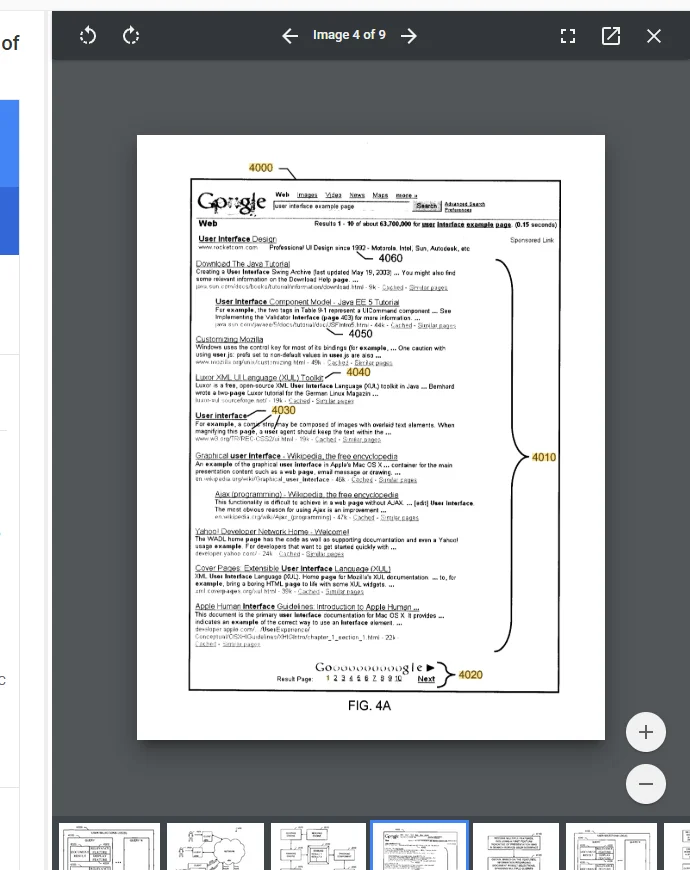
Users click the first search result about 30% of the time. The second result gets roughly 15%. The third gets 10%. This decay curve exists regardless of result quality — position alone explains most of the click-through rate variation.
If Google used raw clicks to rank results, position 1 would stay at position 1 forever. This patent breaks that loop by answering one question: "How many clicks would this result get at this position if it were an average result?"
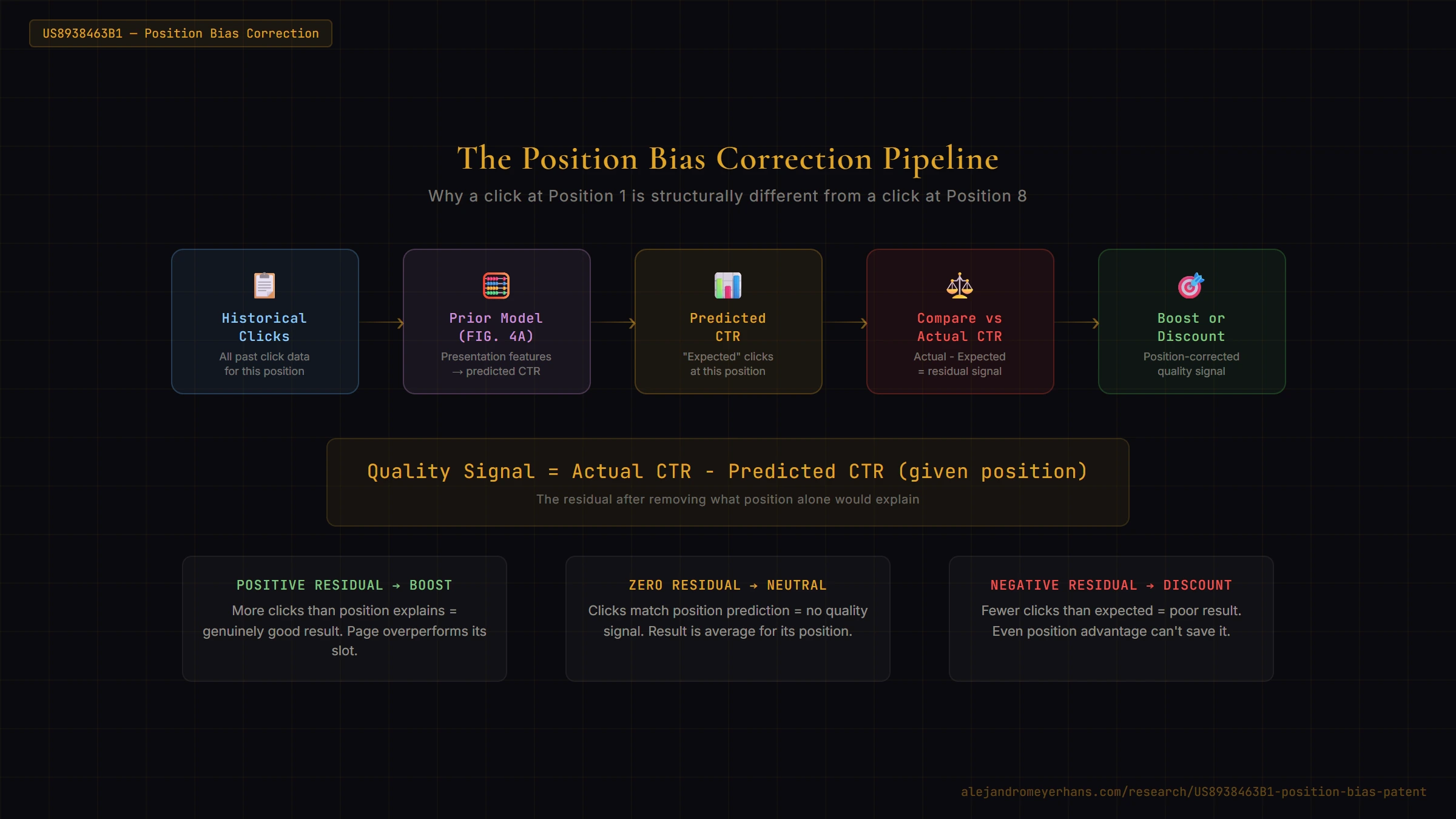
The system works in four steps:
- Build a prior model — From billions of historical clicks, compute the expected click-through rate for every combination of presentation features (position, title length, snippet length, bold terms, ads, etc.) independent of any specific query
- Predict expected clicks — For each result in a SERP, use the prior model to predict how many clicks it should get based solely on its position and presentation
- Compare actual vs. predicted — If a result at position 5 gets more clicks than the model predicts for position 5, something about the result is genuinely better than average
- Boost or discount — Results outperforming their predicted click rate get boosted. Results underperforming (coasting on position) get discounted
Let me translate that to human.
↓
Imagine a talent show where the audience votes, but the first act always gets the most applause just for going first — not because they're best. This patent is the scoring system that says: "A first act normally gets 30% of the applause. This one got 35%. That extra 5% is the real signal." Meanwhile, the fifth act normally gets 10%, but this one got 18%. That overperformance is a stronger quality signal than the first act's raw applause. The system doesn't count clicks — it counts surprises.
The Prior Model: Predicting Expected Clicks
The prior model is built from aggregated click data across all queries. It uses only presentation features — observable characteristics of how a result appears on the SERP, not what the result is about. The patent explicitly lists these features:
| Feature | What It Captures |
|---|---|
| Result position | The primary source of position bias — higher = more clicks |
| Title length | Longer titles occupy more visual space, attracting more attention |
| Snippet length | More text in the snippet = more visual weight on the SERP |
| Number of bold terms | Bold query matches in snippets draw the eye — a visual attractor |
| Indentation level | Sitelinks and indented results have different click profiles |
| Ads present | Ad blocks above organic results shift the visual hierarchy |
| Background colour | Highlighted results (knowledge panels, featured snippets) have different click rates |
| Query length | Short queries produce different click distributions than long queries |
| Navigational flag | Navigational queries heavily bias toward position 1 |
| Base IR score | The initial relevance score before click-based re-ranking |
The prior model is trained using logistic regression or similar statistical methods. For each presentation feature combination, it outputs a predicted click-through rate. This prediction represents what an average result would receive — the clicks explained by position and presentation alone.
The prior model is Google's expectation calculator. It looks at where your result sits on the page, how long your title is, how many bold words are in your snippet, whether there are ads above you, and it says: "Based on all of that, an average result here would get clicked X% of the time." Your actual clicks are then measured against that expectation. The magic isn't in the clicks — it's in the delta between expected and actual.
The Dual-Model Approach: Separating Bias from Quality
The patent describes a sophisticated refinement (FIG. 4D) using two separate models:
Built on all features including presentation bias features (bold terms, title length, snippet length, indentation, ads, background colour). This model captures the total expected click rate from both position and visual presentation.
Built on only quality-correlated features (IR score, position, query features). This model captures the expected click rate from relevance and position — without visual presentation noise.
The ratio Model 2 / Model 1 isolates the pure presentation bias component. If a result has a high click rate but most of it is explained by visual presentation (long title, many bold terms, prominent position), the ratio reveals that the quality signal is weaker than the raw clicks suggest.
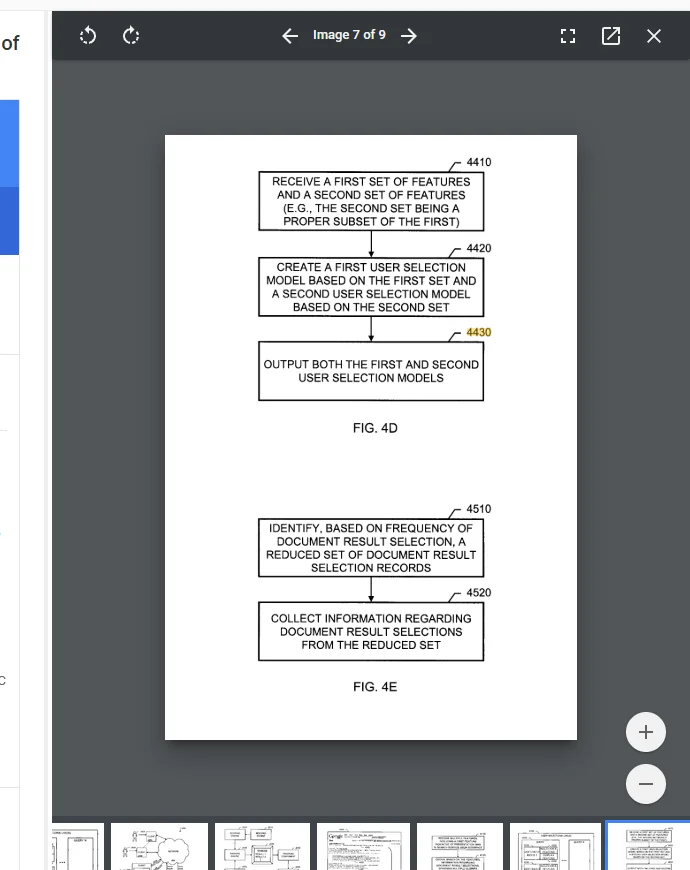
This dual-model architecture means Google can separate three distinct click drivers: position (where the result appears), presentation (how it looks), and quality (whether users actually found it useful). Only the quality component feeds into the ranking adjustment.
Model 1 says: "Here's how many clicks this result would get because of everything — its position, its long title, its bold keywords, the whole visual package." Model 2 says: "Here's how many clicks it would get based on only relevance and position." The difference between the two is the pure visual presentation bias — the clicks you got because your snippet looked pretty, not because your content was good. Google strips those out.
The Boost Formula
The formula is a bounded correction. Z is the gap between actual and predicted clicks. If Z is positive (more clicks than expected), the boost is greater than 1 — your ranking improves. If Z is negative (fewer clicks than expected), the boost drops below 1 — your ranking is demoted. The bounds m₀ and m₁ are guardrails: no single result can skyrocket or crater beyond the caps. It's a self-correcting thermostat, not a light switch.
The formula is bounded — no result can be boosted or demoted beyond the caps set by m₀ and m₁. This prevents outliers from dominating: a single viral result that gets unusual click-through rates can't infinitely boost itself.
I find this design choice revealing. Google built in guardrails from day one. They knew click manipulation was coming — and the bounded formula means even a sophisticated click fraud operation can only push a result's boost to m₀, not to infinity. The cap makes the system resilient by design.
The patent also describes the anti-spam constraint inherited from NavBoost: "one single vote per cookie and/or IP for a given query-URL pair." Click manipulation attempts that reuse cookies or IPs are discarded before they reach the bias correction system.
This patent was filed in 2006 and describes logistic regression models for click prediction. By 2026, the production system likely uses neural models — possibly Transformer-based architectures that can process the full SERP layout as input. The principle remains identical: separate position and presentation effects from quality effects before using click data for ranking. The models evolved; the architecture didn't. The CRAPS acronym confirming this pipeline was still active as of the 2024 API leak.
SEO Implications
New Content Can Break Into Top Positions
Position bias correction is the mathematical reason why new pages can overtake established results. If your page at position 8 generates a click-through rate that exceeds what the prior model predicts for position 8, the system produces a positive boost. Over successive re-rankings, this boost accumulates — your page climbs because it's demonstrably better than its position would predict.
I've watched this happen in real time with client content. A new page launches at position 12 for a competitive query. The title is strong, the snippet matches intent precisely, and the content delivers. Within three weeks, it's at position 4. Not because of backlinks — the link profile barely changed. Because the click-through rate at position 12 exceeded the model's prediction, generating a positive Z value, which produced a boost > 1.0, which improved the ranking, which generated more data, which confirmed the signal. The flywheel this patent describes is the mechanism behind what practitioners call "quick wins" for new content.
Title Tags Are a Presentation Bias Feature
The patent explicitly lists title length as a presentation feature in the bias model. This means Google mathematically accounts for the fact that certain titles attract clicks through visual prominence rather than quality. A clickbait title that generates high CTR but low post-click engagement will be exposed: the bias model predicts high clicks from the title's visual properties, so the quality signal (actual minus predicted) will be low or negative.
SERP Features Change the Bias Baseline
Ads, featured snippets, knowledge panels, and AI Overviews all change the visual hierarchy of the SERP. The prior model accounts for these — when ads push organic results down, the model adjusts predicted click rates accordingly. This means your organic CTR isn't judged against a clean SERP; it's judged against what the model expects given the actual SERP layout your result appeared in.
Bold Terms Drive Clicks (and the Model Knows It)
The number of bold terms in snippets is explicitly tracked. When your snippet contains query matches that get bolded, the prior model predicts a higher click rate. To generate a positive quality signal, you need clicks beyond what the bold matches alone would explain. This is why keyword-stuffed meta descriptions can backfire — they increase predicted clicks without increasing quality clicks, resulting in a net neutral or negative signal.
API Leak Cross-Reference
The most direct connection between this patent and the 2024 API leak is the name itself:
The internal codename CRAPS — revealed through the API leak as QualityNavboostCrapsCrapsData — directly describes this patent's mechanism. "Click Rate" = the click-through rate being measured. "Adjusted by Position and Style" = the position bias and presentation bias correction this patent implements.
| Patent Concept | API Attribute | Evidence Tier |
|---|---|---|
| Position-corrected click signals | CrapsData |
Confirmed (API Leak) |
| Quality-isolated click rate | goodClicks / badClicks |
Confirmed (API Leak) |
| Navigational query detection | navDemotion |
Confirmed (API Leak) |
| Per-cookie/IP deduplication | NavBoost anti-spam layer | Confirmed (Patent + API Leak) |
Citation Network
Same-Day Filing Partners
- US8661029B1 (NavBoost) — Filed same day by same inventors. NavBoost collects clicks; this patent calibrates them.
Related Patents in This Research Library
- NavBoost Deep Dive — Comprehensive analysis of NavBoost including production attributes, DOJ testimony, and the CRAPS codename that directly references this patent's mechanism.
- US10055467B1 (Group-Based Quality) — Host-level quality scoring that operates on the same corrected click data this patent produces.
- US7716225B1 (Reasonable Surfer) — Another click probability model, but for link evaluation rather than SERP behaviour. Both use probabilistic models of user behaviour to weight signals.
- Quality Scoring Ensemble — How position-corrected click data integrates with content quality, trust, and other scoring dimensions.
CRAPS Decoded: The Name Tells the Story
The internal codename CRAPS — Click Rate Adjusted by Position and Style — is the most concise description of Google's click signal pipeline. It tells you exactly what the system does: take the raw click rate, adjust it for position bias (this patent), adjust it for style/presentation bias (also this patent), and output a quality-isolated click signal for NavBoost to consume.
The name leaked in 2024 as part of the QualityNavboostCrapsCrapsData container in Google's Content Warehouse API. The redundant "Craps" in the name (CrapsCrapsData) suggests the container wraps multiple CRAPS-processed data streams — likely separate streams for mobile, desktop, and different aggregation windows.
Understanding this naming convention resolves a question practitioners have debated since the API leak: "Is NavBoost the same as CRAPS?" The answer is no. NavBoost is the ranking system that uses click data. CRAPS is the data processing pipeline that cleans and calibrates the click data before NavBoost consumes it. NavBoost is the engine. CRAPS — this patent — is the fuel filter.
FAQ
What is Google's position bias correction patent?
US8938463B1 describes how Google separates genuine quality signals from position privilege in click data. Users click higher-ranked results more often regardless of quality. This patent builds a 'prior model' that predicts expected clicks based on position and presentation features, then compares actual clicks against that prediction. Results outperforming their position get boosted; results coasting on position get discounted.
Why is position bias correction important for NavBoost?
Without position bias correction, NavBoost would create a self-reinforcing loop — position 1 always gets the most clicks, so it always stays at position 1, regardless of whether it deserves to be there. This patent is NavBoost's calibration layer. It was filed on the same day (November 2, 2006) by the same inventors (Hyung-Jin Kim, Simon Tong), confirming they were designed as companion systems.
How does Google's presentation bias model work?
Google builds two models from historical click logs. The bias model includes all presentation features (position, title length, snippet length, bold terms, ads present). The quality model includes only quality-correlated features (IR score, position, query features). The ratio of quality model to bias model isolates pure presentation bias, which is then used to adjust click signals before ranking.
What presentation features does Google track for position bias?
The patent explicitly lists: result position, title length, snippet length, number of bold terms in snippet, indentation level, presence of ads, background colour of result, query length, whether the query is navigational, and the base IR score. These features form the input to the prior model that predicts expected click-through rates.
Position Bias: What Doesn't Matter as Much as SEOs Think
The nature of this patent is one of the most permanent insights in the entire research library: raw clicks are unreliable quality signals because users are biased by position. This truth doesn't change when Google upgrades from logistic regression to Transformers. It doesn't change when the SERP adds AI Overviews. It doesn't change when users switch from desktop to mobile to voice. As long as search results are presented in a ranked list, position bias exists, and any click-based ranking system that doesn't correct for it will collapse into a self-reinforcing loop.
The flavour — logistic regression with hand-tuned features — was the 2006 approach. By 2026, the prior model is likely a neural network that ingests the entire SERP viewport as input, including features the 2006 inventors couldn't have imagined: AI Overviews, video carousels, "People Also Ask" boxes, image packs. But the correction principle is identical: predict what an average result would get, then measure the surprise.
The counterintuitive truth: practitioners obsess over CTR as a ranking signal, but this patent reveals that raw CTR is literally the signal Google is trying to discard. The system doesn't want your click-through rate. It wants the residual — the clicks you earned beyond what your position and visual presentation already explain. Optimising for raw CTR is optimising for the noise. Optimising for the delta is optimising for the signal.
The same engineers who built the click-counting system (NavBoost) simultaneously built the click-cleaning system (this patent). That tells you everything about how Google thinks about user behaviour data. They don't trust it raw. They never have. Same meal. The seasoning changed — the kitchen hasn't.