The Seed Distance PageRank Patent
The 2024 Google API leak revealed an attribute called PagerankNS — a per-document PageRank field. Google's own leaked documentation defines it verbatim: "Pagerank-NearestSeeds is a pagerank score for the doc, calculated using NearestSeeds method. This is the production PageRank value teams should use." So NS stands for NearestSeeds — documented, not deduced. That concept maps directly to a 2006 patent by Google engineer Nissan Hajaj. The leak confirms Google runs a NearestSeeds PageRank in production; this patent is the clearest public model of how such a system could work — measuring proximity to trusted sites rather than counting raw citations.
This article is built on three sources: the patent text (the legal document filed with the USPTO), the 2024 Google API documentation leak, and observable ranking behavior. The patent proves Google designed a seed-distance ranking system. The API leak shows attribute names consistent with it. Neither proves this exact formula runs in production today — and the patent itself describes its approach as "one possible variation of PageRank." I'll be explicit throughout about where evidence ends and inference begins.
If you've read my analysis of the Reference Contexts patent, that system evaluates what is written around your links. If you've read the Historical Data patent, that one monitors when your links appeared. This patent answers a more fundamental question: how far is your page from the sites Google already trusts? And the answer carries exponential consequences.
The Honest Hedge
Every analysis has a threshold where certainty ends and inference begins. Here's where that line falls for this patent:
- Google filed and was granted a patent for ranking pages based on shortest distances from hand-curated seed sites, using exponential decay scoring.
- The system uses k nearest seeds (k = 3–6), assigns link lengths based on outdegree properties, and pages unreachable from any seed receive no score.
- The patent names Google Directory and The New York Times as example seeds.
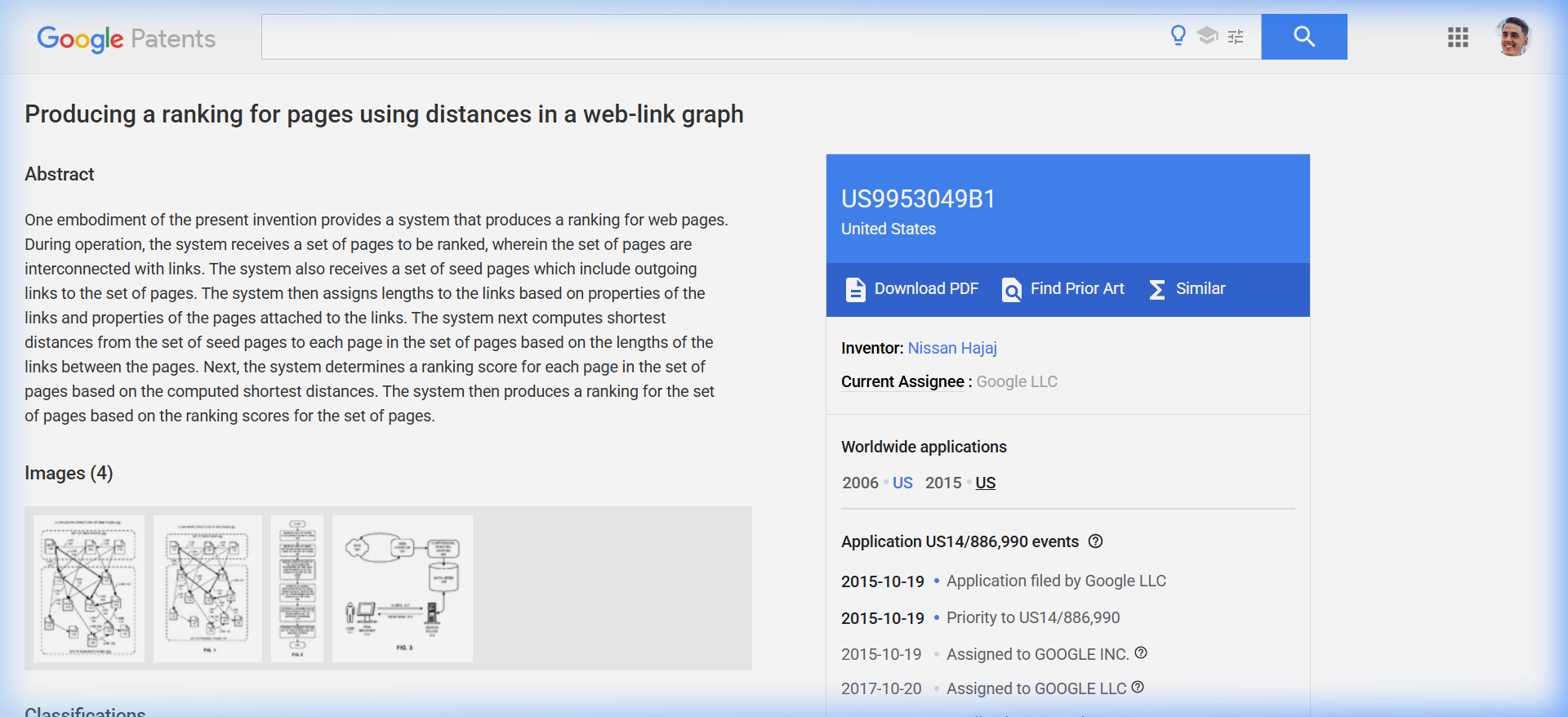
- The parent application was filed in 2006; the continuation was granted in 2018. Year 4 maintenance fees were paid.
- The patent describes itself as describing "one possible variation of PageRank" — not a confirmed replacement of the original.
- A production "NearestSeeds" PageRank is documented in the leak, so the concept is confirmed. What remains inference is that this patent's specific equations are that production implementation.
- The
homepagePagerankNsattribute copies the homepage'sPagerankNSonto each document — a site-level proxy, not a separately computed site score. - Patent continuations and fee payments suggest ongoing legal value — though this proves portfolio maintenance, not necessarily production relevance.
- The exact seed list — it's presumably evolved significantly since Google Directory was discontinued in 2011.
- The current value of k (3? 6? dynamic?).
- Whether seeds are global or topic-sensitive (query-specific micro-seed clusters).
- Whether Graph Neural Networks or SpamBrain pre-processing have superseded the explicit shortest-path formula while preserving the seed-distance concept.
- Whether modern "distance" includes entity co-occurrence (unlinked mentions) alongside hyperlink paths.
- The exact weighting of seed distance within the Q* composite score.
- A maintenance fee reminder has been mailed — if fees aren't paid, the patent expires. This doesn't mean Google would stop using the technology, but it would mean competitors could freely implement it.
Patent Metadata
What This Patent Does (Plain English)
Classic PageRank (the 1998 version) asked: "How many pages link to this page, and how important are they?" This patent describes a variation of that approach — one that asks: "How far is this page from the websites Google has hand-selected as trustworthy?"
Here's what the system does:
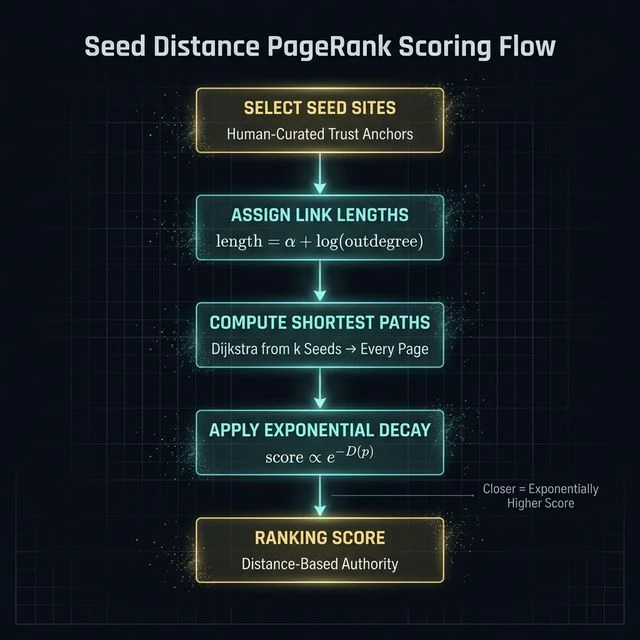
- Select seed sites — Human reviewers at Google curate a set of trusted "seed" websites. The patent names Google Directory and The New York Times as examples. Seeds must be reliable, diverse across fields of public interest, and well-connected with many outgoing links.
- Assign link lengths — Every link on the web is assigned a "length" based on the source page's properties. A page with 5 outgoing links creates short links. A page with 5,000 outgoing links creates very long links. More outgoing links = each individual link is worth less.
- Compute shortest paths — For every page on the web, the system calculates the shortest path from the k nearest seed sites (typically k = 3–6). This requires shortest-path computation in a weighted directed graph — the same class of graph traversal used in GPS navigation.
- Apply exponential decay — The ranking score is proportional to e−D(p), where D(p) is the distance from the kth nearest seed. This is an exponential function — every additional hop away from a seed site doesn't just reduce score linearly; it collapses it exponentially.
- Produce ranking — Pages are ranked by their distance scores. Pages unreachable from any seed get no score at all — they are unscored by this mechanism.
Link Length: Why Outdegree Destroys Value
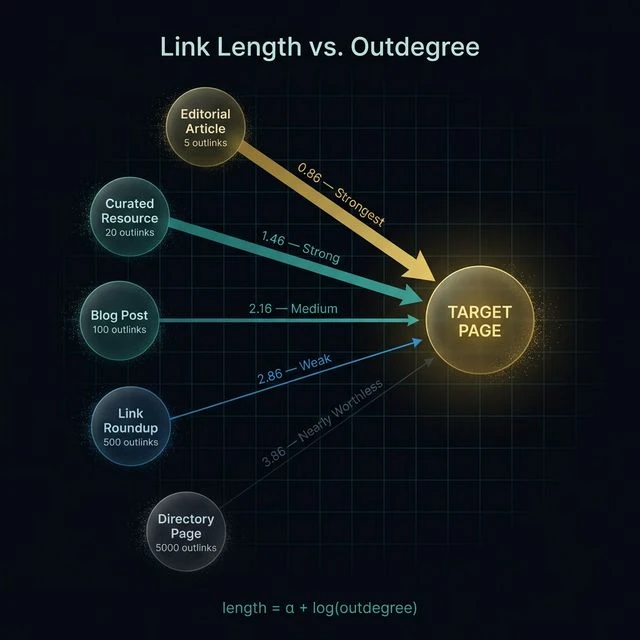
Every link in the web graph is assigned a "length" — a numerical value representing how much distance that link adds between the source and destination. This is the mechanism that makes editorial links from focused pages mathematically superior to links from directories, link roundups, and resource pages with hundreds of outgoing links.
Here's the formula:
Here's what this means in practice:
| Source Page Type | Outgoing Links | Link Length | Relative Value |
|---|---|---|---|
| Editorial article mentioning you in context | 5 | 1.77 | Strongest — genuine endorsement |
| Curated resource page | 20 | 3.16 | Strong — selective curation |
| Blog post with many outlinks | 100 | 4.77 | Medium — diluted |
| Link roundup | 500 | 6.38 | Weak — mass listing |
| Directory page | 5,000 | 8.68 | Nearly worthless — commodity link |
These values are worked examples using the patent's formula with a natural-log reading. The actual ranking score depends on weighted shortest paths through multiple links, the kth nearest seed calculation, and optional link weights — not on a single link's outdegree in isolation.
Under this patent's model, a link from a page with 5,000 outgoing links creates roughly 5× more mathematical distance than a link from a page with 5 outgoing links. That's not a small difference — it means the link from the directory page adds substantially more "distance" between you and the seed sites. And because the final score uses exponential decay, that extra distance has devastating downstream effects.
This patent's formula counts all outgoing links on a page — including navigation, footers, and sidebars. Modern web pages routinely have 200+ links in their DOM from mega-menus alone. Google's Reasonable Surfer patent (US7716225B1) and subsequent DOM segmentation models isolate the main content block, likely calculating effective outdegree from editorial links in the body text — not raw HTML link count. The practitioner takeaway is the same (fewer editorial links on the page = stronger signal), but the raw numbers in the table above assume the patent's simplest reading, not Google's likely modern refinement.
Exponential Decay: The Distance Cliff
This is the mechanism that makes seed distance so consequential. The ranking score for any page is calculated as:
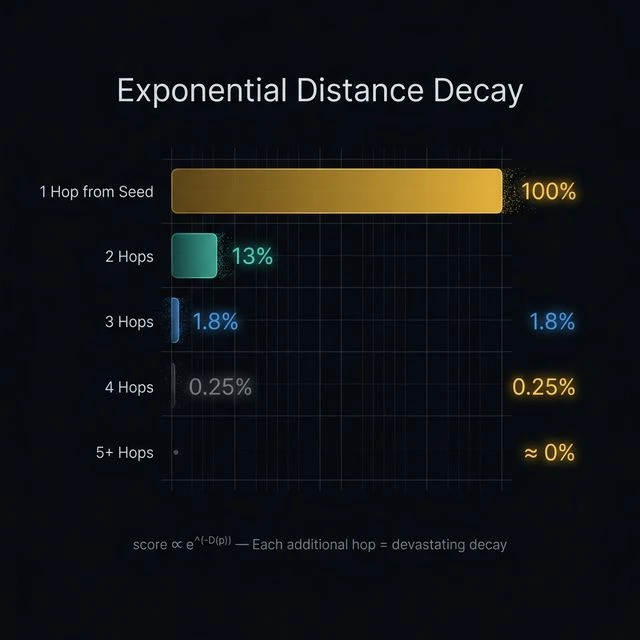
The exponential function creates a cliff, not a slope. The following is a worked example — not a universal lookup from the patent. It assumes each hop passes through a low-outdegree editorial page (roughly 6 outlinks, link length ≈ 2.0):
| Hops from Seed | Score (e−D) | % of 1-Hop Value |
|---|---|---|
| 1 hop | 0.135 | 100% |
| 2 hops | 0.018 | 13% |
| 3 hops | 0.0025 | 1.8% |
| 4 hops | 0.00033 | 0.25% |
| 5+ hops | 0.000045 | ≈ 0% |
Look at that cliff. Two hops from a seed site and you're already at 13% of the maximum value. Three hops and you're under 2%. This is why a single link from a major publication can outperform dozens of links from sites further down the chain — and it's why link chains (whether PBN chains or otherwise) face mathematical headwinds that no amount of volume can overcome.
This doesn't mean sites three or four hops from a seed are worthless. I wouldn't call sites that are three, four hops away from seed dead — not at all. The aggregate of many medium-distance links still contributes meaningfully to your overall profile. But this table explains why the last link sometimes unlocks everything: you already had 50 links that built the foundation, and the 51st link from a seed-adjacent site was the one piece your profile was missing. That one gap was a much bigger deficiency than missing the other 50 combined.
Seed Selection and Tuning: Google's Trust Anchor Network
The entire system rests on one critical foundation: the seed set. These are the "trust anchors" from which all distance is measured. The patent is unusually specific about what makes a good seed:
- Reliable — consistently high-quality over time
- Diverse — covering "a wide range of fields of public interests," not all in ONE vertical
- Well-connected — seeds need large numbers of outgoing links to "facilitate identifying other useful and high-quality pages"
- Manually selected — "selecting the seeds involves a human manually identifying these high-quality pages"
The patent gives two specific examples: Google Directory (the curated web directory Google discontinued in 2011) and The New York Times. These are exactly the kinds of sites you'd expect — broad editorial authority, high trust, deep link graphs reaching into every corner of the web.
The patent describes an iterative refinement process: the ranking results are fed back to "evaluate the quality and the contribution of the seeds, and then modify the list of seeds and/or the weights of the seeds based on this information." In other words, the seed set isn't static — Google continuously evaluates which seeds are producing useful distance signals and adjusts the set accordingly. Seeds that stop connecting to high-quality pages can be demoted or removed. This is an evolving trust network, not a fixed list.
Two structural shifts since 2006 complicate the patent's literal model. First, most major Seed Sites (Forbes, NYT, universities, health portals) now default to rel="nofollow" or rel="sponsored" on outbound links. Google treats those as hints — potentially discounted or excluded edges, not guaranteed graph removals — so the pure hyperlink-distance calculation the patent describes gets muddier at exactly the points where trust should flow most freely. Second, Google likely uses topic-sensitive seed clusters rather than a single universal list. Your "distance" to a seed isn't absolute — it's relative to the query topic. A DR 30 niche-specific journal that's a topical seed for your vertical may carry more weight than a global news seed linking to a tangentially related page. The patent describes a single global seed list; modern Google likely runs thousands of contextual micro-seed networks.
The k-Nearest Seeds
The system doesn't measure distance from just one seed — it uses the kth nearest seed, where k is typically 3–6. This means your page needs to be close to multiple seed sites, not just one. A single link from The New York Times is valuable, but a page reachable from three different seed sites through short paths is structurally stronger than a page reachable from only one.
This is why link diversity isn't just a best practice — it's architecturally built into the scoring function. Google's system literally measures proximity to k different trust anchors. A diverse link profile that connects you to multiple corners of the seed network will structurally tend to outscore a concentrated profile from a single direction.
The Unreachable Problem
Pages that cannot be reached from any seed through any path receive no score at all. They are unscored by this process. This has implications for brand-new websites, orphan pages, and sites in corners of the web that aren't connected to the broader link ecosystem. The patent states: "not all the pages in the set of pages receive ranking scores through this process. A page that cannot be reached by any of the seed pages will not be ranked."
Seed Distance SEO Implications: What This Means for Your Link Profile
1. The "51st Link" Effect — What's Really Happening
I've seen this pattern hundreds of times: a site builds 50 good links and ranks respectably but not competitively. Then they land one placement on Healthline, or Forbes, or a major industry publication — and everything unlocks.
Here's why — and it's more precise than "the other 50 suddenly count." SEO is competitive: you're ranked relative to the sites around you. Under this patent's math, that one seed-adjacent link doesn't activate the previous 50 — the model uses shortest paths and the kth-nearest seed, not a sum of your profile. What the new link does is create a qualitatively shorter or more diverse route into the seed network that the previous 50 didn't provide: a new short hop, or a path to a different nearby seed that improves your kth-nearest-seed distance. The foundation links still do their own work; the new one supplies the route to trust they were missing. And because the scoring is exponential, a shorter path can produce a discontinuous jump.
2. Digital PR Is the Seed Distance Accelerator
Digital PR is amazing — but in isolation, it's nowhere nearly as amazing as when you combine it with everything else. A single high-trust placement shortens your distance to the seed network dramatically. But if that's your only link building strategy, you're missing the aggregate volume that medium-distance links provide. The ideal strategy is both: PR placements for seed proximity plus sustained outreach for breadth.
3. Outdegree Is Your Silent Enemy
Every additional outgoing link on your source page makes your link longer in the graph. A link from a page with 5 outlinks is ~5× shorter than a link from a page with 5,000. When evaluating backlink opportunities, how many other links does this page have? is one of the most underrated questions in link building. Guest posts on exclusive placement pages > guest posts on pages citing 50 other sources.
4. Brand Consensus Works Through Seed Distance
When your brand is mentioned and linked from multiple seed-adjacent publications — industry journals, major media, academic institutions — you're not just building "brand awareness." You're shortening your graph distance to multiple seeds simultaneously. Brand consensus isn't a vague metric — it's the structural result of being close to many trust anchors at once.
5. Seed Proximity May Extend to AI Citations (Hypothesis)
This one is a hypothesis, not a patent finding — flagging it as such. Imagine an article on Bank of America's site that mentions the best lenders in a state and links to you. It's plausible the seed-distance concept extends to how AI systems pick sources: seed-adjacent sources may be cited more readily in AI answers, since retrieval and training lean on the same web-graph trust structure. But nothing in this patent or the leak establishes it — treat it as an informed guess about where this could go, not a demonstrated effect.
US8577893B1 (Reference Contexts) — Evaluates the editorial context around your links. Seed Distance measures how far you are; Reference Contexts measures how naturally your links are embedded. Both feed into link quality scoring.
US7346839B2 (Historical Data) — Monitors the temporal patterns of your link acquisition. Seed Distance is spatial; Historical Data is temporal. Together they form the positional and velocity dimensions of link quality.
Beyond the patent, two forces may reshape how seed distance works in practice — flagged as hypotheses, not patent findings. First, SpamBrain, Google's neural spam detector, plausibly pre-processes the link graph before distance is computed; if it flags unnatural patterns (tiered chains, PBN clusters, velocity spikes) it could sever nodes, so your third-party-tool distance may not match Google's internal graph. Second, modern Google may not limit "distance" to hyperlinks: the API's repositoryWebrefEntityJoin system extracts entity co-occurrence from raw text — no <a href> required — so a mention by a Seed Entity (like The New York Times or WHO) could shorten your effective distance without a literal link. Both are informed extrapolations; this patent describes a hyperlink-only graph.
Google API Leak Cross-Reference: PagerankNS
The 2024 Google API leak — first reported by Rand Fishkin and investigated by Mike King at iPullRank — revealed five attributes that align directly with this patent's mechanisms:
| Patent Mechanism | API Attribute | API Evidence |
|---|---|---|
| NearestSeeds distance scoring | PagerankNS in GDocumentBase | 📗 DOCUMENTED — defined verbatim as "Pagerank-NearestSeeds… the production PageRank value teams should use" |
| Site-level proxy | homepagePagerankNs in PerDocData | 📗 DOCUMENTED — the homepage's PagerankNS copied onto the document |
| Link length via outdegree | outdegree + outsites in AnchorsAnchorSource | 🔷 STRUCTURALLY COMPATIBLE — outdegree data the formula could use (also used by many link algorithms) |
| Per-anchor weighting | pagerankWeight (float) in AnchorsAnchor | 🔸 WEAKLY COMPATIBLE — a pageranker/linkmaps weight; not specific evidence of seed-distance decay |
| — | scaledSelectionTierRank | ⚪ ADJACENT — an indexing signal, not evidence for this patent |
| — | authorityPromotion in CompressedQualitySignals | ⚪ ADJACENT — documented as "converted from QualityBoost.authority.boost"; no NearestSeeds link |
📗 DOCUMENTED = the leak's own text names the mechanism directly. 🔷 STRUCTURALLY COMPATIBLE = generic data the patent's formula could use, but not unique to it. 🔸 WEAKLY COMPATIBLE = plausibly related, but the field's documentation ties it to something else. ⚪ ADJACENT = a real signal, but with no documented connection to NearestSeeds.
PagerankNS is defined in the leak as "Pagerank-NearestSeeds… the production PageRank value teams should use." That's documentation, not a clue — NS is NearestSeeds, and it's the score Google's own teams are told to use. What the leak doesn't give us is the scoring formula; the patent supplies the clearest public candidate. Together they're strong — but the leak doesn't prove the production code matches the patent's equations exactly.
The leak provides the field names and one crucial definition; the patent provides the mechanism. What's confirmed: a production NearestSeeds PageRank exists. What's inferred: that this patent's equations are how it's computed. The API also reveals homepagePagerankNs — the homepage's PagerankNS copied onto each document (a site-level proxy, not a separately computed site score).
Citation Network
Patent Family Chain
US9165040B1 (parent, filed 2006, granted 2015) → US9953049B1 (this patent, continuation, granted 2018)
Forward Citations (Patents Citing This Patent)
| Patent | Relevance |
|---|---|
| US20160335257A1 | Extends graph-based ranking methodology |
| US10692298B2 | Builds on distance-based page quality assessment |
| US20230153924A1 | Recent (2023) patent application citing seed distance concepts |
Related Articles on This Site
- US8577893B1 (Reference Contexts) — While Seed Distance measures how far your page is from trusted sources, Reference Contexts measures how naturally each link is embedded in its surrounding text. Distance + context = the complete link quality picture.
- US7346839B2 (Historical Data) — Historical Data watches for temporal anomalies in link acquisition. Seed Distance gives the spatial dimension; Historical Data gives the temporal dimension. A page that suddenly shortens its seed distance through a burst of high-trust links will trigger temporal analysis.
- US7603350B1 (Entity Trust) — If Seed Distance measures trust through the link graph, Entity Trust measures trust through the entity graph — how much the people who vouch for your content are trusted by others. Both were filed in 2006, four months apart, by different Google engineers. Two dimensions of the same trust architecture.
- US7716225B1 (Reasonable Surfer) — Seed Distance determines how far your page is from Google's trust anchors. The Reasonable Surfer determines how much equity each link actually passes, using ML-learned per-link weights. You need both: links from seed-adjacent sites (short distance) AND those links need to be high-weight editorial placements (high wᵢ).
- US8682892B1 (Implied Links) — Implied Links extends the distance concept: you can be "close" to a trusted source through a brand mention, not just through a hyperlink path. Both patents feed
CompressedQualitySignals. Seed Distance measures graph proximity through links; Implied Links adds unlinked entity mentions as a parallel channel. - NavBoost Deep Dive — Seed Distance determines how close you are to trust; NavBoost determines whether users confirm that trust with their behaviour. A page can have excellent seed proximity but poor engagement — or vice versa. The practitioner synthesis maps how NavBoost's host-level quality scoring creates a statistical distribution that interacts with the trust signals seed distance provides.
Seed Distance: What Doesn't Matter as Much as SEOs Think
The nature of this patent is simple: trust radiates from known sources, and it decays with distance. That's not an algorithm quirk — that's how human trust actually works. You trust your doctor's recommendation more than a stranger's. You trust the stranger your doctor recommended more than someone five referrals removed. The web graph works the same way.
The flavor — the specific math, the kth nearest seed, the logarithmic link length formula — that was the 2006 approach, refined through 2018. Google has likely evolved the implementation. The seed set has certainly changed since Google Directory shut down. The k value may be dynamic. The decay function may have been modified.
But the architecture — measuring distance from trust anchors rather than counting raw citations — that isn't going anywhere. It's too fundamental. It's the difference between asking "how many people vouch for you?" and "how close are you to people we already trust?" The second question is harder to game, more resistant to manipulation, and more aligned with how authority actually propagates through networks.
The SEO industry still obsesses over Domain Rating as if it's the signal. It isn't. DR measures the aggregate power of all incoming links — it's a useful proxy, but it doesn't measure seed distance. Two DR 60 sites can have wildly different distances from the seed network. DR is like measuring someone's height. Seed distance is like measuring their relationship to power. Both are real — but don't confuse one for the other.
Here's what I tell clients: if you're worried about which links to build next, stop wondering about DR and start asking — how close is this site to the sites Google already trusts? That's the question this patent's architecture rewards — and the API naming suggests it's closer to Google's actual scoring than raw link counts are.
Frequently Asked Questions
What does patent US9953049B1 actually do?
It describes a distance-measurement variation of PageRank. Instead of asking "how many pages link to you?", the system measures how far your page is from a hand-curated set of trusted seed sites — and applies exponential decay to the score. Closer pages get exponentially higher scores.
What is PagerankNS in the Google API leak?
PagerankNS is a per-document PageRank field. Google's leaked documentation defines it as "Pagerank-NearestSeeds… the production PageRank value teams should use" — so NS stands for NearestSeeds, and it is the production PageRank score, not a legacy citation count. Patent US9953049B1 is the clearest public model of how a NearestSeeds system works, though the docs don't confirm the production code matches the patent's exact equations.
Does seed distance make PBNs (private blog networks) useless?
Not directly. Seed distance penalizes chained PBNs — where private sites link to each other in chains, adding hops and compounding distance. A PBN using expired or auctioned domains that are already close to the seed network may retain some of the previous owner's graph position — though this patent doesn't address domain ownership transfers, and SpamBrain's ability to detect unnatural link patterns in acquired domains adds significant uncertainty to this strategy.
Why does one Forbes link sometimes outperform 50 niche blog links?
Profile completion. If you already have 50 good mid-distance links, your aggregate foundation is solid but you're missing seed proximity. One Forbes link closes that gap — you were at 99% and it fills the final 1%. That last 1% was a bigger deficiency than the other 50 combined. Forbes alone without the foundation wouldn't rank you either — it's the combination that unlocks competitive positions.
How does seed distance affect AI Overviews and LLMs?
This is a hypothesis, not something this patent establishes. It's plausible that AI systems lean toward seed-adjacent sources when choosing citations, since retrieval and training draw on the same web-graph trust structure — so being close to a source like Healthline may also make you a more likely citation target. But the patent and the leak don't demonstrate it; treat it as an informed extension, not a confirmed effect.
Is Domain Rating (DR) the same as seed distance?
No. DR measures the aggregate strength of all incoming links to a domain — it's a third-party metric from Ahrefs that approximates PageRank. Seed distance measures proximity to Google's hand-curated trust anchors. Two DR 60 sites can have very different seed distances. Think of DR as measuring how many people vouch for you, and seed distance as measuring how close those people are to actual power. Both are real signals, but they measure different things.
What happens to pages that aren't connected to any seed site?
They receive no score at all. The patent explicitly states that "a page that cannot be reached by any of the seed pages will not be ranked." This affects brand-new websites, orphan pages without inbound links, and sites in isolated corners of the web. Getting your first link from a seed-connected domain isn't just helpful — it's the entry ticket to being scored at all.