A 60-second visit on a sports news site means the user read several headlines. A 60-second visit on a cooking tutorial means the user barely finished reading the ingredient list. Same duration. Completely different quality signals. This patent — co-invented by Noam Shazeer, the mind behind Transformers and NavBoost — ensures Google knows the difference.
Raw dwell time is one of the most misleading metrics in search. Without context, it's meaningless — is a 3-minute visit good or bad? This patent provides the context by computing category-relative engagement scores. Your site's dwell time isn't judged against all websites. It's judged against websites in the same content category. For how these normalized dwell signals feed into the broader click-based ranking pipeline, see the NavBoost deep dive.
The Honest Hedge
Every analysis has a threshold where certainty ends and inference begins. Here's where that line falls for this patent:
- The system computes a Website Duration Score (WDS) as a statistical aggregate of all user session durations
- Websites are assigned to categories from Google's taxonomy, with weighted membership across multiple categories
- A Cross-Website Category Duration Score (CWCDS) establishes the benchmark for each category
- Performance is measured relative to category peers — above 50th percentile = positive, below = negative
- Last-visited page duration is discounted (noise from idle users leaving their browser open)
- Direct URL entry and bookmarks boost the duration measurement
- Tab switching suspends sessions rather than ending them
- Co-invented by Noam M. Shazeer — also a NavBoost co-inventor
- The API leak attributes
lastLongestClicksand dwell-weighted click signals reflect category-normalized values, not raw durations - NavBoost's classification of clicks as "good" (long) or "bad" (short) uses category-relative thresholds rather than absolute time cutoffs
- Chrome browsing data provides the session-level engagement data this patent requires — tab switching, direct navigation, and cross-site transitions
- The specific category taxonomy used in production (the patent describes a hierarchical system with subcategories)
- Whether Google now uses learned category embeddings rather than a fixed taxonomy
- The exact percentile thresholds (the patent uses 50th percentile as an example, but this is tunable)
- How mobile vs. desktop session patterns affect category-relative scoring
Patent Metadata
The inventor list includes Noam M. Shazeer — one of the most consequential engineers in modern AI. Shazeer co-invented NavBoost, co-authored the "Attention Is All You Need" paper that introduced Transformers, and co-founded Character.AI. His involvement in both NavBoost and this dwell normalization patent confirms the architectural relationship: these systems were designed to feed each other.
The other inventors come from Google Research and NLP teams, reflecting the cross-disciplinary nature of this work — it combines information retrieval, natural language processing (for category classification), and statistical analysis (for duration benchmarking).
What This Patent Does (Plain English)
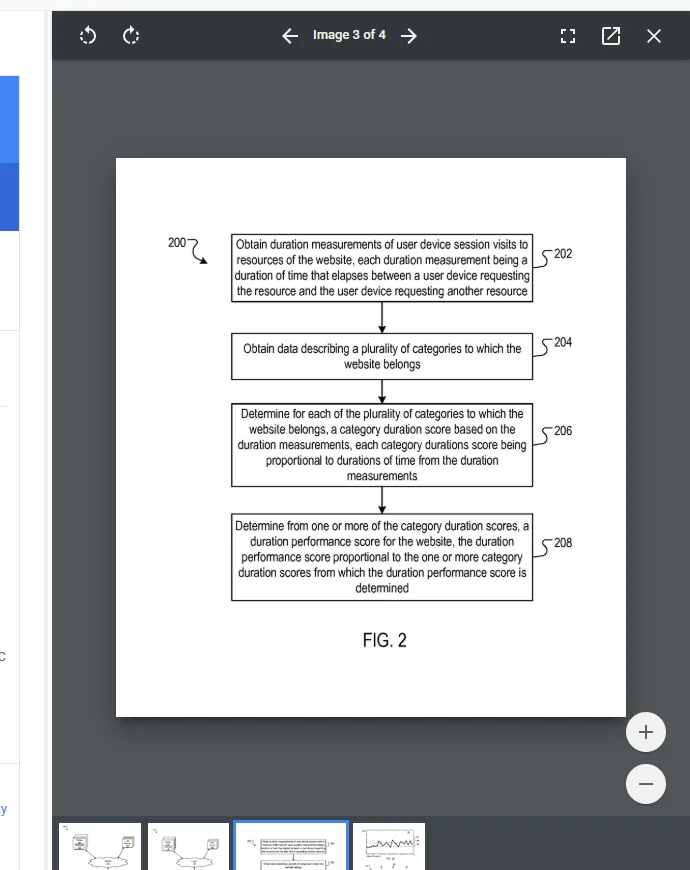
This patent solves the "compared to what?" problem in dwell time measurement. The system works in five steps:
- Measure session durations — Track how long users spend on a website per visit session. A session is a sequence of page views on the same site without navigating to another site
- Compute a Website Duration Score (WDS) — Aggregate all session durations into a single statistical measure (median, trimmed mean, etc.) for each website
- Classify the website by category — Assign the site to one or more categories from Google's taxonomy (news, sports, cooking, science, etc.) with weighted membership
- Compute category benchmarks — For each category, calculate the distribution of WDS values across all websites in that category. This produces the Cross-Website Category Duration Score (CWCDS)
- Score relative to peers — Compare the website's WDS against its category's CWCDS distribution. Above the 50th percentile = positive signal. Below = negative signal
The result: a cooking site where users spend 4 minutes per session can score better than a news site where users spend 6 minutes — because the median cooking site gets 2 minutes, while the median news site gets 8 minutes. Context determines quality.
Let me translate that to human.
↓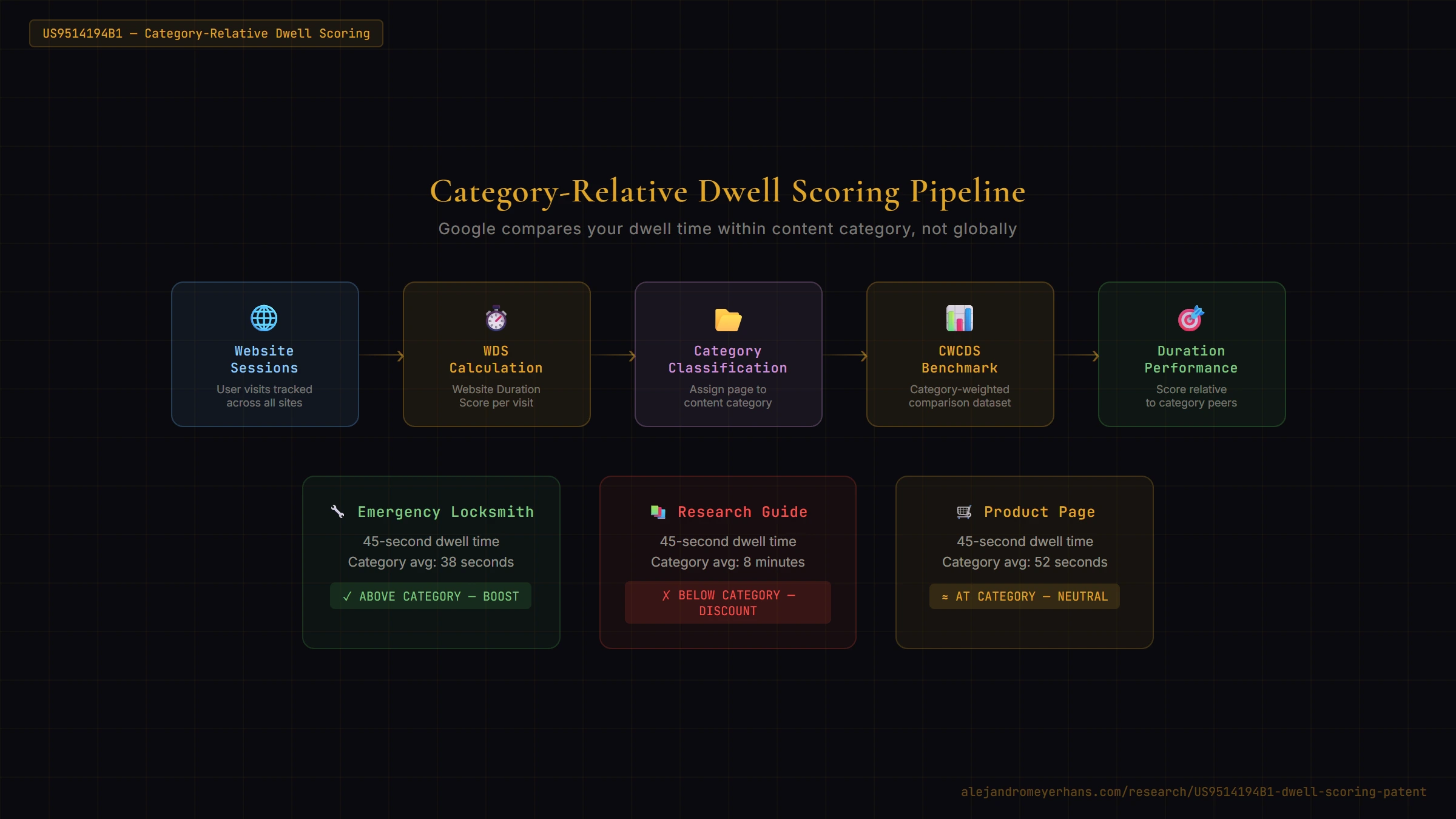
Think of it like grading on a curve in school, but the curve is different for every subject. Getting 70% in advanced physics might be an A because the class average is 55%. Getting 70% in basic arithmetic might be a D because the class average is 92%. This patent is the grading curve for dwell time. It doesn't ask "how long did users stay?" — it asks "how long did they stay compared to every other site teaching the same subject?"
Session Mechanics: What Counts as a Visit
The patent defines precise rules for what constitutes a "session" and how duration is measured:
A session is a sequence of consecutive visits to resources on the same website without visiting a resource on another website. If a user visits Site A → Site A → Site B → Site A, that's two sessions on Site A (before and after the Site B detour).
Duration Adjustments
| Behaviour | How It's Handled | Rationale |
|---|---|---|
| Last page in session | Discounted — duration reduced or excluded | Users often leave a tab open while idle. The last page's duration is noise, not signal. |
| Direct URL entry / bookmark | Boosted — extra weight added to duration | Typing a URL or using a bookmark indicates deliberate positive intent. The patent calls this "indicative of positive user assessment." |
| Tab switching | Session suspended, not ended | Users multitask. Switching to another tab doesn't mean they've left the site — they may return. |
| Prior-visited duration | Can be added — time at previous site contributes | How long a user spent at the site they visited before this one provides context about the transition. |
These rules reveal a sophisticated understanding of browser behaviour. Google isn't simply timing how long a tab is open. It's modelling actual human attention patterns — accounting for idle tabs, multitasking, and deliberate navigation.
Google knows the difference between "reading" and "tab left open." If you visit a site, read two pages, then switch to another tab to check email, the patent says that's a pause, not an exit. And if you typed the URL directly instead of clicking a search result, the system gives your visit extra credit — you went there on purpose, not because an algorithm put it in front of you. But if the page you're reading is the last one before you close the browser? That timer gets discounted, because Google can't tell if you read for 5 minutes or just forgot to close the tab.
This patent was filed in 2011 and describes a category taxonomy with statistical percentile comparison. By 2026, the production system likely uses learned category embeddings and neural models rather than a fixed taxonomy. The core principle — normalising engagement by content type — is well-established in the ML literature and confirmed by the API leak's differentiated click quality signals. The specific percentile thresholds and category boundaries have likely evolved; the architectural decision to compare engagement relative to peers has not.
Category Comparison: The Core Innovation
The critical insight of this patent is the category-relative comparison. Here's how it works mathematically:
For each website, aggregate all session durations into a single score. The patent suggests using robust statistical measures — median or trimmed mean — to reduce the impact of outlier sessions (e.g., a user who left their browser open overnight).
For each category in Google's taxonomy, collect the WDS values of all websites in that category. Compute the distribution — mean, median, percentiles. This establishes what "normal" engagement looks like for that category.
Compare the website's WDS to its category's CWCDS distribution. If the WDS exceeds the 50th percentile → positive score. If below → negative score. For multi-category sites, compute a weighted aggregate across all categories.
The patent explicitly describes weighted category membership. A site like "CNN" might be 70% news, 20% politics, 10% entertainment. Its duration performance is evaluated against each category separately, then combined using those weights. This prevents cross-category confusion — a news site isn't penalised for having shorter sessions than a tutorial site.
This is where it gets elegant. Your site isn't pinned to one category — it can straddle several. If you're 70% cooking and 30% lifestyle, Google evaluates your dwell time against cooking sites for 70% of the score and lifestyle sites for the other 30%. The weighted blend means your benchmark is as specific as your content mix. A site that tries to be everything gets benchmarked against everything — and that's much harder to beat.
The Duration Performance Score
The final output of this system is a Duration Performance Score that acts as a ranking signal. The patent describes several ways this score can be used:
- Direct ranking adjustment — The score is added to or multiplied against the existing IR score
- Quality threshold — Sites below a minimum duration performance score are flagged as low-quality
- NavBoost calibration — The score contextualises NavBoost's dwell-weighted click data, telling the system what "long" and "short" mean for each content type
Importantly, the patent describes this as a site-level signal, not a page-level signal. The WDS is computed across all sessions on the website, then compared against category peers. Individual pages contribute to the aggregate, but the score applies to the entire site. This connects directly to the Group-Based Quality patent — both operate at the host level.
SEO Implications
Topical Focus Affects Your Benchmark
If your site belongs to a category with high average dwell times (tutorials, research, educational content), you need longer sessions to score well. If your site belongs to a quick-answer category (dictionaries, weather, sports scores), shorter sessions are expected and don't penalise you. This means the "ideal" dwell time depends entirely on your content category — there is no universal target.
Content Type Mismatch Creates Scoring Confusion
A site that publishes both long-form research and quick reference content faces a categorisation problem. If Google classifies it as a research site, the quick-reference pages drag down the WDS. If classified as a reference site, the research pages artificially inflate it. This is another mathematical argument for topical coherence — sites with clear, focused content categories get cleaner duration performance scores.
I've seen this exact pattern with a client who ran both a glossary section and a deep-dive blog on the same domain. The glossary had 200 pages with 15-second average sessions. The blog had 30 pages with 8-minute average sessions. The site-level WDS was a muddy 2.5 minutes — which looked mediocre against both tutorial sites and reference sites. When we moved the glossary to a subdomain, the main domain's WDS jumped, because Google was now benchmarking it against a cleaner peer set.
Direct Traffic Boosts Your Duration Score
The patent explicitly states that direct URL entry and bookmark usage boost the duration measurement. This creates a compounding advantage: brand strength → more direct traffic → boosted duration metrics → better duration performance score → higher rankings → more brand awareness. The same direct-traffic advantage appears in the Group-Based Quality patent (DVF) and the Implied Links patent.
The Last Page Problem
The patent discounts the last page's duration because it's noise — users leave tabs open, get distracted, close the browser later. This means your page's engagement signal comes primarily from what users do after landing on it — do they click deeper into your site? If a user lands on your page and it's the only page they visit (single-page session), the discounted last-page duration produces a weaker signal than a multi-page session would.
API Leak Cross-Reference
| Patent Concept | Likely API Attribute | Evidence Tier | Reasoning |
|---|---|---|---|
| Category-normalised dwell time | lastLongestClicks |
Inferred | The "longest" clicks stored in NavBoost likely use category-relative thresholds rather than absolute durations |
| Session-level engagement | CrapsData session components |
Inferred | CRAPS processes click and dwell data together — normalisation would occur in this pipeline |
| Good/bad click classification | goodClicks / badClicks |
Confirmed (API Leak) | The threshold between "good" and "bad" clicks likely varies by content category, not a fixed 30-second cutoff |
| Site-level quality aggregation | siteQuality |
Inferred | Duration performance is a site-level metric that would feed into host-level quality scoring |
| Category classification | Google's topic taxonomy | Confirmed (DOJ) | Google's content category system is well-documented and confirmed through multiple sources |
The key practical insight: when practitioners debate whether a "good click" threshold is 30 seconds, 60 seconds, or 3 minutes, the answer from this patent is "it depends on your category." The threshold is relative, not absolute.
Citation Network
Inventor Overlap
- Noam M. Shazeer — ✅ NavBoost co-inventor. Also co-authored "Attention Is All You Need" (Transformers), co-founded Character.AI. His involvement in both patents confirms the architectural link.
Related Patents in This Research Library
- US8661029B1 (NavBoost) — Uses dwell time to weight clicks. This patent normalises that dwell data by category.
- NavBoost Deep Dive — Comprehensive analysis of the full NavBoost architecture, including how
lastLongestClickscaptures dwell-weighted engagement. - US10055467B1 (Group-Based Quality) — Also operates at the host level using engagement duration. The average duration metric in Group-Based Quality likely uses category-normalised values from this patent.
- US8938463B1 (Position Bias) — Position Bias corrects click rates; this patent corrects dwell durations. Both are calibration layers for NavBoost.
- US9767157B2 (Panda) — Panda evaluates content quality at the site level. Duration Performance provides a complementary engagement quality signal at the same level.
Dwell Scoring: What Doesn't Matter as Much as SEOs Think
The nature of this patent is simple and permanent: engagement can only be evaluated in context. A 60-second visit is neither good nor bad — it depends on what category your site belongs to and what the norm is for that category. This truth doesn't change when Google upgrades its taxonomy from fixed categories to neural embeddings. The fundamental insight — that dwell time is relative, not absolute — is mathematically permanent.
The flavour — a fixed hierarchical taxonomy with percentile comparison — was the 2011 approach. By 2026, Google likely uses learned content embeddings to define category boundaries dynamically. But the architecture is the same: group sites by type, compute peer benchmarks, measure performance relative to peers.
The SEO industry often discusses dwell time as if it were an absolute metric — "aim for 3 minutes on page" or "anything under 30 seconds is a bounce." This patent demolishes that assumption. Dwell time is meaningless without a reference point. A dictionary site where users spend 15 seconds finding a definition is providing excellent service. A medical reference site where users spend 15 seconds is a disaster — they clearly didn't find what they needed.
Here's the mistake I see practitioners make repeatedly: they look at their Google Analytics dwell time, compare it to some blog post that says "3 minutes is good," and either panic or celebrate. But this patent says the only comparison that matters is against your category peers. A site with a 90-second average session duration can be outperforming if it's in a quick-answer category, and underperforming if it's in an educational category. The number means nothing. The delta from the category median means everything.
The practical takeaway: stop chasing absolute dwell time targets. Instead, understand what category your site belongs to, research the engagement norms for that category, and aim to exceed the category median. If you're in a high-dwell category (educational content, tutorials, long-form research), invest in depth and interactivity. If you're in a quick-answer category, optimise for speed and clarity — making users stay longer than necessary is not a quality signal in your category. Same meal. The seasoning changed — the kitchen didn't.
FAQ
What is Google's category-relative dwell scoring patent?
US9514194B1 describes how Google normalizes dwell time by comparing a website's engagement duration against other websites in the same category. A 60-second visit means something different on a sports news site (where users scan headlines) than on a tutorial site (where users follow step-by-step instructions). This patent measures performance relative to category peers, not against absolute thresholds.
How does Google categorize websites for dwell scoring?
Google assigns websites to categories from its taxonomy (news, sports, science, cooking, etc.) with weighted membership — a site can belong to multiple categories. For each category, Google computes the distribution of session durations across all sites in that category. A website's engagement is then scored against that distribution — above the 50th percentile is positive, below is negative.
What is the Website Duration Score in Google's patent?
The Website Duration Score (WDS) is the statistical measure of all user session durations on a website. A session is defined as consecutive visits to resources on the same site without visiting another site. The last-visited page duration is discounted (noise from idle users), and direct URL entry gets a boost. The WDS is then compared against the category's Cross-Website Category Duration Score.
How does this patent connect to NavBoost?
NavBoost uses dwell time to weight click signals — longer clicks are weighted as positive, shorter clicks as negative. But raw dwell time is misleading without context. This patent provides the normalization layer that tells NavBoost what 'long' and 'short' actually mean for each content category. A 30-second visit on a dictionary site is normal; a 30-second visit on a research paper is a bounce.
Who invented the category-relative dwell scoring patent?
The inventors include Noam M. Shazeer — who also co-invented NavBoost, co-authored the 'Attention Is All You Need' Transformer paper, and co-founded Character.AI. His involvement in both NavBoost and this dwell normalization patent confirms they were designed to work together.