On-page SEO is the practice of optimizing individual web pages to rank higher in search engines, earn visibility in AI-generated answers, and drive relevant organic traffic. This guide goes beyond checklists — into Google's quality systems, the mathematical formulas behind entity scoring, and the 15 attributes Google's API documentation describes for every term on your page.
I've spent years testing on-page SEO techniques across hundreds of pages — isolating variables, reading patents, and cross-referencing every finding against Google's leaked API documentation. This guide covers everything from title tag optimization and heading structure to entity scoring, schema markup, Core Web Vitals, and E-E-A-T signals. Whether you're optimizing a blog post, a product page, or a landing page, I'll show you the algorithmic mechanics that separate pages that rank from pages that don't.
This guide synthesizes three types of evidence: Google's leaked API documentation (field names and data structures — not weights or thresholds), granted patents (mechanisms — not confirmation of current production use), and practitioner testing (correlations — not controlled experiments). Where claims rest on inference rather than direct observation, I've aimed to signal that.
Honest Hedge: On-Page SEO Evidence — What We Know vs. What We Infer
This on-page SEO guide draws from three types of evidence. Intellectual honesty requires distinguishing between them:
Directly visible in the leaked API documentation (field names and data structures) or described in granted patents (mechanisms and architectures). SignalTermData with 15 attributes, Goldmine title scoring with 40+ factors, normalizedTopicality entity budget, NavBoost goodClicks/badClicks/lastLongestClicks, Entity Scoring formula S=a·R+b·N+c·C+d·P.
Reasonable conclusions drawn from API field names, patent mechanisms, and industry testing. contentEffort as an LLM-based judge (the field exists; how it works is inferred), Rhubarb delta behavior, the relationship between Core Web Vitals and NavBoost demotions, the ensemble agreement model between Chard/Tofu/Keto.
Gaps we can't fill with current evidence. Exact weights for quality model contributions, the threshold values for expectedTf per query, how contentEffort handles non-English content, the precise interaction between site-level Panda and page-level BabyPanda, whether Keto has replaced or supplements earlier models.
What Is On-Page SEO? Definition and Core Elements
On-page SEO is the practice of optimizing a single web page — its content, HTML structure, entity alignment, and user experience — to rank higher in search engines. It's often confused with on-site SEO, but they're not the same thing. On-site SEO is the broader discipline: it covers site architecture, content silos, internal linking strategy, and topical map design — decisions that affect the entire site holistically. On-page SEO is a sub-discipline of on-site SEO, focused on one page at a time.
On-page SEO specifically covers optimizing individual web page elements — including title tags, meta descriptions, heading structure, keyword placement, entity optimization, internal linking, image optimization, and schema markup — to improve search engine rankings and user experience. On-page SEO encompasses everything you do on a web page to improve its search performance:
- Content optimization — writing comprehensive, unique content that matches search intent
- HTML elements — title tags, meta descriptions, heading structure, image alt text
- Entity optimization — aligning your content with the concepts Google's Knowledge Graph recognizes
- Internal linking — connecting related pages to distribute topical relevance
- Page experience signals — load speed, layout stability, mobile responsiveness
On-page SEO is distinct from off-page SEO (backlinks, brand signals, digital PR) and technical SEO (crawlability, indexation, site architecture). All three pillars of search engine optimization work together, but on-page SEO is where every optimization campaign starts because you have full control over it. Google's own "How Search Works" documentation confirms this — keyword placement on the page remains "the most basic signal that information is relevant."
On-Page SEO vs. Off-Page SEO
| Factor | On-Page SEO | Off-Page SEO |
|---|---|---|
| Control | Full — you edit your own pages | Partial — depends on third parties |
| Speed | Fast — changes indexed in days | Slow — link building takes weeks/months |
| Examples | Title tags, headings, content, internal links | Backlinks, brand mentions, social signals |
| Primary purpose | Make content relevant and understandable | Build authority and trust signals |
Why On-Page SEO Still Matters in 2026
On-page SEO isn't optional—it's foundational to search engine optimization. Google's How Search Works documentation confirms that keyword placement on the page remains "the most basic signal" of relevance. But in 2026, on-page SEO optimization serves three audiences simultaneously:
- Traditional search engines — Google's crawlers and ranking systems evaluate your content, structure, and entity coverage
- AI systems and LLMs — ChatGPT, Perplexity, and Google's AI Overviews cite pages with well-structured, extractable content
- Human readers — engagement signals (clicks, dwell time, scroll depth) feed into ranking through behavioral systems like NavBoost
A Google VP's internal email, revealed during the DOJ antitrust trial (Exhibit 417581), stated: "I'm pretty sure that NavBoost alone was/is more positive on clicks by itself than the rest of ranking." This confirmed what technical SEOs had suspected but couldn't prove: user engagement isn't just a localized metric; it's the anchor of the algorithm. NavBoost—internally codenamed CRAPS (Click Rate Adjusted by Position and Style)—proves that user engagement with your content directly impacts rankings. I've documented the full mechanism in my NavBoost patent deep dive.
The Two Schools of Advanced On-Page SEO
Advanced on-page SEO splits into two complementary methodologies. The best practitioners combine both:
The Semantic School
Treats Google as a meaning engine
- Topical maps — mapping every entity and subtopic
- Entity-driven optimization — concepts over keywords
- Microsemantics — exact terminology in precise context
- Cost of retrieval — HTML structure for cheap extraction
Notable practitioners: Koray Tuğberk Güber
The Mathematical School
Treats Google as a reverse-engineerable algorithm
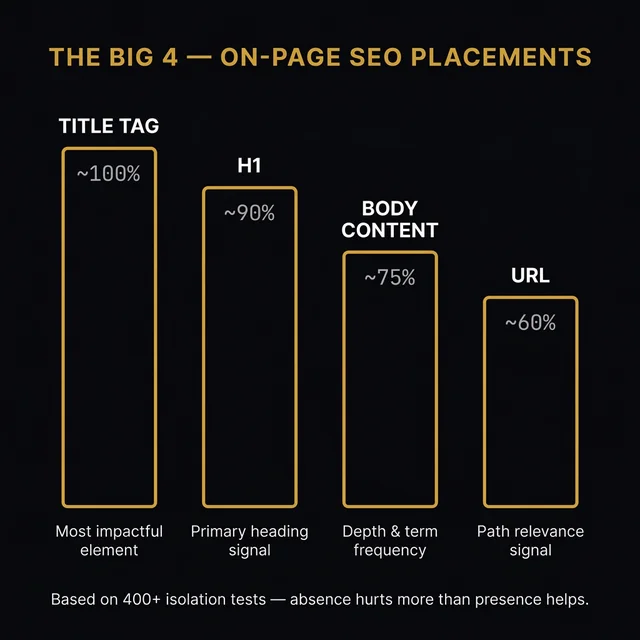
- The "Big 4" — Title, H1, Body, URL (400+ controlled tests)
- Absence > presence — missing hurts more than over-optimizing
- Edge analysis — beat your specific SERP competitors
The Complete On-Page SEO Checklist (10 Ranking Factors)
1. Title Tag Optimization for On-Page SEO
Title tag optimization is consistently the most impactful on-page SEO element in controlled testing. Google's internal title evaluation system, called Goldmine (Google's title scoring algorithm), uses over 40 factors and considers 8 candidate title sources before deciding what to display in search results.
Best practices for titles that rank:
- Keep it under 60 characters to avoid truncation in search results
- Place your primary keyword within the first 3 words — front-loading keywords correlates with higher rankings
- Make it accurate and compelling — Goldmine measures a
readabilityScoreand flags bad titles with anisBadTitleboolean - Ensure title terms appear in your body content — Google tracks
percentBodyTitleTokensCovered - Use proper site name markup —
siteNameMarkupFactoraffects title scoring - Write unique titles for every page
Google doesn't just look at your <title> tag. Goldmine pulls candidates from your H1,
internal anchor text, external anchor text, and even visually prominent text detected during rendering.
Each candidate gets scored on pageScore, trustFactor,
readabilityScore, and salientTermFactor. Google even A/B tests title variants,
storing a baseRank and testRank to measure which version performs better.
Write your title for the person who will read it. Make it specific, accurate, and under 60 characters — front-loading your primary keyword helps, but clarity matters more. Google's Goldmine system checks whether your title reflects what the page actually delivers. If it doesn't, Google will rewrite it.
2. Meta Description Optimization and Click-Through Rate
Meta description optimization is not a direct on-page SEO ranking factor, but meta descriptions heavily influence click-through rate—which feeds into ranking through Google's NavBoost click signal system. An Ahrefs study of millions of pages found that Google rewrites meta descriptions approximately 63% of the time, but a well-written meta description can still win.
- 120-160 characters — long enough to be informative, short enough to avoid truncation
- Include a clear value proposition
- Include a call to action — "Learn how," "Discover," or "See the complete guide"
- Match search intent
Write your meta description as a sales pitch for your page. Even though Google rewrites it most of the time, when yours does show, it's your 160-character ad. Treat it like one.
3. Heading Structure and Passage Ranking (H1–H6)
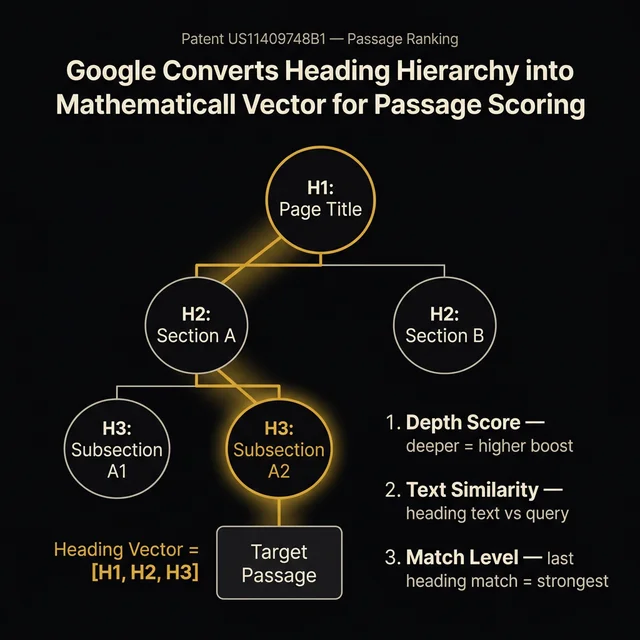
Heading structure optimization isn't just for readability—it's a core on-page SEO signal. Google's Passage Ranking Patent US11409748B1 describes a system that converts your H1→H2→H3 heading hierarchy into a mathematical vector that's matched against query intent. See the original patent on Google Patents.
- One H1 per page — Google explicitly recommends this
- Include keyword variations in H2/H3 headings — multiple ranking correlation studies show a consistent positive relationship between keyword-optimized headings and higher positions
- Structure headings as a logical hierarchy — Google vectorizes the H1→H2→H3 path
- Use tables and lists under headings — different featured snippet scoring criteria apply
Your headings are not decorative—they're coordinates. Google reads your H1→H2→H3 path like a map. If someone searches "how to optimize title tags" and your H2 is "Title Tag Optimization" under an H1 about on-page SEO, that heading vector matches the query. Make every heading a clear, specific signpost for what follows.
4. URL Structure and Keyword Placement
- Keep URLs short and descriptive —
/on-page-seo-guide/beats/blog/post/12345/ - Include your primary keyword
- Use hyphens, not underscores
- Avoid unnecessary parameters
5. Content Quality: Google's Five Quality Scoring Systems
Content quality is the most complex on-page SEO factor. Google's API reveals five distinct quality scoring systems that evaluate whether your content deserves to rank:
| Model | What It Measures | Key Insight |
|---|---|---|
| Chard | Content quality baseline | Operates at both site and page level |
| Tofu | Parallel quality predictor | Separate architecture for ensemble agreement |
| Keto | Versioned quality predictor | Appears to be actively evolving — likely Google's most recent quality model |
| Rhubarb | Page vs. site quality delta | Good pages can escape mediocre sites |
| contentEffort | LLM-based effort estimation | Appears to use LLM-based effort estimation |
A positive Rhubarb score means your page is better than your site average—it can escape a mediocre site's quality ceiling. A negative score means even a strong site can't save a thin page. This is how Google lets individual standout content rise above a domain's average quality. Rhubarb measures whether your page exceeds your own site's baseline — it doesn't override the competitive weight of domain authority, link equity, or brand signals in contested SERPs.
📖 Deep dive: How Google Scores Your Content: The Five Quality Models Behind Every Ranking
How to create content that scores well:
- Include original data, examples, and case studies
- Add comparison tables and structured summaries
- Cite authoritative sources
- Provide unique information gain — content that adds something no competitor has
- Show first-hand experience — the "Experience" in E-E-A-T likely corresponds to the
contentEffortsignal
6. Entity Optimization: How Google Understands What Your Page Is About
Entity optimization bridges two systems. The first — visible in Google's API documentation — measures how well your page communicates its topic. The second — described in a patent — scores entities inside the Knowledge Graph itself. Both matter for on-page SEO, but they work at different levels.
Document-Level Entity Signals (API)
Google's API documentation reveals three scores that measure how well your page establishes its entities:
| Score | What It Measures | Example |
|---|---|---|
| Confidence [0-1] | Is this entity actually mentioned? Weighted: Title > H1 > Anchor > Body | "RSS" in footer = 0.95 confidence, 0.02 topicality |
| Topicality [0-∞) | Is this entity the document's topic? | "iPhone" on Apple page = 0.85 |
| Connectedness [0-1] | How linked to other entities on the page? | Coherent content = high connectedness |
normalizedTopicality sums to 1 across ALL entities on a page. This creates a fixed "entity
budget" — every entity competes for share. Having too many unrelated entities dilutes your primary
entity's topicality score. Fewer, focused entities > many scattered ones.
Knowledge Graph Entity Scoring (Patent)
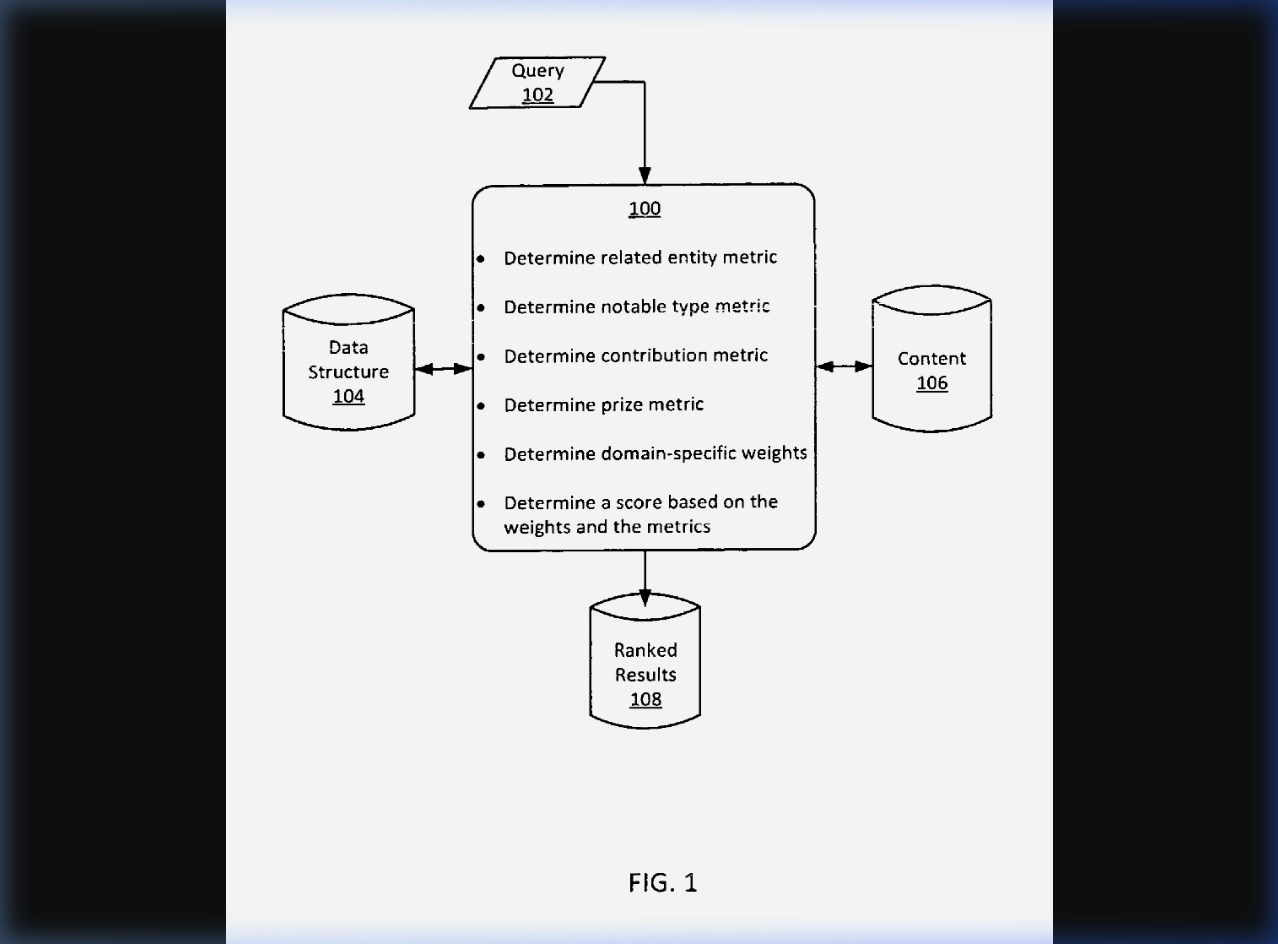
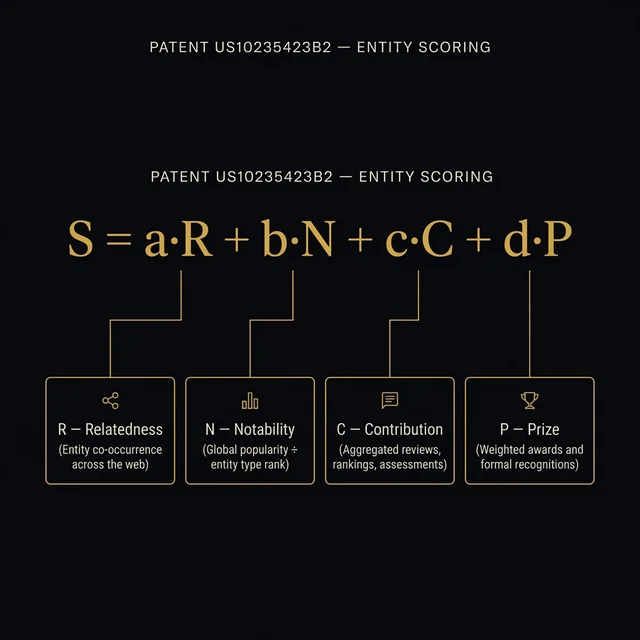
Separately, Google's Entity Scoring Patent US10235423B2 (view original patent) describes how entities are ranked inside the Knowledge Graph — the system behind info panels, "People Also Ask" boxes, and entity-enriched SERP features:
S = a·R + b·N + c·C + d·P
R = Relatedness · N = Notability · C = Contribution · P = Prize
Weights (a, b, c, d) are domain-specific
Note: This patent was filed in 2016. Google's modern ranking systems are neural and probabilistic — the formula above describes the design architecture, not necessarily the current production implementation.
Wait. Let me translate that to human.
▸ Try the Entity Scoring Simulator
50.0
Prioritizing relatedness and global notability.
S = (0.40 × 50) + (0.40 × 50) + (0.15 × 50) + (0.05 × 50)
The patent describes how Google scores entities within the Knowledge Graph — determining whether "Brad Pitt" is notable enough for an info panel. The API signals (confidence, topicality, connectedness) describe how Google measures your page's relationship to those entities. When your page clearly establishes entities that score well in the Knowledge Graph, you benefit from that association — your document inherits topical authority from the entities it correctly covers.
Think of your page as having a fixed "attention budget" for topics. Every concept you mention takes a slice. If you write about on-page SEO but also talk about social media, email marketing, and paid ads, you're splitting your budget four ways. Stay focused — fewer, deeper topics beat broad, shallow coverage. And when you do cover entities, cover them well enough that Google recognizes the connection to its Knowledge Graph.
7. Strategic Keyword Placement and Term Frequency Analysis
Keyword placement in on-page SEO goes far beyond counting occurrences. Google's API documentation describes 15 separate attributes per term in
SignalTermData (Google's term analysis system):
| Attribute | What It Does |
|---|---|
observedTf | Your ACTUAL term frequency on the page |
expectedTf | What Google EXPECTS for this IDF score |
correctedTf | Adjusted frequency after correction |
virtualTf | Synthetic TF combining all signal sources |
salience | Overall importance weight [0-1] |
centrality | How central the term is to the document [0-1] |
observedTf ≫ expectedTf  → KEYWORD STUFFING detected
observedTf ≪ expectedTf  → INCOMPLETE COVERAGE
observedTf ≈ expectedTf  → Natural frequency — optimal
Google analyzes three separate channels independently: body text (what you write), anchor text (what others call your page), and click queries (what searches bring users). A page can rank for terms it never mentions—if anchors and clicks confirm relevance.
Google knows what "normal" looks like for every keyword. Use a term too much and you'll be flagged for stuffing. Use it too little and you'll look incomplete. The sweet spot is natural writing—mention your target keyword and its variations where they make sense for the reader, not where you think an algorithm wants them.
8. Internal Linking for On-Page SEO
Internal linking is one of the most powerful on-page SEO signals—and one you have complete control over. Internal links distribute topical authority across your site and help Google understand the relationship between your pages.
- Link from high-authority pages to new content — new pages inherit domain-level click quality through NavBoost
- Use descriptive, topically relevant anchor text
- Create virtual silos — internal linking passes relevance without external backlinks
- Ensure contextual placement — in-paragraph links carry more weight than nav links
- Audit for orphan pages — pages with no internal links struggle to rank
When you publish a new page, link to it from your strongest existing pages. This is the simplest, most underutilized tactic in SEO. A new article linked from a page that already gets clicks inherits that page's reputation. Think of internal links as votes of confidence from your own site.
9. Image Optimization and Google's NIMA Pipeline
Image optimization is an often-overlooked on-page SEO factor. Google runs a sophisticated image quality pipeline called NIMA (Neural Image Assessment, Google's image scoring system) that evaluates every image on your page across technical and aesthetic dimensions.
- Write descriptive alt text with relevant keywords — alt text is one of the strongest signals Google uses to understand image content and context
- Use descriptive file names —
entity-scoring-formula.webpbeatsIMG_4523.jpg - Compress images for page speed — unoptimized images are the #1 cause of slow LCP scores
- Use next-gen formats (WebP, AVIF) — 30-50% smaller file sizes at equivalent quality
- Add
ImageObjectstructured data — helps Google understand image licensing, creator, and caption - Make images informational, not decorative — Google's pipeline distinguishes between images that carry information (diagrams, charts, screenshots) and generic stock photos. Informational images get an
isIndexableflag - Include captions — text immediately adjacent to images provides strong contextual signals for what the image depicts
Use original, informational images—diagrams, charts, screenshots, annotated examples. Generic stock photos add nothing to your SEO. Name your image files descriptively, write alt text that actually describes what's in the image, and compress everything. A single unoptimized hero image can tank your Core Web Vitals.
10. External Links to Authoritative Sources for E-E-A-T
- Link to authoritative primary sources — official documentation, research, government data
- Use descriptive anchor text
- Check for broken outbound links regularly
- Ensure relevance — every outbound link should add reader value
Advanced On-Page SEO Tactics
Core Web Vitals: Page Speed as an On-Page SEO Factor
Core Web Vitals contribute to on-page SEO rankings — likely through their effect on user engagement signals. Slow pages increase badClicks (pogo-sticking) in Google's NavBoost system, which feeds a
navDemotion score from 0–1023.
Schema Markup and Structured Data for On-Page SEO
- Article —
datePublished,dateModified,author,publisher - FAQPage — questions and answers for rich results
- HowTo — step-by-step instructions
- BreadcrumbList — navigation hierarchy
Optimizing On-Page Content for AI Overviews and LLM Citation
- Direct, concise definitions near the top (40-60 words)
- Well-labeled headings matching natural language questions
- Comparison tables and structured data AI can extract
- Factual claims with sources — AI prefers citable content
- FAQ sections with self-contained answers (optimal for AIO extraction)
NavBoost: Google's Click Signal System and On-Page SEO
NavBoost (internally codenamed CRAPS, Google's click-based ranking system) is documented in Google's NavBoost Patent US8661029B1 and explored in depth in How NavBoost Really Works—one of the most powerful ranking signals in modern search. Understanding how NavBoost works is critical to on-page SEO because the quality of your on-page content directly determines whether users click, stay, and stop searching.
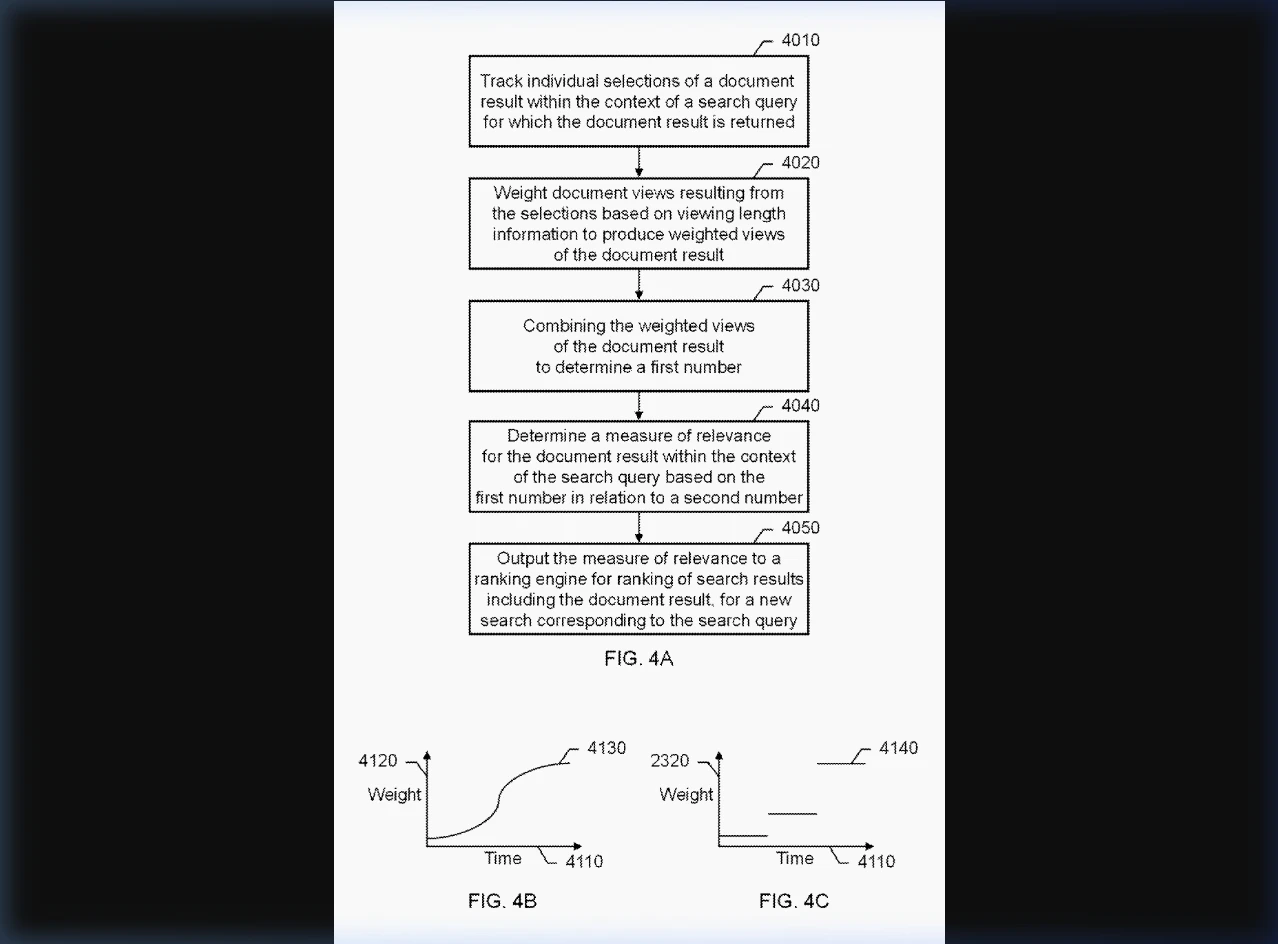
Wait. Let me translate that to human.
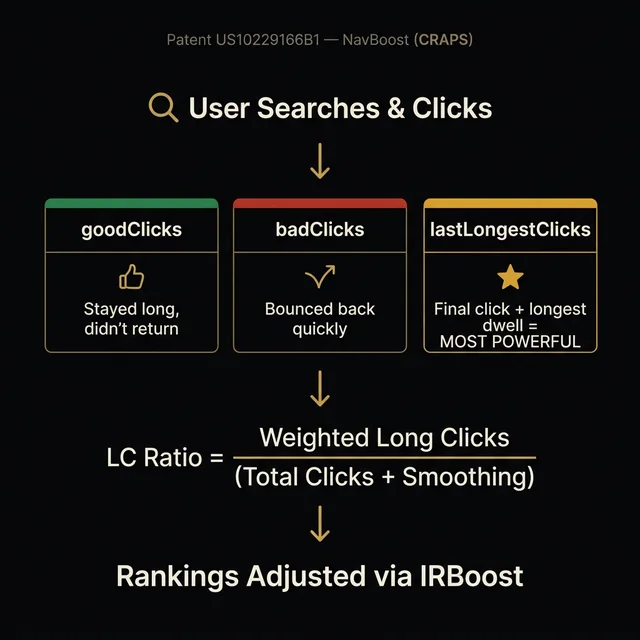
| Signal | What It Measures | Goal |
|---|---|---|
goodClicks | User clicked, stayed long, didn't return | Higher = better |
badClicks | User clicked, bounced back quickly | Lower = better |
lastLongestClicks | User's FINAL click AND longest dwell — most powerful | Higher = better |
Create content that makes users stop searching. The lastLongestClicks
signal—the result that was the user's final click AND where they spent the longest time—is among the strongest behavioral signals in Google's ranking system. NavBoost stores click data at three levels: URL,
host, and domain. New pages inherit their domain's aggregated click reputation.
Google Panda: The Content Quality Firewall Behind On-Page SEO
Google Panda isn't one filter—the API reveals three quality system variants, and together they form the content quality firewall that every on-page SEO optimization must survive:
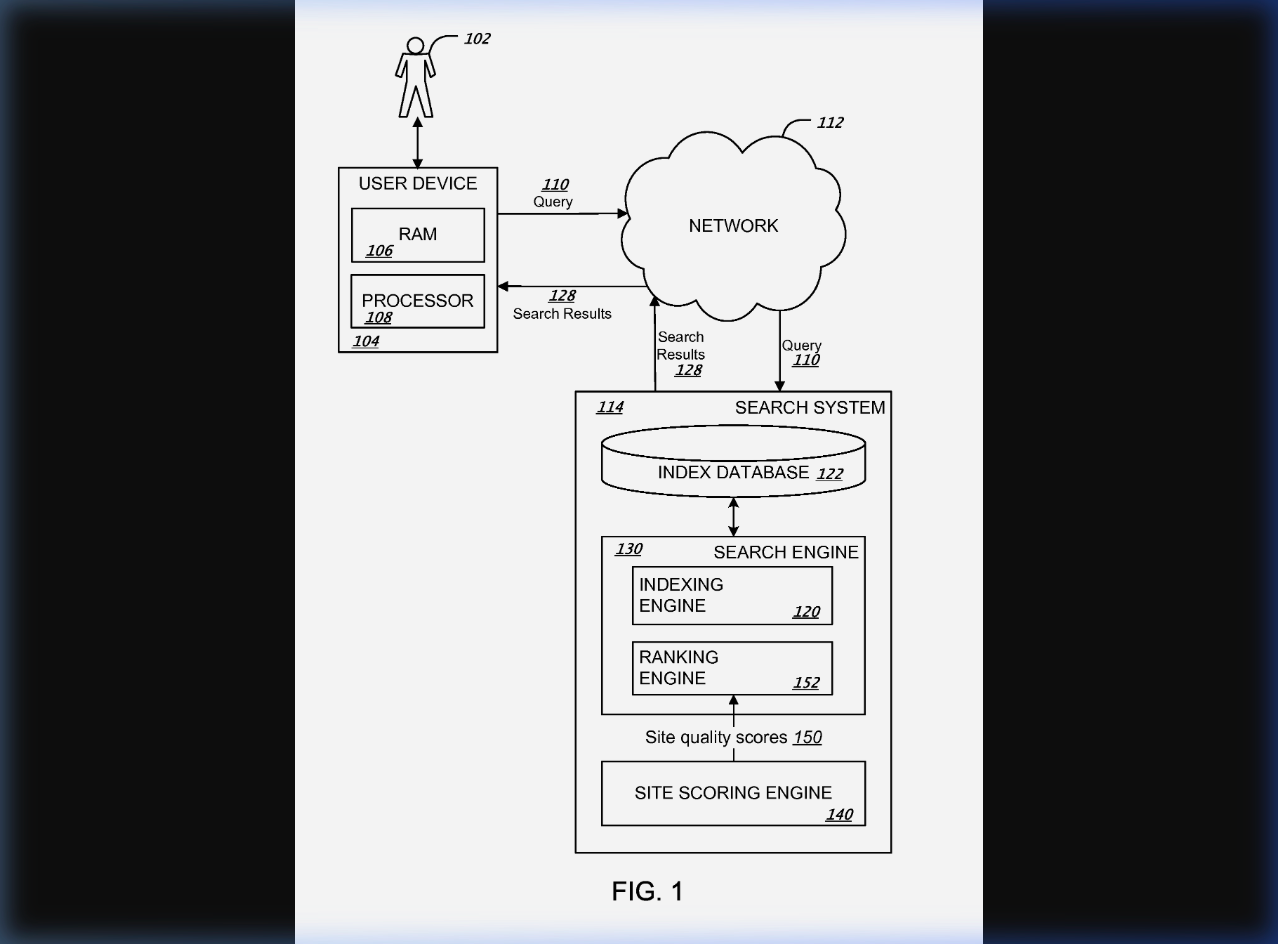
Wait. Let me translate that to human.
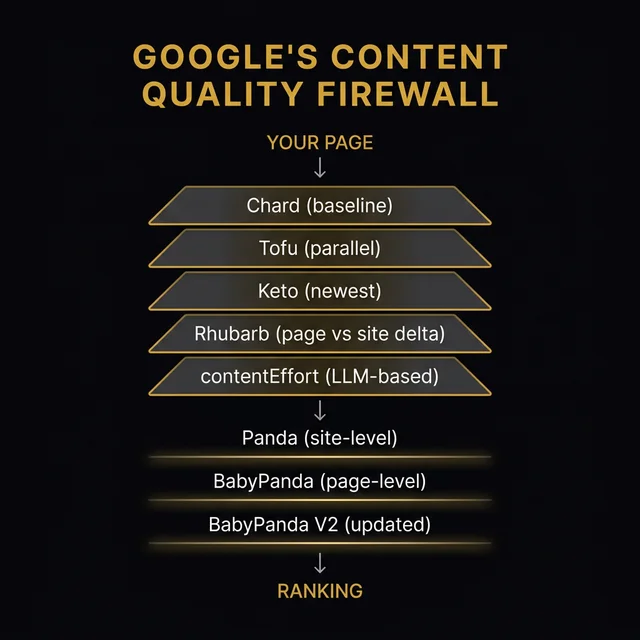
| Variant | Scope | What It Checks |
|---|---|---|
| Panda | Site-level | Thin content across the entire site |
| BabyPanda | Page-level | Individual page quality, runs more frequently |
| BabyPanda V2 | Page-level | Updated detection model |
Each produces a demotion score from 0 to 1023. They're not binary pass/fail—they're granular multipliers. Key
inputs include contentEffort, page2vecLq (neural similarity to known low-quality
pages), clutterScore, spambrainLavcScore, and racterScores
(AI-generated content fingerprints).
📖 Full analysis: The Five Quality Models Behind Every Ranking · The Panda Patent (US9767157B2)
How to survive all three Pandas:
- Invest in content depth —
contentEffortappears to evaluate authoring effort - Remove thin and cluttered pages — they drag down site-level
pandaDemotion - Diversify traffic sources — the patent's quality formula M = IL/RQ compares linking domains against query diversity (Panda patent analysis)
- Avoid template content at scale —
page2vecLqdetects similarity to known low-quality pages - Build brand awareness — raises the site quality formula's S value
E-E-A-T and Human Quality Raters: What Google Actually Evaluates
E-E-A-T (Experience, Expertise, Authoritativeness, Trustworthiness) isn't a vague on-page SEO guideline — it corresponds to specific signals visible in Google's API documentation. Google's Search Quality Evaluator Guidelines define the E-E-A-T framework for human raters, and the API leak reveals field names that appear to correspond to each dimension:
These mappings are our best interpretation of API field names and their positions in the data structure. Google has not confirmed these correspondences.
| Dimension | Technical Signal | How It's Measured |
|---|---|---|
| Experience | contentEffort | LLM evaluates first-hand knowledge, original examples |
| Expertise | isAuthor + relevanceScore | Author detection, topic relevance, entity coherence |
| Authoritativeness | isPublisher + normalizedTopicality | Publisher detection, topical focus, site authority |
| Trustworthiness | nsr + scamness + spambrainLavcScore | Site quality, scam detection, auto-content detection |
E-E-A-T Signals Explorer
Data derived from Google Search Quality Rater Guidelines and API documentation
How to Measure On-Page SEO Success
| Metric | Tool | What to Look For |
|---|---|---|
| Organic traffic | GSC, Ahrefs | Rising impressions and clicks |
| Keyword rankings | Ahrefs Rank Tracker | Movement into Top 10 |
| Click-through rate | Google Search Console | CTR above position average |
| Core Web Vitals | PageSpeed Insights | All metrics in "Good" |
| Engagement | Google Analytics | Time on page, scroll depth |
| AI citations | Brand Radar | Content cited in AI Overviews |
On-Page SEO in Practice: Nature vs. Flavor
Everything above covers the science of on-page SEO — the engineering, if you will. Here's the practitioner's manual for on-page optimization.
The Five Most Important On-Page SEO Actions
- Write a title tag that's accurate, compelling, and front-loads your keyword. Google's Goldmine system will rewrite your title if it's bad. Give it a good one so it doesn't have to.
- Structure your content with clear, specific headings. Google converts your heading hierarchy into a mathematical vector. Make sure each heading accurately describes what follows — think of them as signposts, not decoration.
- Stay focused on fewer topics and cover them deeply. Your entities share a fixed budget. Every unrelated tangent dilutes your primary topic's signal. Go deep, not wide.
- Create content that makes people stop searching.
NavBoost's most powerful signal —
lastLongestClicks— fires when a user clicks your page, stays a long time, and never goes back to the search results. Be the last click. - Link your new content from your best existing pages. Internal linking is the most underused lever in SEO. New pages inherit reputation from the pages that link to them.
Overrated On-Page SEO Factors
- Exact keyword density — Google tracks expected frequency, not a magic percentage. Write naturally and you'll be fine.
- Meta description wording — Google rewrites ~63% of them. Write a good one, but don't agonize over it.
- Word count — There's no ideal length. Depth matters, padding doesn't. Google's
contentEffortevaluates whether you put in genuine work, not whether you hit 2,000 words.
Underrated On-Page SEO Factors
- Entity coherence — keeping your content tightly focused on related concepts. Every off-topic mention steals entity budget from your primary topic.
- Original images and diagrams — Google's NIMA pipeline distinguishes informational images from stock photos. Custom visuals signal effort and originality.
- Citing your sources — linking to authoritative primary sources (patents, official docs, studies) strengthens trust signals. Google tracks outbound link quality, not just inbound.
- The Rhubarb escape hatch — your page can outperform your site's average quality score. If you're on a lower-authority domain, an excellent page has a better chance of competing — though domain authority and link equity still weigh heavily in competitive SERPs. Focus your effort where it compounds.
On-page SEO in 2026 isn't about tricks — it's about being genuinely useful, comprehensively focused, and clearly structured. Google's quality systems are sophisticated enough to measure whether you put in real work. The good news for on-page SEO practitioners is: if you did, they'll reward it. The primary sources are linked throughout.
On-Page SEO FAQ
What is the difference between on-page SEO and off-page SEO?
On-page SEO covers everything you do on your own web pages—content, HTML elements, internal linking, entity optimization. Off-page SEO covers external signals like backlinks, brand mentions, and digital PR. You control on-page fully; off-page depends on third parties.
What is the difference between on-page SEO and technical SEO?
On-page SEO optimizes individual page content and HTML for relevance and quality. Technical SEO ensures the entire site is crawlable, indexable, and fast (sitemaps, robots.txt, canonical tags, Core Web Vitals). On-page asks "is this page good?" while technical asks "can Google find and process it?"
How often should I update on-page SEO?
Review important pages every 3-6 months. Google's freshness systems track updates, and
contentEffort evaluates the current state. Outdated stats, broken links, and stale examples
degrade quality signals.
Does on-page SEO work for AI search engines too?
Yes. AI systems like ChatGPT, Perplexity, and Google AI Overviews prefer pages with clear definitions, structured data, well-labeled headings, and sourced claims. The structural qualities that help Google understand your content also help LLMs extract and cite it.
What are the most important on-page SEO factors?
Based on 400+ controlled isolation tests (Kyle Roof's patented testing methodology) and API leak data, the "Big 4" are: (1) Title Tag, (2) H1 heading, (3) Body content, and (4) URL. Beyond these, entity optimization, internal linking, content quality (five simultaneous quality models), and user engagement (NavBoost) all contribute significantly.
Can I do on-page SEO without tools?
You can do basic on-page SEO manually: titles, keywords, headings, internal links. But to match Google's
expectedTf values, analyze competitor entities, or identify specific SERP weaknesses, tools
like Ahrefs, Semrush, or Surfer SEO help significantly.