The Low Quality Site Classifier
In 2012, three Google engineers filed a patent for a system that never once reads your content. Not a word of it. It reads the pages that link to you, sorts them into quality tiers, and — if too many of them are junk — classifies your entire site as low quality and quietly turns your rankings down. The whole machine pivots on a single number it calls a "resource quality score." And here's the thing: the patent flatly refuses to tell you what that number is. Which leaves the one line I keep coming back to — Google can demote your entire site based on the quality of the pages linking to you, judged by a definition of "quality" it won't share, but one we can piece together.
This is the site-level companion to the page-level story I told in the five quality models: those score your content, this one scores your neighborhood.
The Honest Hedge
Every analysis has a threshold where certainty ends and inference begins. Here's where that line falls for this patent:
- The patent operates at the site level, not the page level — the classification and demotion apply to the whole site.
- It buckets linking pages into quality groups the patent names vital, good, and bad, then computes a weighted ratio and compares it to a threshold.
- It gives example weights (w = 5, 10, 15, 20) and example thresholds (0.05, 0.10, 0.15, 0.20).
- Before scoring, it runs four filters: boilerplate removal, same-domain deduplication, same-content-context deduplication, and logarithmic group capping.
- It states plainly that the system "receives resource quality scores from the search engine" — it does not compute or define them.
- Assignee Google LLC; inventors Rajan Patel, Zhihuan Qiu, Chung Tin Kwok; granted 2015; maintenance fees paid through year 8; active.
- The undefined "resource quality score" is a strong candidate for
nsr(Normalized Site Rank) — a per-page quality score that, in the 2024 API leak, lives in the same module as Google's content-quality models. - The vital/good/bad groups appear to correspond to the leak's
sourceTypetiers (HIGH_QUALITY / MEDIUM_QUALITY / LOW_QUALITY) — an analogue, not a proven lineage. - This classifier is likely one building block of what Google now calls SpamBrain, not a standalone system.
- The same "measure of quality for a resource" concept appears in US9558233B1 (same inventor, Chung Tin Kwok) — the two are conceptually lineal, though they do not cite each other.
- What Google actually plugs into the "resource quality score" slot — content, behavior, PageRank, or a blend.
- The production weight and threshold values, or whether the explicit formula still runs in its 2012 form.
- Whether the standalone classifier survives at all, or has been absorbed as a feature inside a neural spam model.
- Whether the "verification process" the patent mentions before demotion is human, automated, or retired.
Patent Metadata
The filing date matters. June 2012 places this squarely in what I think of as the behavioral-and-brand generation of Google's link work — the same window that produced implied links and the click-validation ideas in US9558233B1. It predates SpamBrain's public existence by roughly a decade, which is exactly why reading it as a live, standalone system is a mistake I'll come back to.
What This Patent Does (Plain English)
Every ranking system needs a way to spot the sites that don't deserve to rank. This one does it without reading a word of your content — it reads your neighborhood, and specifically the quality distribution of the pages linking to you, not their raw count.
Let me show you what it does, step by step:
- Identify every page (the patent calls each one a "resource") that links to your site.
- Filter — discard links that appear only in boilerplate, collapse multiple links from the same domain to one, collapse links sharing the same content context, and cap large groups of near-identical sources.
- Receive a "resource quality score" for each surviving linking page — from elsewhere in the search engine.
- Bucket each page into a quality group: vital, good, or bad.
- Compute a single site-level link quality score from that distribution.
- Classify and demote — if the score falls below a threshold, the site is labeled low quality and its ranking scores are reduced.
Let me translate that to human.
↓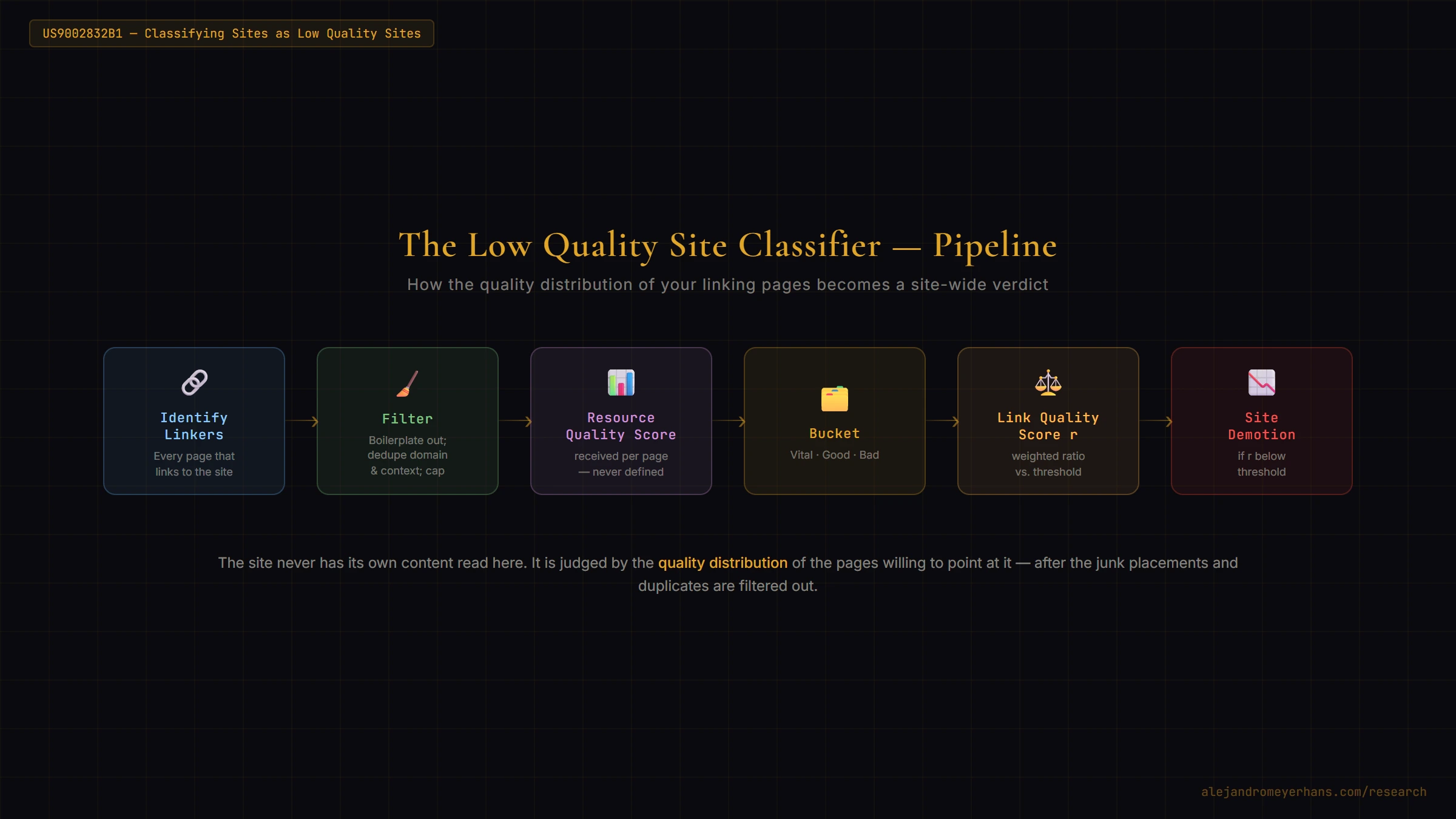
Imagine Google grades every page on the web from "vital" to "bad." This patent lines up all the pages pointing at your site, throws out the junk placements and the duplicates, tallies how many fall into each grade, and asks one question: is a big enough share of your link neighborhood non-garbage? If not, the whole site takes a hit — not just one page.
The Formula: A Weighted Ratio, Not a Backlink Count
Most people treat links like coins in a jar — collect enough and you win. This patent treats them as a ratio. For the canonical three-bucket embodiment, it hands you an explicit formula:
This is not an average and it's not a tally. It's "what fraction of your link weight is not bad," with vital links counted several times over. Because w multiplies vital pages in both the top and bottom of the fraction, the score stays between 0 and 1 — and a single vital link can offset a stack of bad ones. Start from nothing and add one vital link (w = 10) against ten bad ones: r = 10 / 20 = 0.5, comfortably clear of any threshold. One good link, ten bad: r = 1 / 11 ≈ 0.09, right in the danger zone.
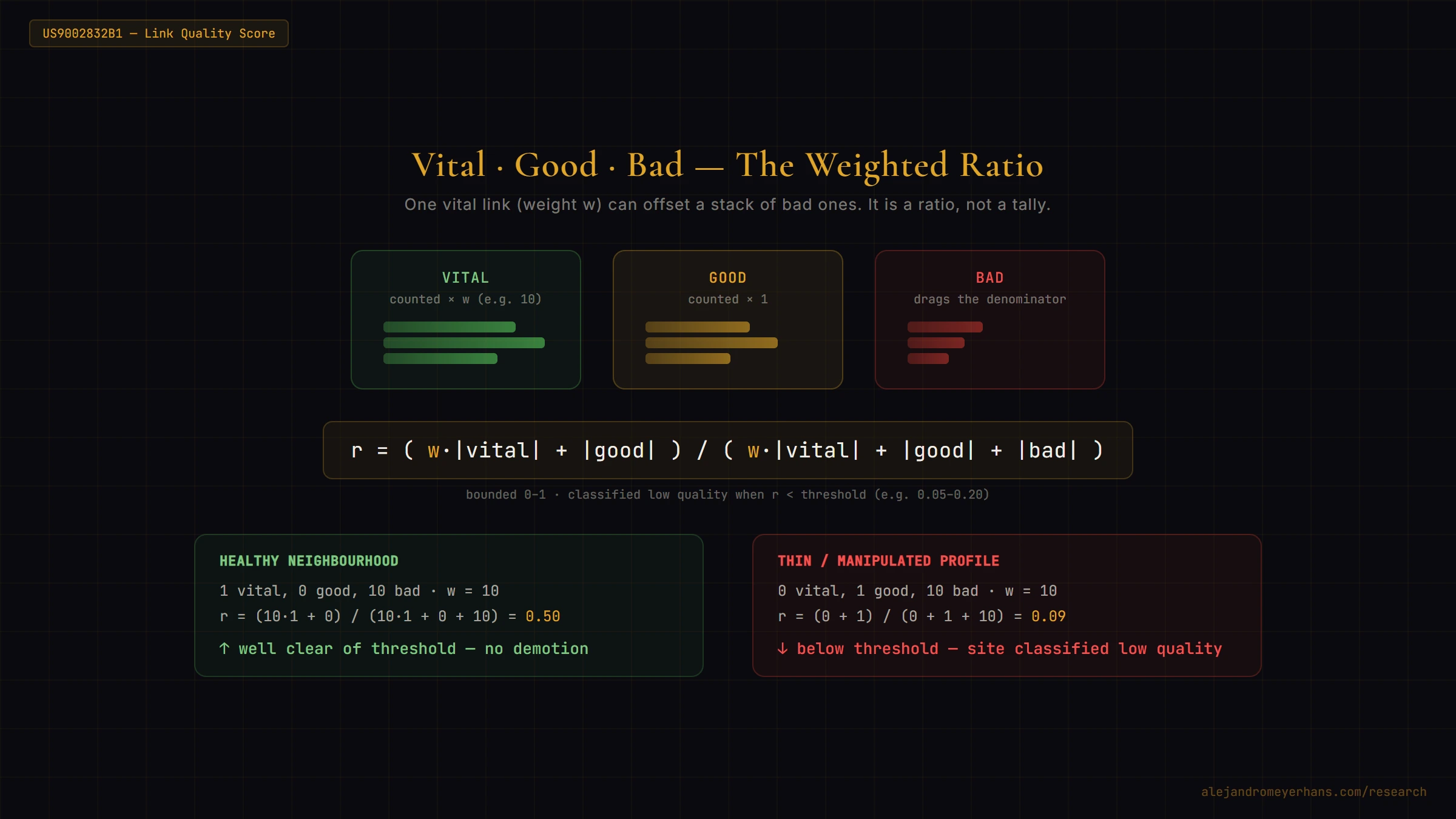
A drafting note worth flagging for the record: the broad language of claim 1 divides the weighted sum by "a total number of resources" (which could exceed 1), while the dependent claims and the worked example use the weighted denominator above (which is bounded to 0–1). For the vital/good/bad example everyone quotes, the weighted, normalized reading is the operative one. It's a small thing, but it's the difference between the demotion math working cleanly and not, so it belongs in an honest analysis.
This patent was filed in 2012. A fixed weight w, three hand-drawn buckets, and a threshold you can write on a napkin are a 2012-era design — the kind of explicit, rules-based formula Google published freely because the real advantage was in the data, not the arithmetic. In 2026, a distribution like this is far more likely to be one learned feature inside a neural spam model than a literal fraction evaluated with w = 10. The shape of the idea — quality distribution of your link neighborhood, weighted toward the top tier — is what persists. The specific formula is very likely not what runs today. Read it as architecture, not as a live equation.
The Four Filters: What Gets Thrown Out Before Scoring
The formula gets the attention, but the filters do the quiet work. All four run before a single page is bucketed — which means they reshape the input the whole score is built on.
| Filter | What it removes | What it means for link building |
|---|---|---|
| Boilerplate removal | Links appearing only in navigation, footers, sidebars, sitewide templates | Footer and sitewide links can be removed from the input entirely — not merely discounted |
| Same-domain dedup | All but the single highest-quality linking page from one domain (also via shared IP / co-link patterns) | 100 links from one domain can reduce to one signal for this classifier |
| Same-content-context dedup | Linking pages that share the same content context — the same article syndicated, the same press release, the same embed | An 80-domain syndication push can collapse toward a single signal |
| Logarithmic group capping | Large groups of similar sources, kept only at N/2, N/4, log₂N, or √N | Even surviving similar links face diminishing returns by design |
Before Google asks "how good is your link neighborhood," it first removes the links you didn't really earn (template placements), then refuses to let any one source — or any one piece of content spread across many sources — count more than once. Domain diversity isn't a best practice here; it's enforced in the arithmetic. And content diversity matters as much as domain diversity: the same article on eighty sites is, to this filter, close to one link.
When I audit a client's profile, this is the part that reframes the conversation fastest. "We built you fifty links" means nothing until you know how many survive the filters and where the survivors land. Fifty syndicated placements of one press release can enter this system as a small handful of signals — and if the host pages are weak, those signals land in the bad bucket, where they pull the ratio down.
The Black Box: The Score Google Won't Define
Here's the sentence the whole patent hangs on. One line, easy to miss: the system receives resource quality scores from the search engine. Receives. It doesn't compute them. It doesn't define them. The single number that decides whether your site lives or dies in this classifier is left deliberately blank.
That blank is not sloppiness — it's how the patent claims the aggregation method (bucket, weight, ratio, threshold, demote) independently of whatever quality signal gets plugged in. And when I went looking for whether "resource quality score" is a fixed, canonical term used elsewhere, I found the opposite: every neighboring patent names this object differently.
| Patent | What it calls the per-page quality number |
|---|---|
| US9002832B1 (this one) | "resource quality score" — received, undefined |
| US9558233B1 | "resource score" — "a measure of quality for the resource…based on the quality of the source resources that link to the resource" |
| US9767157B2 (Panda) | "site quality score" — phrase-model-derived, site-level |
| US10055467B1 (group-based) | "initial score" — a measure of relevance or quality of the resource |
There's no single dictionary entry for "how good is this page" in Google's patents. Each system rolls its own name for it and plugs it in. That tells you these quality measures are modular and interchangeable — which is exactly why this patent leaves the slot empty. It's not hiding one number; it's designed to accept whichever quality signal Google wants to feed it.
So what fills the slot? The strongest single candidate is nsr — Normalized Site Rank — a per-page quality score that, in the 2024 API leak, sits inside the same module (QualityNsrPQData) as Google's five content-quality models. If that's the wiring, then the "quality" of a linking page is driven primarily by its content — which makes content effort a link-building concern, not just an on-page one. A behavioral score of the kind described in US9558233B1 (do people actually click the links on this page?) is a plausible second input. PageRank is a third. Most likely it's a blend, normalized into one number before this classifier ever sees it.
You can't see nsr. So here's the proxy I actually use. For a link insertion on an existing page, the only justification is that the page already has traffic or earns links on its own — that's the fastest read on whether it's a page Google would grade well. If it doesn't, I'd rather publish a new page and hit the on-page fundamentals than borrow a dead one. But note the asymmetry, because it matters: the absence of traffic is not a disqualifier. A well-made new page has no traffic by definition, and US9558233B1 describes Google propagating quality to pages that lack their own audience. Traffic confirms quality; it doesn't define it.
The Living Average: Why Demotions and Recoveries Lag
Early in my career I ran an affiliate site that lost about 45% of its traffic in a week. No manual action ever arrived. I checked seasonality, content, the server — then I looked at the backlink profile and found a large, illegitimate spike in referring domains on Ahrefs. I filed an aggressive disavow, and within 24 hours I had all the traffic back, a little stronger. That kind of clean, next-day recovery was possible up to around 2020. It rarely happens now — and understanding why is the most useful thing in this whole analysis.
Modern Google scores behave like a living average. A data point that jumps from a 3 to a 10 doesn't flip your ranking tomorrow. The system waits — the DOJ trial surfaced reassessment windows on the order of two to three months — and only once a sustained 10 is confirmed does it become your new baseline. In between, your old 3 and your new 10 blend and migrate over time.
Apply that to a disavow and the picture clarifies. Removing links doesn't just move this classifier's ratio — it changes your PageRank, the resource score in US9558233B1, your anchor-text profile, and a handful of other link metrics, each recalculating on its own clock. And during those two to three months, any healthy site is also acquiring new links. So the reason I no longer promise a clean, one-to-one "we disavowed and rankings moved" story isn't that the mechanism stopped working. It's that the feedback window is long enough, and the profile changes underneath you fast enough, that clean attribution is no longer honest.
My own site recovered in a day because exactly one thing was broken and I was on it around the clock. Client sites recover slowly because there's rarely one broken thing. As I tell operators: you do the one thing you obviously have to do — and you might still have another fifty things to do. Until you do all fifty, the site won't recover.
Low Quality Site Classifier SEO Implications: What This Means for Your Rankings
1. Bad links are not neutral — they sit in the denominator
The formula means low-quality links don't "do nothing." They enlarge the bottom of the fraction and pull your ratio toward the threshold. Adding bad links to a thin profile can actively push you under.
2. Audit before you build
Because the denominator is real, cleaning a profile can matter as much as growing it — with the living-average caveat that you'll see the effect over months, not days, and never in perfect isolation.
3. The unit of judgment is the site, not the page
Every result from a site inherits the classification. You can publish the best page on the internet and still watch it underperform if the site's link neighborhood is graded low. "Great content that won't rank" sometimes means "a site that's been pre-demoted."
4. Domain diversity and content diversity are enforced
The filters collapse same-domain and same-content-context links. Syndication and press-release distribution can be net-neutral or worse: deduplicated to a single signal, and if the hosts are weak, a single bad one.
5. Judge linking pages by content quality first
If the black-box score is nsr, and nsr is content-primary, then the pages you build on should be judged the way you'd judge your own — content effort, genuine substance, real editorial life — not by domain metrics in isolation. Traffic is a confirming signal on existing pages, not the definition.
US9558233B1 — "Determining a quality measure for a resource" — the click-validation system that produces exactly the kind of per-page quality score this classifier consumes; shares inventor Chung Tin Kwok.
US10055467B1 — "Ranking search results" — the behavioral, host-level quality-drag mechanism. How bad pages drag down good pages →
Google API Leak Cross-Reference
Now let's line the patent up against what actually leaked. The 2024 Google API leak — first reported by Rand Fishkin and investigated by Mike King at iPullRank — exposes attributes that rhyme with this patent's mechanisms. None is documented as this patent's implementation; treat every row as an analogue, not a lineage.
| Patent Mechanism | API Attribute | Alignment |
|---|---|---|
| Vital / good / bad quality groups | sourceType (HIGH_QUALITY / MEDIUM_QUALITY / LOW_QUALITY) | 🔶 STRONG MATCH |
| Per-page "resource quality score" | nsr (source-page quality) | 🔶 STRONG MATCH |
| Boilerplate removal | fontsize, offset per anchor | 🔶 STRONG MATCH |
| Same-domain deduplication | parallelLinks, outsites, outdegree | ✅ CONFIRMED (infrastructure exists) |
| Same-content-context deduplication | context2 (nearby-terms hash) | 🔶 STRONG MATCH |
| Site-level classification output | siteAuthority | 🔶 STRONG MATCH |
| Ranking demotion | anchorMismatchDemotion, exactMatchDomainDemotion | 📜 PATENT ONLY (related, not specific) |
| Source independence beyond domain/IP | indyrank | 🔶 API EXTENDS |
The API leak provides attribute names and data types — not scoring formulas or wiring. The patent provides the aggregation method — not the source of its input score. Together they suggest a strong, coherent story; neither, alone or combined, demonstrates that any one leaked field is this patent's output. Where I've written "strong match," read "plausible modern analogue."
DOJ Trial Corroboration
The U.S. v. Google antitrust trial didn't name this patent, but it corroborated the architecture it assumes:
- Site-level quality is real: testimony described top-level Quality (Q*) and Popularity (P*) signals, and that "every site gets a quality score." A site-level classifier like this one is consistent with that stack.
- PageRank feeds quality: trial evidence that PageRank feeds Q* supports the idea that multiple link-side signals — not just raw PageRank — contribute to a site-level quality judgment.
- The feedback window: trial material is consistent with the multi-month reassessment cadence that explains why link-profile changes take months, not days, to fully register — the "living average" above.
What the trial did not do is align most cleanly with this patent. The exhibits map more directly onto the query-and-behavior site-quality patents (US9760641B1, US9767157B2) than onto link-distribution classification. That's a point for honesty, not against the patent: it's evidence this is one contributor to site quality, not the spine of it.
Citation Network
Patent Family Chain
Single-family application — no parent or continuation identified on the public record.
Forward Citations (Patents Citing This Patent)
Worth stating plainly, because it corrects a common assumption: the forward-citation record here is not the lineage story. The pages that cite this patent are overwhelmingly outside Google search.
| Patent (assignee) | Relevance |
|---|---|
| CN109829098A (Alibaba Shenma) | Search-result optimization — a competitor independently citing the technique |
| CN113360798B (Baidu) | "Flooding data identification" — competitor spam-detection angle |
| US11605098B1 (Amazon), US11810052B2 (Shopify), US10656987B1 (EMC) | Brand curation, template mapping, generic analysis — unrelated to web search ranking |
The meaningful neighbors are conceptual siblings, not citations — the site-quality cluster below.
Related Articles on This Site
- The Five Quality Models (Chard, Tofu, Keto, Rhubarb, contentEffort) — the content-quality models that most likely feed the
nsrscore this classifier consumes. - US10055467B1 — Group-Based Quality — the behavioral, host-level version of the same "your neighborhood drags you down" idea.
- US9767157B2 — Predicting Site Quality (Panda) — a parallel site-level quality patent, content-model-based.
- US8682892B1 — Implied Links — the brand-proportionality sibling from the same filing window.
- The On-Page SEO Guide — the fundamentals that determine whether a page you build on would grade well in the first place.
Site Quality: What Doesn't Matter as Much as SEOs Think
The nature of this patent is a permanent truth about how search has to work: you are judged, in part, by the company you keep. No system that ranks the whole web can sit down and read every site by hand. So it does what any of us do when we can't check everything ourselves — it looks at who vouches for you, and how good they are. That will be true in some form for as long as links exist.
The flavor — vital, good, bad, a weight of ten, a threshold of 0.1 — was just the 2012 way of writing it down. That flavor has very likely dissolved into a learned model by now. My read: this is one building block of what we now call SpamBrain, not a standalone lever you can pull. Treat it as the mechanism and go chasing its exact formula, and you'll spend your budget optimizing a signal Google stopped computing that way years ago.
Which brings me to the honest frustration underneath all of it. This is the patent hiding behind every "get links from high-quality pages" cliché in the industry — and, exactly like the cliché, it will not tell you what quality means. So the job was never to satisfy a formula. The job is to make every page you're tied to — your own, and the ones you earn links from — a page that would stand on its own two feet. Because you don't get to know which door Google is checking.
Google can demote your entire site based on the quality of the pages linking to you, judged by a definition it won't share. You can't reverse-engineer the definition. You can only refuse to be deniable — from every direction at once.
Frequently Asked Questions
What does patent US9002832B1 actually do?
It classifies an entire site as "low quality" based on the quality distribution of the pages linking to it. It sorts linking pages into vital/good/bad groups, computes a weighted ratio, and if that ratio falls below a threshold, it lowers the ranking scores for results from that site. It never examines the site's own content.
Is this the Penguin algorithm?
There's no evidence it is. It's one of the few Google link-quality patents we can read in detail, and it's best understood as one contributor to site-level quality — likely a building block of the broader spam systems now grouped under SpamBrain — rather than a named, standalone algorithm like Penguin.
What is the "resource quality score" the patent uses?
The patent doesn't say — it states the system "receives" the score from elsewhere in the search engine. The strongest candidate is nsr (Normalized Site Rank), a per-page quality score that appears in the 2024 API leak alongside Google's content-quality models. It may be content-driven, behavior-driven, or a blend.
Do sitewide and footer links count?
The patent describes a boilerplate filter that removes links appearing only in navigation, footers, and sidebars before scoring. For this classifier, those placements may not count at all — not merely count less.
Should I disavow bad links to improve my score?
It can help, because bad links sit in the denominator of the ratio. But don't expect the clean, next-day recoveries of the past. Google's scores now behave like a living average that reassesses over two to three months, and your profile changes during that window, so clean one-to-one attribution is rarely possible.
Does a linking page need traffic to be valuable?
No. Traffic is a useful confirming signal on an existing page, but its absence is not a disqualifier. A well-made new page has no traffic by definition, and US9558233B1 describes Google propagating quality to pages that lack their own audience. Judge linking pages primarily by content quality.
Is this a page-level or site-level system?
Site-level. The classification and the resulting demotion apply to the whole site, so every page can inherit the effect — which is why a strong individual page sometimes can't rank on a site with a weak link neighborhood.