The Click-Validated Quality Patent
In the U.S. v. Google antitrust trial, Google conceded under oath what it had spent years deflecting: it uses click data to rank results. Years before that testimony, its ranking team had already patented a version of the same idea aimed at links — Hyung-Jin Kim, the VP of Search who took the stand, is the lead inventor, alongside ranking engineer Paul Haahr. The mechanism it describes is more structural than "clicks decide which links count." Every page ends up with three different scores — one shaped by who links to it, one by what it links out to, and one by the traffic moving across those links — and each of the three reaches rankings in its own way. The patent stops short of the full formula. But the structure it does lay out is enough to change how you build links.
If you've read my breakdown of the Reasonable Surfer patent, that system predicts which links should get clicked — from font size, position, where they sit on the page. This one works from the other direction: it measures whether links actually get clicked, and uses that to judge whether a linking page can be trusted at all. Predicted clicks and measured clicks — the a-priori guess and the a-posteriori audit.
The Honest Hedge
Every analysis has a threshold where certainty ends and inference begins. Here's where that line falls for this patent:
- The patent gives every page three distinct scores that build on each other: a seed score (the proportionality of clicks to its inbound links, adjusted for how long those clicks dwell), a source score (a function of the seed scores of the pages it links out to), and a resource score (a function of the source scores of the pages linking to it). Claim 7 adjusts ranking on the resource score.
- The seed score is claim-language explicit: a ratio of link selections to linking pages (Claims 3/12/21), quality-adjusted by dwell.
- Those selections are graded by click duration — short / medium / long — inside independent Claim 1, not an optional embodiment.
- A source below the threshold is classified unqualified, and its links are subtracted from the count ranking uses: "discounting the total number of source resources… classified as unqualified" (Claims 8/17/24).
- Anchor text is broken into n-grams that inherit the source's quality score (Claims 9–10); the worked spam example is literally "payday loan."
- The 2024 API leak fields
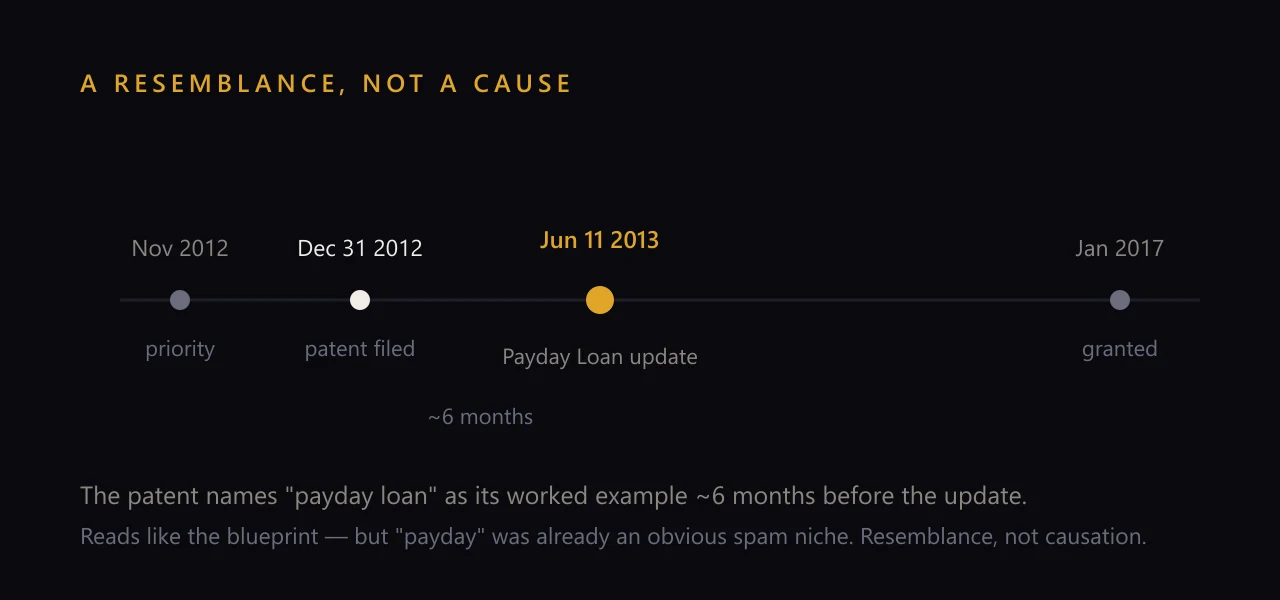
goodClicks,badClicks,lastLongestClicks, and thesourceTypequality tiers are the same kind of machinery this patent needs — classified click quality and per-source quality metadata. They show Google has the constituent parts; they don't prove these fields are this patent's output. - The mechanism resembles the design intent behind the June 2013 Payday Loan update — same per-query, spam-niche shape — but resemblance is not causation (see the aside in the Honest Hedge below).
- Because the scoring is behavioral (clicks, dwell), the principle likely survives even if the discrete arithmetic was long ago replaced by learned models.
- Whether this specific computation — the destination ratio, the seed → source → resource propagation, the subtraction arithmetic — runs in production today, or was replaced by a neural equivalent.
- Whether the click signal is even trustworthy in a privacy-restricted, bot-saturated web — and how much Chrome's data access offsets that.
- No leaked field is documented as this patent's implementation. The lineage is inferred, not stated.
Patent Metadata
Two names on the inventor list matter for how much weight to give this. Hyung-Jin Kim is a Google VP of Search — the witness whose sworn testimony put Google's use of click data on the record. Paul Haahr, another inventor here, is the ranking engineer behind Google's widely-cited 2016 "How Google Works" talk and a co-author of the Reference Contexts patent. This is not a speculative filing from a corner of the org; it's from the people who work on ranking.
What This Patent Does (Plain English)
The patent names the problem in its own opening: "some resources may be linked to by a number of resources that is disproportionate compared to the amount of traffic the resource receives from theses [sic] links." The point hiding in that sentence: when a page collects far more links than the traffic those links actually generate, that gap is itself the manipulation signal the system is built to catch.
Its answer is three scores per page — a seed score, a source score, and a resource score — computed in a chain:
- Measure the destinations — For pages with enough data, compute a seed score: the clicks on the links pointing at that page, divided by the number of pages linking to it, adjusted for click quality.
- Judge the linking pages — Score each source page by the seed scores of the destinations it links to. A page that links to healthy, clicked destinations is a good recommender; a page that links to behaviorally dead ones is not.
- Classify sources — Sources below a threshold are labeled unqualified.
- Propagate to everyone else — Pages that don't have their own click data yet inherit a resource score from the source scores of the pages linking to them.
- Subtract the dead weight — In ranking, the effective count of linking sources is reduced by the number of unqualified ones.
Here's what that looks like in the patent itself. This is FIG. 2A — the three roles any page can play in the link graph:
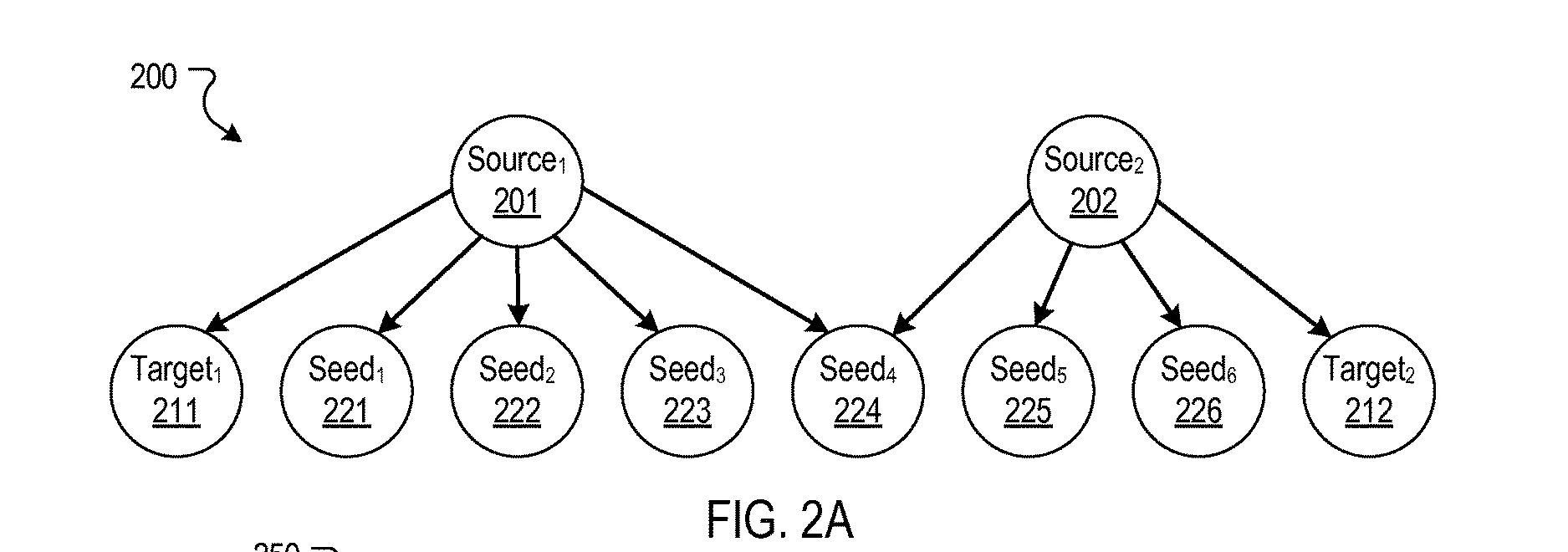
A "resource" is just a web page. A "seed" here does not mean a trusted site (the way it does in some other patents) — it simply means a page Google has enough click-and-link data to measure. A seed's score can be high or low. High means healthy; low means "lots of links, little genuine traffic" — the manipulation signature.
Seed → Source → Resource: The Three Scores on Every Page
Before we touch a single ratio, get this distinction clean — everything downstream depends on it, and it's where the confusion usually starts. Ranking factors don't exist. There are systems. What a page has isn't a "link factor" you switch on. It's three different scores that pass value down a chain — I call it the Vouch Chain — and they don't all help the page that owns them: the score that ranks you is set by other pages, not by you. Your rank is borrowed.
FIG. 2A above showed the three roles a page can play. FIG. 2B shows how the scores are computed — the same seed, source, and target, now with the math flowing through them:
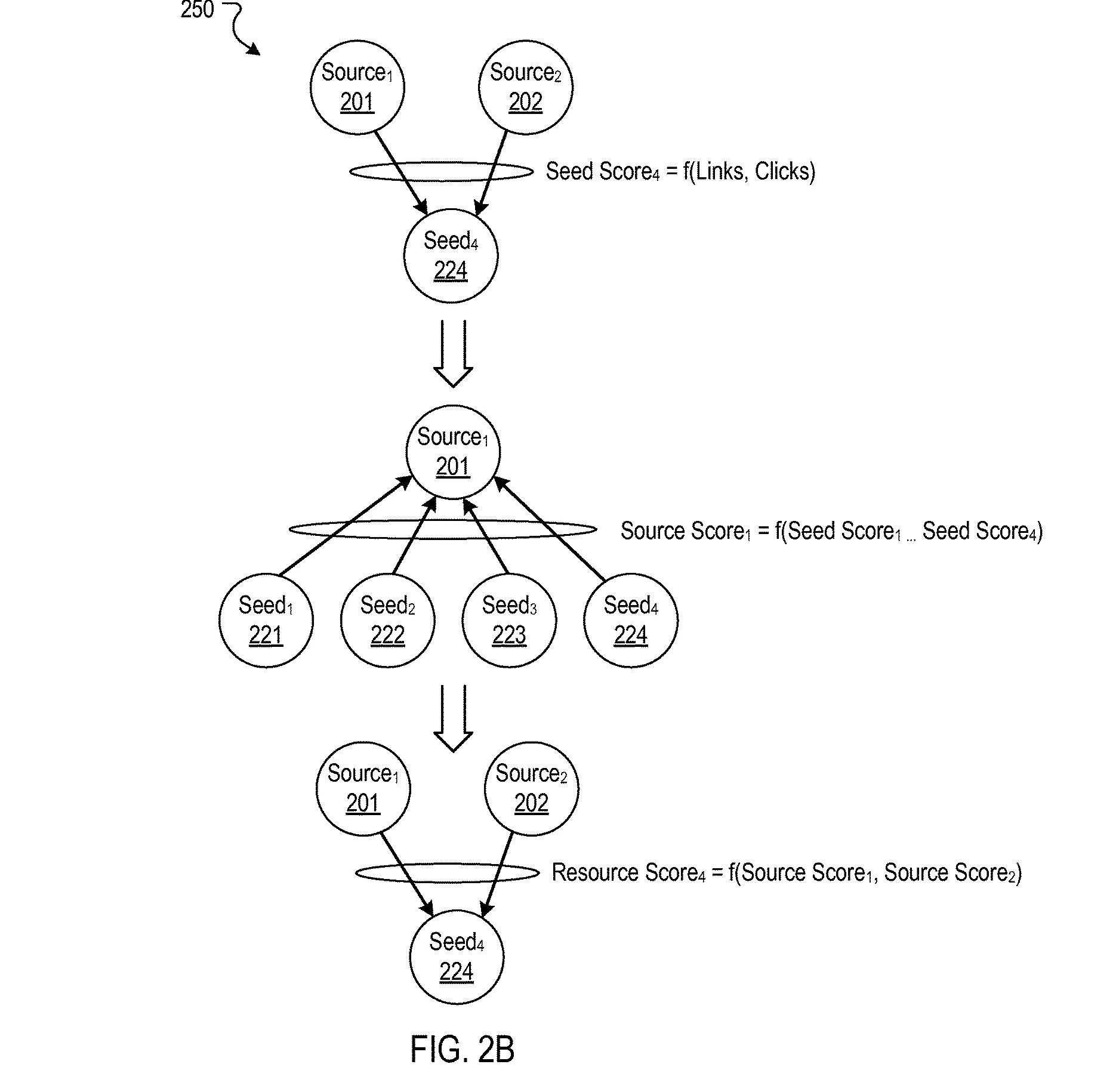
Let me translate that to human.
↓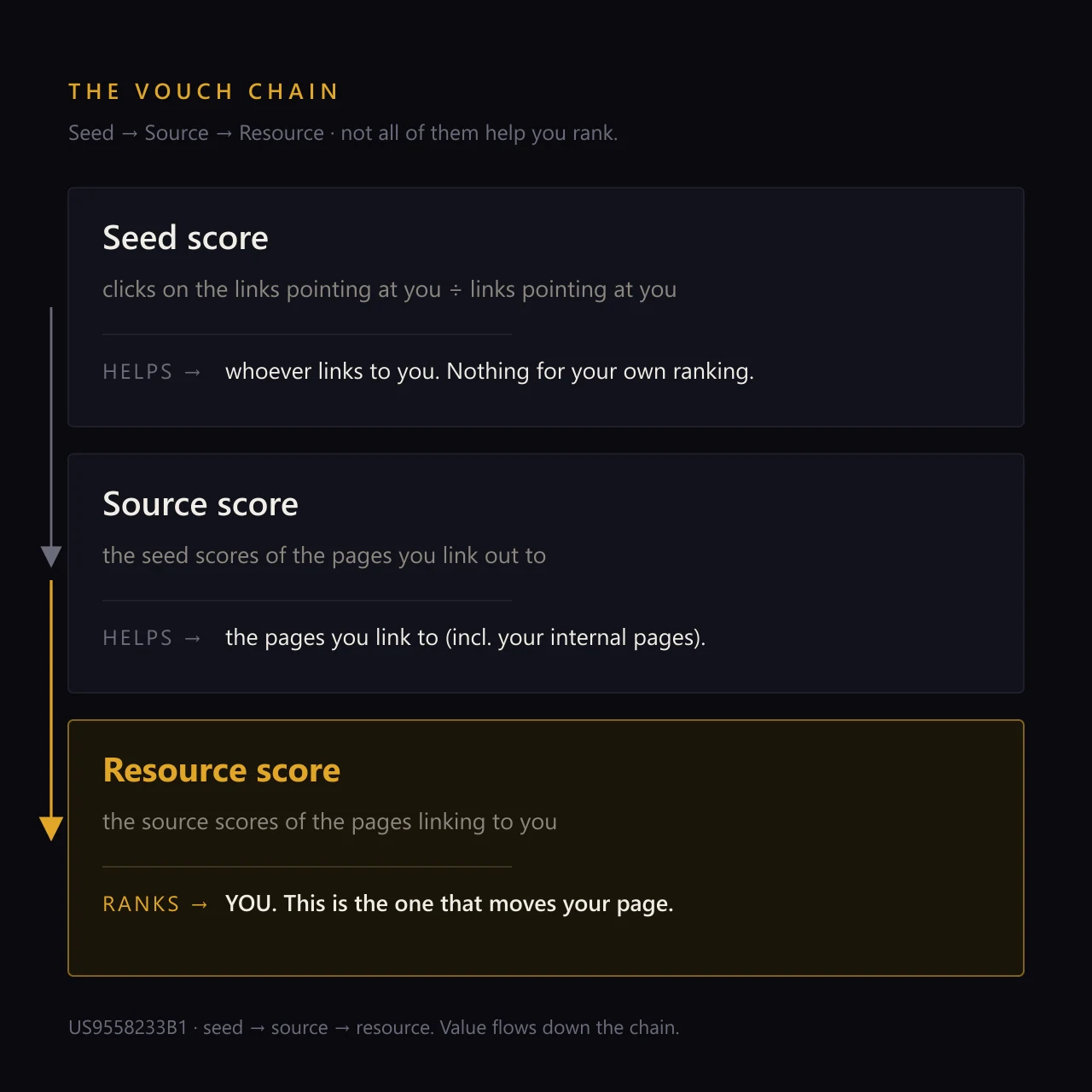
Walk it through in order:
- Your seed score is the proportionality and quality of the clicks your inbound links earn — the ratio we unpack next. It does nothing for your own page's ranking; it's the raw material other pages are judged by.
- Your source score is a function of the seed scores of the pages you link out to. It mostly helps the pages you link to — including your own internal pages.
- Your resource score is a function of the source scores of the pages linking to you. This is the one the patent routes into ranking (Claim 7: adjust ranking "based on the resource score"). This is the one that moves you.
Two things, in this order. One — be linked from genuinely good sources. That's what sets your resource score, and the resource score is the only one that ranks you. Two — link out to genuinely good seeds. That's what creates source quality in the first place: it's what makes your own pages strong sources for the pages they point to, and it's what makes a guest-post page worth having a link on. Whether your page becomes a seed itself is a distant third — a compounding bonus (more seeds in your network means your internal links naturally point to more of them), never the goal. Read carefully, because this is where it gets dangerous: nothing here says "you must get links from pages that send clicks to you." Your ranking rides on the quality of the sources pointing at you, not on your own seed score.
Who you link out to determines the quality of the container you are. Who you recommend determines the quality of the recommender you are. It mimics human trust: recommend a scam and people stop trusting your recommendations; recommend something excellent and your word gains weight. This is why "always put external links on your page" was never a ranking factor — it's the visible surface of the source-score mechanism underneath.
What Sets Your Seed Score
Two inputs set a page's seed score: how often the links pointing at it get clicked, and how good those clicks are. Take the ratio first — the patent puts it in claim language (Claims 3, 12, 21): the seed score is based on "a ratio between the total number of selections of the links to the seed resource and the total number of resources that each include a link to the seed resource."
Read the formula carefully, because the "at the destination" part is what everyone gets wrong. It's measured from the links pointing at a page — any page. This is how a page earns (or fails to earn) a seed score, the first box in the diagram above. And keep the priority straight: the seed score is the secondary one. It doesn't rank the page that holds it — it's the raw material source and resource scores are built from. A "selection" counts only when a real user clicks through; a raw impression doesn't move it. Drop a perfect link into the footer of a busy page and let nobody click it, and it adds nothing to that destination's seed score — the host page's traffic is beside the point; only whether the link itself gets selected.
"Zero clicks ÷ many links" is not a low score — it's the exact arithmetic the system is built to catch. When I audit a stalled link profile, the tell isn't that the links are low quality in the abstract; it's that the container pages hand out links into a void. Real editorial pages refer traffic that moves. Link inventory doesn't.
This patent was filed at the end of 2012. The explicit ratio and hand-tuned thresholds described here were the 2012-era way of doing it — discrete counters, integers divided by integers. In 2026, a signal like this probably lives inside learned models that infer link value from behavior rather than running the division by hand. What the patent gives you is the architecture: measure whether link popularity is corroborated by real navigation. The implementation has very likely moved past the exact formula — but read that as "the machinery evolved," not "the idea was abandoned."
Then the clicks are graded: short, medium, long
That's the ratio. The second input is click quality: the patent doesn't just count clicks — it grades them. Claims 5 and 6 classify each selection by click duration: "a length of time the user making the selection dwelled on the resource after making the selection," sorted into short, medium, and long clicks. A short click (a bounce straight back) counts for little; a long click — someone who arrives and stays — counts for real. The description adds a second quality test: whether the visitor then navigates further on the destination site.
| Click type | What it looks like | Quality contribution |
|---|---|---|
| Short click | Click, then bounce back quickly | Low — reads as accident, bot, or disappointment |
| Medium click | Some engagement, moderate dwell | Moderate |
| Long click + onward navigation | Arrives, stays, clicks deeper into the site | High — the pattern of a real, satisfied human |
"Dwell" is how long you stay after clicking before coming back. The onward-navigation test is the anti-bot heuristic: a bot can fake a click, but faking a click and a long stay and a further click into the site is much harder and more expensive. It legitimizes the traffic as human.
Here's the honest limit, though: the patent describes a heuristic that makes crude automation less useful. It does not lay out the full anti-fraud stack — the identity, browser, and IP defenses — so it would overstate the evidence to say bots categorically can't clear this bar. What we can say is that the design specifically devalues the shallow, bounce-back click that cheap manipulation produces.
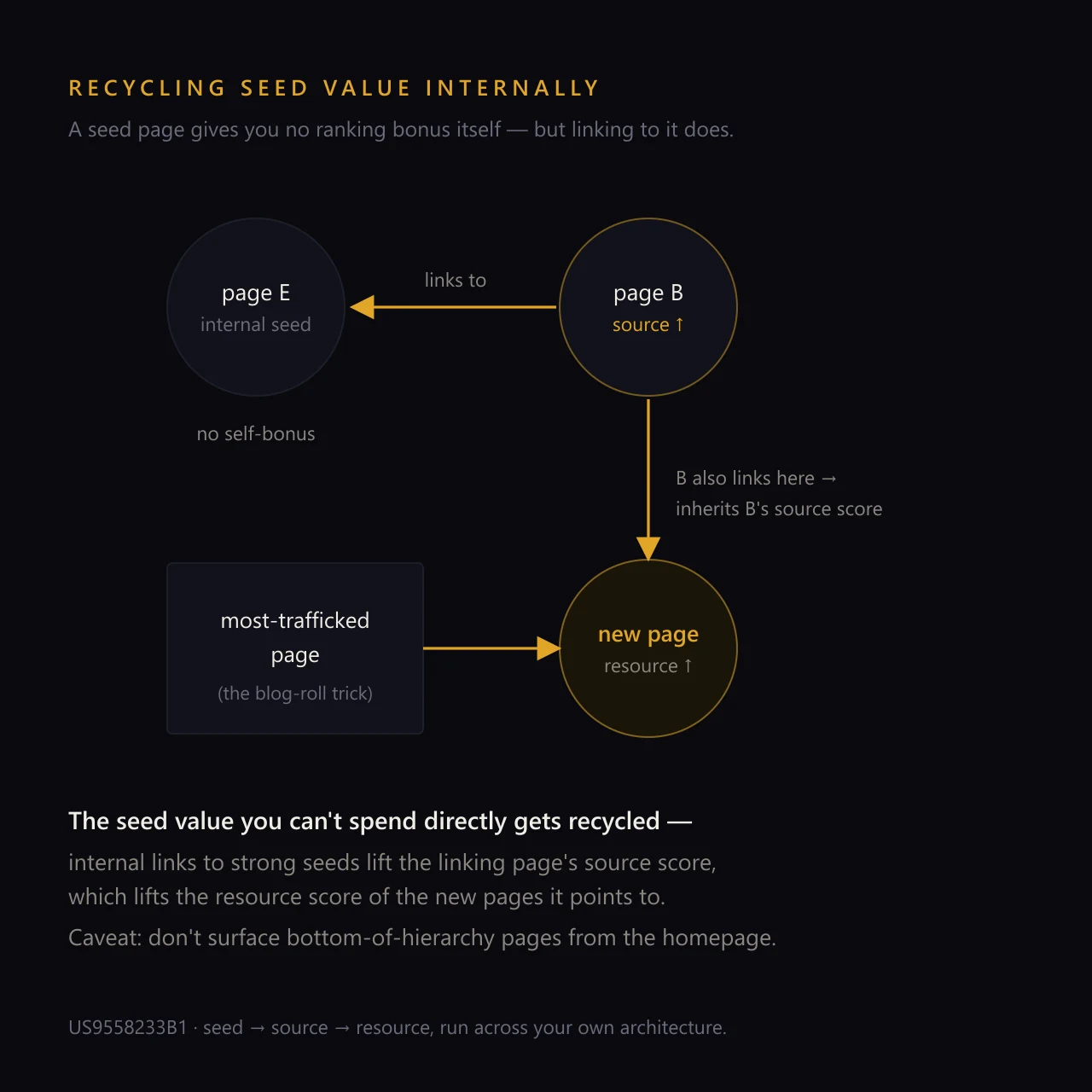
And a reminder of what the seed score does not do: lift your own ranking. A high seed score makes a page worth linking to — it raises the source score of whoever links to it, and inside your own site it's what your internal links recycle into new pages. The seed score is the raw material. The next two scores are where it gets spent.
What Sets Your Source Score
Your source score is set by the company you keep — specifically, the seed scores of the pages you link out to. Link to seeds that carry high seed scores (destinations whose inbound links get genuinely clicked) and you read as a credible recommender; link to behaviorally dead ones and you don't.
Now, to become a strong source you have to link to strong seeds — and that sounds like a catch-22, because a page only becomes a seed through who links to it. But the good seeds already exist. I tell people to go find the government-level resource, the position-one authority for the ancillary topics your page leans on. Say you sell a niche insurance that only applies if you already hold a specific policy in certain states. Link to the government page that defines that rule. That's a seed sitting on a seed site — and linking out to it is what makes you a credible source. You don't get to be trusted; you earn it by who you're willing to vouch for.
The other half of the story is what happens when a source fails — the patent's teeth, in claim language (Claims 8, 17, 24). A source page whose score falls below a threshold is classified unqualified. Then, in ranking:
Read that carefully, because the precise unit matters. The thing removed is the unqualified source page — not the individual link, judged in isolation. A source fails on its pattern across the destinations it links to. One quiet link doesn't condemn a page; a page that systematically hands out links into behaviorally dead destinations condemns all the links it emits. Guilt by association, at the level of the linking page.
"Discounting the count" means the link's contribution is removed from the tally before ranking counts your links at all — not down-weighted to a smaller value, removed. That's a meaningfully harsher outcome than a link that simply carries little weight.
The 2012 patent frames this as a hard classify-and-subtract step. Modern spam handling (Google's neural SpamBrain, built well after this filing) more often neutralizes — silently stops counting manipulated links — rather than applying a visible penalty. The observable outcome to a site owner is the same as the patent's subtraction: you paid for authority that never arrives, and nothing in Search Console tells you why. Same nature, more probabilistic machinery.
So a source's score doesn't just describe it — it decides which of its links survive to be counted at all. Which brings us to the only score that ranks you.
What Sets Your Resource Score — the One That Ranks You
Your resource score is built from the source scores of the pages linking to you — Claim 7 is explicit that ranking is adjusted "based on the resource score." After the subtraction has done its work, only the qualified sources remain in the count. So your resource score is, in plain terms, the quality of the pages still vouching for you once the unqualified ones have dropped out.
This is the score that moves your rank, and the uncomfortable part is that you don't set it. You can influence your seed score by earning clicked links, and you fully control your source score by choosing who you link to — but the score that actually ranks your page is handed to you by the pages that link to you. Your rank is borrowed. Read through this patent, the whole job of link building is to be vouched for by pages that are themselves credible sources — pages that link to good seeds and get their own links clicked.
Click-Validated Quality SEO Implications: What This Means for Your Link Building
Now that the three scores are straight, the most-repeated piece of link-building advice can be corrected without it misleading you.
"Build links on pages with traffic" — right instinct, wrong mechanism
You've heard it a hundred times, and it's almost right. The patent shows why the usual reasoning is wrong. The traffic of the host page isn't the signal. What matters is whether the links on that page get selected — clicked through to destinations people actually want — because that's what makes the page a qualified source, and a qualified source is what passes you a real resource score. A high-traffic page whose links nobody clicks is not a good source. A modest page whose links genuinely get used can be. So chase link selection and the quality of what the page links to, not the host's traffic number. And to kill the dangerous misread head-on: nothing here says the link to you has to rack up clicks for your page to rank. Your ranking rides on your resource score — the quality of the sources pointing at you — never on your own seed score.
1. Vet the whole outbound neighborhood, not just the DR
When someone brings me a stalled campaign — "I've been buying links from these places for a long time and nothing moves" — the container pages almost always share two traits: no internal links to the rest of their own site, and no external links to anything better than the client. Under this patent, that page can't make anyone a strong resource, because it isn't a credible source of anything. Before you value a placement by its domain metrics, ask what else is on the page and where it points.
2. The guest post that links only to you is the weak one
This is the most common way the industry wastes link budget. A guest post that links only to you derives its entire source score from you — a page that doesn't rank yet. So it has a poor source score, and you inherit a poor resource score from it. You still get the anchor relevance and some topical context, but you've left the biggest lever untouched.
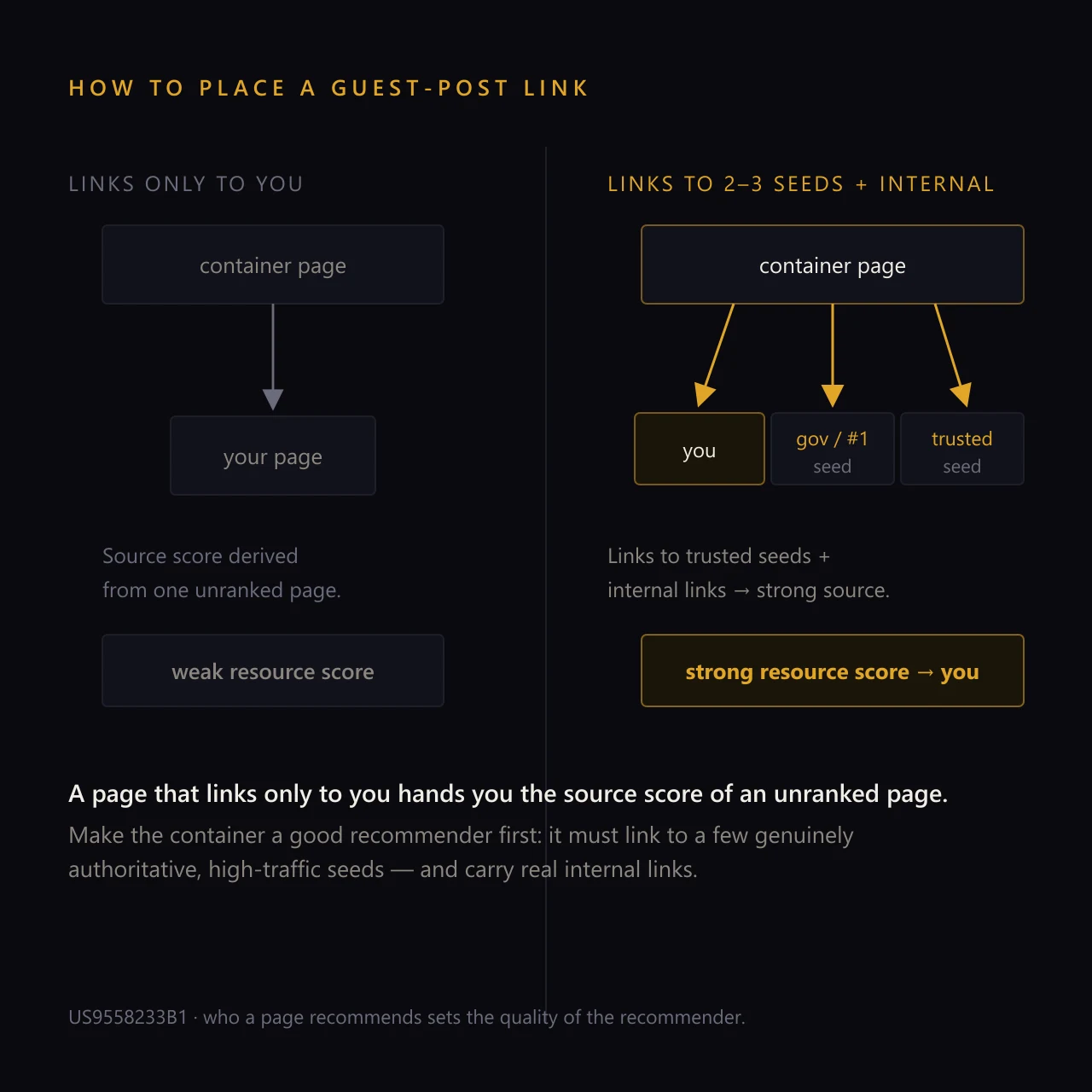
So the rule I give: a guest post should link not only to you but to two or three highly authoritative, high-traffic pages relevant to the container's topic — and the site should carry internal links to its own best content. That's also a fast editorial-standards check. A publisher whose guidelines require internal links is a publisher who controls what it publishes, which lowers the odds the page gets neutralized as spam.
3. A link from a household-name brand isn't automatically a good link
The upgrade most people reach for is the "link insert" — paying to slot a line into an existing, well-established article, usually on a big SaaS or media brand. It feels like a win: you got a link from a DR90 name everyone recognizes. Whether it's a good link is a harder question, and this patent is one reason why.
These pages accumulate outbound links. A resource section or a "best tools" roundup on a strong brand routinely carries 200 or more. Under the source-score mechanic that works against you: a page that links to everyone is vouching for a lot of destinations, and most of them are low-traffic pages with weak seed scores. The more of those it points to, the more its own source score gets dragged down — and a weak source hands you a weak resource score, brand name or not. The keyword-rich anchor text these lists lean on doesn't help either (that's Reference Contexts territory).
But here's the relativity that makes link building genuinely hard: it's never one system in isolation. A link insert on a DR90 brand with millions of monthly visitors is probably sitting on a site that is itself a seed, or one hop from the seed list, carrying real entity trust — a separate mechanism this patent doesn't cover, closer to Seed Distance and brand signals. So even with 300 outbound links on the page, that link can still carry merit. The same insert on a DR30 nobody visits, twenty hops from any seed, with no entity behind it, is not the same link — even though a marketplace will price and label the two almost identically.
So the honest answer to "is this a good link?" is usually "it depends, and you have to look at all of it" — the container's own inbound profile, its entity standing, its distance from trusted seeds, and what else it links to. Perfect link building doesn't exist. What exists is being more right about these variables than your competitors are, and that is enough.
4. Recycle seed value through your own architecture
Your seed page gives you no direct ranking bonus — but linking to it does work for you. When an internal page links to a strong internal seed, that page's source score rises, which lifts the resource score of every other page it links to, including brand-new content. This is the real mechanism under the old "link new posts from your highest-traffic pages" advice.
5. Or manufacture the seed: the calculator play
Everything so far assumes the strong seeds live on other people's sites. You can also build one. The play I document in Linkable Assets: The Calculated Play is a working example: an interactive calculator that targets a high-search-volume keyword. Done right, two things happen at once. The page pulls steady traffic on its own, and it accumulates links from people referencing the tool — and links to a calculator are exactly the kind that get clicked, because the link exists so the reader can go use the thing. High click-through on its inbound links is the definition of a strong seed score.
Then the cascade starts, and every step of it runs on this patent's chain. The calculator's own traffic flows through its outbound links, which pushes up the seed scores of the pages it links to. Every internal page that links to the calculator is now linking to a strong seed, so its source score rises. And a page with a stronger source score hands a better resource score to everything else it links to — including the money pages that would never attract a link on their own. One genuinely useful page, and the scores improve in three directions around it. That's what a power page actually is, mechanically — not "a page with high DR," but a page whose seed score is strong enough to be worth recycling through your whole architecture.
6. Spam-prone niches play by different rules
The patent's third layer scores queries by their propensity to surface spam, using anchor n-grams that inherit source quality. For a query it reads as spam-prone, the description says the system may "trust" link counts less and click evidence more. If you work finance, health, gambling, or legal, assume link quantity is discounted harder and genuine engagement matters more. (This layer lives in the description, not the claims — hold it as design intent, not proven production behavior.)
7. It runs per page, and partly at query time
The patent says the scores can be computed "in terms of domains, web sites, URLs, or partial URLs." That kills "every link from a high-DR domain is equal." A strong domain can contain an unqualified page or section; the relevant unit is the page emitting the link, not the domain's average.
US7716225B1 (Reasonable Surfer) — predicts click probability per link from its features. This patent measures the click reality. A-priori model and a-posteriori audit of the same question.
US9953049B1 (Seed Distance) — measures graph proximity to trusted seeds. This patent asks whether anyone actually clicks along that path. Position plus behavioral confirmation.
Google API Leak Cross-Reference: The Click Machinery
The 2024 Google API leak — first reported by Rand Fishkin and investigated by Mike King at iPullRank — contains fields that match this patent's machinery. Read the alignment column carefully: none of these is documented as this patent's output. They show Google has the constituent parts, not that this exact design is a named production system.
| Patent Mechanism | API Attribute | Alignment |
|---|---|---|
| Short / medium / long click classification | goodClicks, badClicks, lastLongestClicks | 🔶 STRONG MATCH — same click-quality taxonomy, but in the NavBoost/SERP-click surface, not proven for within-page link clicks |
| Qualified / unqualified source classification | sourceType (HIGH_QUALITY → LOW_QUALITY) | 🔶 STRONG MATCH — a compatible source-quality tier; can encode several systems, not uniquely this one |
| The subtraction / per-link discount | pagerankWeight (per anchor) | 🔸 WEAKLY COMPATIBLE — an available lever, cleaner match for Reasonable Surfer |
| Per-page source quality | nsr (per-page quality score) | 🔸 WEAKLY COMPATIBLE — occupies a similar role; no documentation ties it to the seed ratio |
| Anchor n-gram spam scoring + temporal smoothing | AnchorPhraseSpamInfo | 🔶 STRONG MATCH — anchor-phrase spam + spike detection; multiple anchor systems could produce it |
| Seed → source → resource propagation | — | 📜 PATENT ONLY — no leaked counterpart |
🔶 STRONG MATCH = the field clearly corresponds to the mechanism's class. 🔸 WEAKLY COMPATIBLE = plausibly related, but the field's role points elsewhere. 📜 PATENT ONLY = described in the patent, no leaked field found.
The honest reading: the leak shows Google maintains classified click quality, per-source quality metadata, a per-anchor weight, and anchor-phrase spam tracking — every part this design would need. It does not show the destination ratio, the propagation chain, or the subtraction running as a named system. The parts are on the workbench; the leak doesn't show this exact machine assembled and running.
DOJ Trial Corroboration
The U.S. v. Google antitrust trial is the one venue where Google's use of click data was extracted under oath rather than volunteered in a blog post. It corroborates the fuel this patent runs on, with one boundary worth keeping honest:
- Classified clicks are real and used: the concepts behind
goodClicks("long click") andbadClicks("short click") appear in the plaintiffs' proposed findings, drawn from trial evidence — the same short/long taxonomy this patent claims. - Click data is a major ranking input: testimony described NavBoost as one of the most impactful ranking systems, with a multi-month memory of click behavior.
- Why Google defends its click data at any cost: the trial's core showed Google paying billions to be the default search engine across the browsers and phones people already use — and running Chrome as its own front door to search — which is exactly how it preserves the behavioral signal this kind of system depends on, even as privacy layers erode it elsewhere.
NavBoost measures clicks on search results; this patent measures clicks on links within pages. Different surface, same fuel. The trial confirms the click-quality machinery and the data infrastructure — it does not confirm this specific patent. "Dual-source corroboration of the click machinery" is the accurate claim; "the trial proved this patent" is not.
Citation Network
Related Articles on This Site
- US7716225B1 (Reasonable Surfer) — The predictive counterpart. Reasonable Surfer estimates which links should be clicked from their features; this patent measures which were. Note Reasonable Surfer expired in March 2025 — cite it as the historical a-priori model, not current production.
- US8577893B1 (Reference Contexts) — Paul Haahr is on both. Reference Contexts judges the text around a link; this patent judges the behavior the link produces. Two independent anti-manipulation layers.
- US9953049B1 (Seed Distance) — Measures how far you are from trusted seeds through the link graph. This patent asks whether the links along that path are actually clicked. Position plus confirmation.
- NavBoost Deep Dive — The SERP-click sibling. Same click-quality taxonomy, different surface: NavBoost re-ranks results by result clicks; this patent evaluates links by link clicks.
- US7346839B2 (Historical Data) — Both handle temporal manipulation. Historical Data watches link velocity; this patent smooths sudden score spikes and can trigger human review.
- US9002832B1 (Low-Quality Site Classifier) — The consumer, and a near-sibling (it shares inventor Chung Tin Kwok). It buckets sources and applies a distribution demotion, feeding on exactly the per-page quality scores the Vouch Chain produces.
- SpamBrain (Link Spam) — The modern neural successor to the classify-and-subtract step. Where this patent removes a link from the count, SpamBrain more often neutralizes it silently.
- U.S. v. Google (DOJ Trial) — Where Google's use of classified click data was established under oath.
Click-Validated Quality: What Doesn't Matter as Much as SEOs Think
Strip the arithmetic away and the nature of this patent is a very human idea: a link is a claim about human interest, and the claim can be checked. That's all Google is doing here — emulating how trust works in the real world. A recommendation is only worth something if the people receiving it actually act on it. You can count the links all you like. If nobody walks through the door, the endorsement was never real in the first place.
The flavor — the explicit ratio, the seed/source/resource arithmetic, the classify-and-subtract step — that was the 2012 way of saying it. The math has very likely been folded into learned models since; I'd be surprised if the production code still divides two integers. But the architecture — judging a page by whether its endorsements produce real behavior — isn't going anywhere. It's too close to how authority actually moves through a network to ever throw out. The formula is the flavor; the trust is the nature.
This is why "ranking factors" is the wrong model, and why I keep pulling clients off it. A factor is a thing you toggle. This is a system — the Vouch Chain: conditions, inputs, outputs, and three scores that serve three different parties. External links were never a checkbox you tick for a point. They're how a page proves it's a credible recommender, which is how everything it touches earns a little trust. Miss that and you'll keep paying for links that got subtracted before ranking ever saw them — and you'll never know why, because nothing tells you.
So the question to walk out of here with isn't "how many links do I have?" It's the one the patent's own math is asking: when someone links to me, does anyone actually click — and does the page doing the linking send its readers somewhere worth going? Answer that honestly and the rest follows. Your seed score is a gift to everyone else in your graph. Your resource score is the only one that's really yours.
The patent uses "payday loan" as its worked example of a spam-prone anchor n-gram. It was filed December 31, 2012; Google's Payday Loan update shipped about six months later, in June 2013 — same per-query, spam-niche shape. It reads like a blueprint, and the connection is rarely discussed. But "payday loan" was already the industry's canonical spam category, and a patent naming a known problem isn't evidence it became the deployed code. Call it a moderate-confidence architectural resemblance — not causation, and not a number.
Frequently Asked Questions
What does patent US9558233B1 actually do?
It scores web pages by whether their links are corroborated by real user clicks. It measures a destination's ratio of clicked inbound links to total inbound links, uses that to judge the pages that link to it, and can subtract the links of "unqualified" source pages from the count ranking uses. In short: it tests whether backlink popularity matches genuine human interest.
Does this patent mean I should only build links on high-traffic pages?
Not quite — that's a related but different signal. This patent counts clicks on the specific link pointing at a page, not the host page's overall traffic. A link nobody clicks on a busy page still contributes little. What matters is whether the placement earns a real click-through and whether the linking page sends readers to good destinations generally.
What does the API leak confirm about this patent?
It confirms Google has the machinery this design needs — classified click quality (goodClicks, badClicks, lastLongestClicks), per-source quality tiers (sourceType), and anchor-phrase spam tracking. It does not confirm this patent's specific computation runs in production. The parts are documented; the assembled machine is not.
Why does a guest post that links only to me underperform?
Because the container page's source score is then derived entirely from you — and if your page doesn't rank yet, that's a weak source score, which becomes a weak resource score passed back to you. A page that also links to two or three trusted, topical authorities becomes a credible source, and the link it gives you carries more weight.
What's the difference between the seed score, source score, and resource score?
They're the three links in what I call the Vouch Chain. Your seed score is your inbound-link clickedness — it helps whoever links to you, not your own ranking. Your source score comes from the quality of what you link out to — it mostly helps the pages you link to. Your resource score comes from the sources linking to you — it's the one the patent routes into your ranking.
Is this the patent behind the 2013 Payday Loan update?
It resembles it — same per-query, spam-niche mechanism, and the patent literally uses "payday loan" as its example six months before the update. But "payday loan" was already an obvious spam category, and a patent example isn't proof of deployed code. Treat it as a moderate-confidence architectural resemblance, not causation.
Does this still work in 2026, with privacy restrictions and bots?
The principle is behavioral, so it likely survives even if the 2012 arithmetic was replaced by learned models. Privacy layers and bot traffic do degrade the click signal — but the click-quality tests (long dwell plus onward navigation) raise the cost of faking it, and Google's investment in Chrome and default-search deals is largely about preserving exactly this kind of behavioral data.