Everyone says, "build a calculator to earn links." I say that too. But now I can show you with data just how good a move that really is. Because a calculator doesn't just do one thing for your business (get you backlinks). It does two, and the second one could be even bigger, a lot bigger.
Ask me why a business should build a calculator instead of writing another blog post, and the question answers itself: because it wouldn't be yet another blog post. You already have a hundred of those, and you know what they return. What you almost certainly don't have is a single working tool your customers keep searching for — and let me show you what one of those actually does for the business that builds it.
If you've published a hundred blog posts and zero calculators, publish a calculator. You don't have any.
I've called calculators an S-tier link-building play for a while. The trouble is that everyone repeats the advice and nobody has shown the data beneath it. So I pulled it — the first primary-research dataset I know of on what a linkable asset does for the business that owns it. It starts, of course, with the calculator.
Everything here comes from a census of 200 calculator keywords — 555 ranked results across 326 unique domains — of which 166 were real small and mid-size businesses I then profiled in depth, via the Ahrefs API (US, July 2026). All figures are Ahrefs estimates. The keyword sample is purposive — representative at the head, deliberately niche-diverse in the long tail — so the percentages describe this sample, not the whole web. And from the outside, no one can cleanly separate links that were earned from links that were pursued; that caveat is heaviest at the head.
The dataset at a glance — what the charts below are drawn from
| What we looked at | Count |
|---|---|
| Calculator keywords sampled | 200 |
| Top-3 ranked results examined | 555 |
| Unique domains that appeared | 326 |
| ↳ small & mid-size businesses (DR < 70) — deep-dived | 166 |
| ↳ large sites (DR 70+) — noted, not deep-dived | 109 |
| ↳ exact-match domains (e.g. mortgagecalculator.com) | 45 |
| ↳ generalist aggregators (calculator.net and similar) | 6 |
Two Mechanisms Hide Inside One Tactic
The headline finding is that a calculator doesn't do one thing. It does two, and which one dominates depends on the search volume and the industry. Below, every dot is a real ranking calculator page. Across: how many websites link to it. Up: how much of its whole domain's traffic that single page carries. Two clusters fall out.
Real businesses climb the traffic axis on very few links — the calculator is a traffic engine. Tool sites pile up on the link axis — a link magnet. Same page type, two economies. Hover any point.
Here is the part that kills the lazy version of the advice: calculators absolutely earn links. The average real-business calculator in the sample carries 51.5 referring domains against a normal content page's roughly zero. But the median is 6, because the distribution is heavily skewed — a handful pull hundreds (one golf-handicap calculator has 1,775), and most pull a solid handful. So the promise everyone makes isn't wrong. It's aimed at the wrong axis for most businesses. If you run a normal company in a normal niche, the calculator's first gift is traffic — often your single most-visited page — and the links compound on top.
Where a Small Business Can Actually Win
Because the second thing the data makes brutally clear is that you cannot win everywhere.
Small-business share of top-3 results climbs from ~1% at the head to ~23% in the long tail.
Head, body, long tail are search-volume brackets: head terms get 100,000+ searches a month, body terms 10,000–100,000, and long-tail terms under 10,000. EMD means exact-match domain — a site whose name is the search term, like mortgagecalculator.com; a different game, so it's counted separately. Aggregators are generalist calculator hubs (calculator.net, omnicalculator) that rank for thousands of tools at once — not a rival a niche business competes with directly. n is simply how many ranked results sit in that tier — the sample size behind each percentage.
The big terms — mortgage, BMI, currency — belong to governments, universities, and decade-old exact-match domains carrying thousands of links. You don't beat nih.gov's BMI page (8,793 referring domains). You beat nobody, in the long tail, where the only real competition is that no one has bothered to build the tool yet.
Explore the Data Yourself
This is the point of publishing the data instead of just quoting it. Filter the real-business calculators by industry and by site authority — a domain's Ahrefs Domain Rating (DR), a 0–100 estimate of how strong its backlink profile is. One thing to know: the composition chart above counts everyone who ranks, giants included, whereas this filter covers only the small and mid-size businesses (DR under 70) I profiled in depth — the internet giants were left out of the deep dive because their calculator is self-evidently a minor page on an already-enormous site. Thin cells are flagged — don't read a headline off two domains.
What Good Looks Like
Numbers persuade; cases convince. Two from the set worth looking at directly — the calculator you'd want to build, and the one that teaches you what not to measure.
hubtap.com — a wedding-alcohol calculator
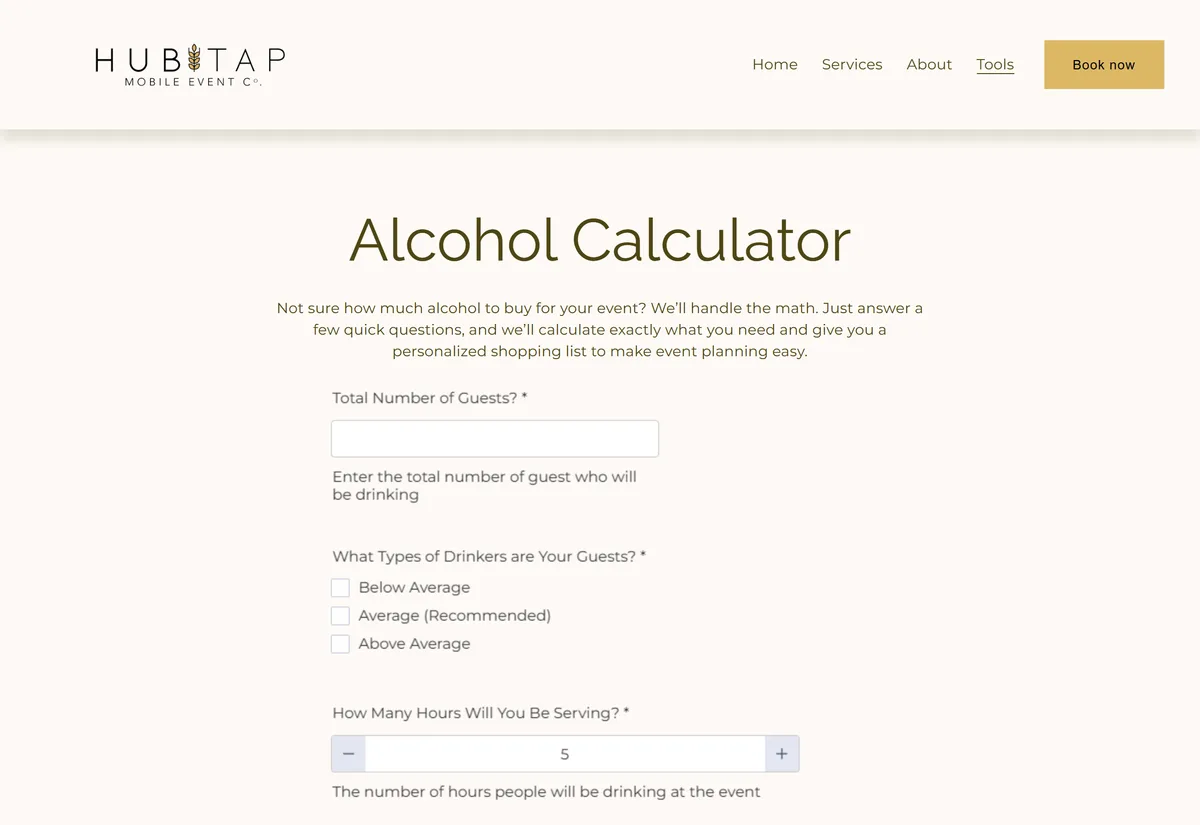
#1 page on the whole site · 25 referring domains · linkers include junebugweddings (DR 77), bridalmusings (DR 71), thebudgetsavvybride (DR 70), apracticalwedding (DR 66)
This is my favorite in the dataset, and I can tell you exactly why, because I lived it. I got married recently and DIY'd the whole thing — no planner, a two-day event, 50 people, in the middle of nowhere. The venue had no alcohol, so I had to buy all of it and ship it out there myself. Working out how much to buy was one of the hardest parts of the entire wedding. Who doesn't drink. Who's staying late on the hard liquor. Who's a wine person, who's a cider person, who empties the beer fridge. Short day or long. Buying up front or paying by consumption. I have hospitality experience — I've worked bars, I know roughly how much people drink per hour — and I still spent three or four hours running the math seventy different ways, and still didn't quite nail it. There was a little too much soda, I could have brought more white wine, and there was a bit too much beer that now I don't know what to do with.
That's why this calculator earns DR-70 links from real wedding publishers without anyone begging for them. It solves a genuinely hard, genuinely high-stakes problem. You don't want to disappoint your guests, and you don't want to blow two grand on excess you'll be drinking for a year. When a tool takes a problem that painful and makes it easy, people link to it because it's the useful thing in the room.
18birdies.com — a golf-handicap calculator

1,775 referring domains — of which roughly two-thirds don't survive scrutiny
The biggest number in the set, and the most useful lesson in it. Pull those 1,775 domains and about two-thirds are flagged as spam — directories, scraper mirrors, bookmark farms — with only a small core of genuinely trafficked, editorial sites underneath. That gap is the whole point: a link count is not link equity. Google knows this better than anyone; its own systems, from SpamBrain to the click-validated quality test, exist precisely to discount links exactly like these. Which is oddly freeing: the number to chase was never the biggest count. It's the handful of real ones — the DR-70 wedding editors who linked to hubtap because the tool actually helped. Build for those, and whatever junk accumulates on top is harmless noise Google already ignores.
Why It Works — and It Isn't Only the Links
If you stop at "calculators get links," you've seen the smallest part of it. A well-built tool pulls several levers of ranking power at once — and each one maps to a system I've documented elsewhere on this site:
- Traffic. It becomes a top page and a real slice of the site's total visits — often the single biggest.
- Engagement. A calculator holds people and answers them, so they don't bounce back to the results page. Those satisfied sessions — long clicks, no pogo-sticking — are exactly what NavBoost rewards and what category-relative dwell scoring measures.
- Effort and originality. An interactive tool reads as high-effort, original work — the kind of signal Google's quality-scoring models and the
contentEffortjudge I cover in the on-page guide are built to reward. - Whole-site lift. Quality is judged in groups, not just page by page — so one genuinely strong page pulls its neighbours up, the flip side of the mechanism in the group-based quality patent. It's why these tools are so often the strongest page on the domain.
- The internal ripple. A page this well-linked becomes an internal anchor of trust — and the authority it holds flows, through your internal links, to the pages you point it at. That's the seed / source / resource cascade I break down in the click-validated quality patent: a calculator that earns clicked links becomes a strong internal "seed," every page that links to it gains source score, and every page those pages link to gains resource score. The calculator doesn't just rank itself; it lifts the pages you connect it to.
The Play, If You Do One Thing This Week
The tactic is now almost free, which is the whole reason it's worth writing about in 2026. Building a calculator used to cost a developer and a budget. It now costs an evening. So — one thing:
- Open Claude Code (or your tool of choice) and feed it this article — the examples here are a starting library of ideas.
- Tell it what your business does and the kinds of problems your product or service solves. That's where the calculator ideas come from.
- Grab an Ahrefs API key — even a free account gets you enough to sanity-check whether a term has the search volume to bother with.
- Build the one useful thing your niche keeps searching for, and put it on your site. You'll ship something real and pick up a skill worth having.
Who This Doesn't Work For
I'll be honest about the failure case, because it's specific and it isn't the tactic. This falls apart for exactly one kind of person: someone whose entire relationship with AI is the consumer chat box, who has no interest in getting up to speed with what the technology can do now. The old objections — "I can't code," "development is expensive" — stopped being true. The only real barrier left is whether you're willing to open the tool and build. If you are, the money and the difficulty that used to gate this are simply gone.
Method & Honest Limits
Two hundred calculator keywords in the US, stratified by search volume and drawn niche-diverse across the long tail. For each, the top-three organic results were recorded and classified by domain size, whether they were exact-match domains, and whether they were generalist aggregators — 326 unique domains in all. The 166 that were non-EMD, non-aggregator small and medium businesses (DR under 70) were then deep-dived: where the calculator page ranks within its own domain by traffic and by links, and what share of the domain's totals it represents. Each business was classified by type from its own pages.
All figures are Ahrefs estimates. The keyword sample is purposive, not a random census. From the outside no one can cleanly separate earned links from pursued links — heaviest at the head, where incumbents certainly build links on purpose. The deep dive covers small and medium businesses; the giants weren't profiled because their calculator is self-evidently a minor page. And a slice with a handful of domains is directional, never a headline — which is why the tool above tells you when you're in one.